


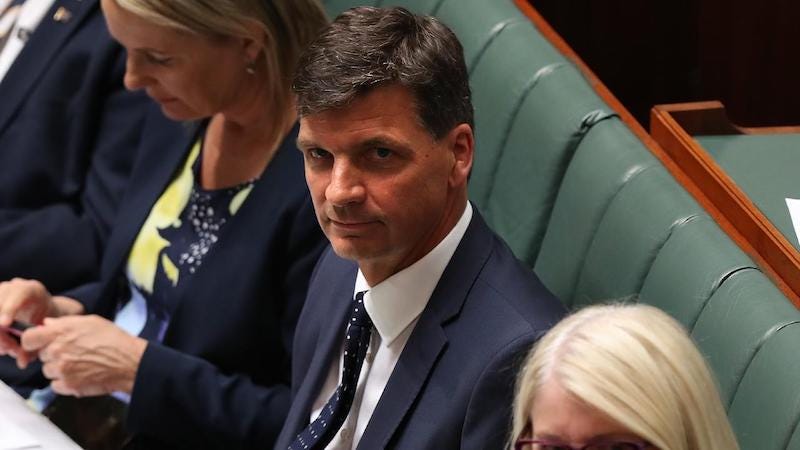
The Liberal Party has a new leader in Angus Taylor, but whether this represents renewal or just an exercise in political rebranding is unclear. As someone who’s had ambitions for a long time, Taylor now holds the leadership just at the moment when the party is at its lowest point in its history. He has promised to refocus on cost-of-living pressures, home ownership and immigration, trying to position himself as the figure who can restore the party of Menzies and Howard. And good luck with that. But the main question is whether Taylor has the authority and the strategic skills to reverse a deep and structural decline that’s been in place for over the past decade or so for the Liberal Party.
The recent split between the Liberal and National parties – the second within the past year – over proposed gun law changes following the Bondi attack exposed massive fractures within the parties, ultimately destabilising the leadership of Sussan Ley and leading to her resignation. But this wasn’t so much about the legislation – there’s been long-standing tensions over direction and the ideology of the party, and this was another example of the internal dirty laundry displayed in the public view, and it was not a good look. Political professionalism was once again cast aside in preference of a public showing of disunity, reinforcing the perception that the conservative side of politics is splintering and falling apart and quickly becoming a rabble.
Taylor has inherited these problems, some of which he has created, and it’s now a question of whether he’s capable or even has the inclination to fix up these problems, which essentially commenced during the time the Liberal Party was in government between 2013 and 2022. Of course, electoral success will always conceal a party’s problems but the leadership transitions – from Tony Abbott to Malcolm Turnbull to Scott Morrison – reflected a deeper instability about the party’s ideological identity. Even after losing office in 2022, internal reviews suggest that there was not enough serious policy development and a shadow cabinet that was reluctant to undertake the hard work that was required to offer credible alternatives to the electorate.
This has happened before for a mainstream conservative party. After a landslide defeat, the conservative United Australia Party (the precursor to the Liberal Party) collapsed and was reorganised by Robert Menzies into the modern Liberal Party. In the mid-1990s, the long a period of leadership instability – John Howard, Andrew Peacock, John Hewson, Alexander Downer – ultimately gave way to Howard’s second leadership stint, who returned the party to office in 1996. The difference today is the absence of a comparable figure waiting in the wings. Of course, Taylor could yet surprise us all – which seems unlikely – but he is now leading a far diminished parliamentary team with limited depth and a shrinking voter base in urban Australia.
The Liberal Party’s most serious loss since 2022 might not be so much in the number of seats but in its lost constituency. The inner-metropolitan electorates that were once central to its identity have shifted toward independents and the Australian Greens. Traditional “small-L” liberal voters, particularly those in metropolitan areas, have drifted away.
Without reclaiming an urban base, the electoral recovery will become more difficult with each election cycle. A party can’t rebuild its base by just opposing – as the Liberal Party has done for well over a decade, even when it was in office – it needs to offer a coherent vision. This focus on dismantling things, or always articulating what they oppose, is something that might encourage protest, but it’s rarely an approach that can sustain long-term political success.
There is also a broader concern for politics overall. The Labor government is in a position of strength – although it rarely displays or uses this strength – but a weakened opposition creates a vacuum. In these kinds of unusual circumstances, it’s tempting for a government to expand into this empty space and rework their own positions to occupy parts of the centre-right space.
Prime Minister Anthony Albanese has frequently spoken of positioning Labor as the “natural party” of government, and if the Coalition fails to rebuild itself in a meaningful way, Labor might consolidate its current dominance not just on the electoral map but its own ideological positions and move even further to the centre right. Australian political history shows that mainstream political parties rarely disappear permanently; they will always lick their wounds from electoral defeats, reorganise and return, even if it does take some time for this to occur. But political recovery requires discipline, talent recruitment and patience – and these seem to be qualities that are currently in short supply within the Liberal Party.
One Nation and the fragmentation of the right
While the Liberal Party is now going through that difficult process of trying to re-establish itself politically, the rise of Pauline Hanson’s One Nation is a new development that’s reshaping the conservative landscape – for the time being – and the defection of Barnaby Joyce to One Nation suggests that there’s more problems to come. Although Joyce lacks credibility due to his many indiscretions and allegations of sexual harassment in the past, his defection appears to have given One Nation a boost, which suggests what kinds of characters are acceptable to their new-found supporters.
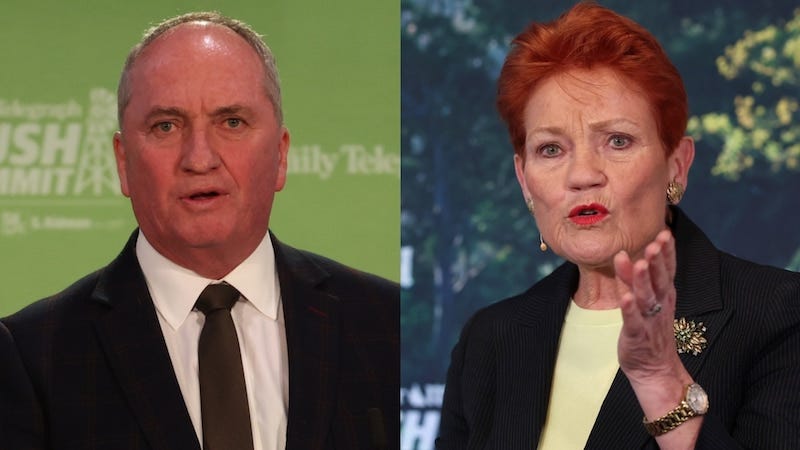
Though One Nation has struggled historically to translate their culture of complaint and protest into a sustained parliamentary presence – they’ve never actually won a federal lower-house seat under the One Nation banner – its current opinion polling numbers suggest a strong dissatisfaction with politics among conservative voters.
These kinds of populist movements often thrive on this grievance. One Nation’s appeal relies less on detailed policies and more on a culture of complaint directed at political elites, immigration and the insufferably long culture wars. This style of politics can be electorally disruptive, as is now proving to be the case in Australia, but converting that protest into an ability to form government – and if this was ever to be achieved, a competent government – is another matter entirely. Australia’s preferential voting system and entrenched party structures make it very difficult for a party to leap from marginal representation – at this stage, holding one seat following a defection from the National Party – to being able to form government.
Political realities should also put a check on the ambitions of One Nation. Inner-city electorates such as Grayndler, Watson, Kooyong and Wentworth are unlikely to ever fall to One Nation and if any gains do occur, they would be more likely to emerge in outer-suburban or semi-rural seats traditionally held or contested by the Nationals. Any wholesale shift toward One Nation would represent not so much a broad national surge but a reconfiguration within the existing conservative bloc.
And this is where the danger for the Liberal Party lies: the cannibalisation of the right. Every percentage point in the opinion polls flowing over to One Nation weakens the Coalition’s capacity to present itself as a government-in-waiting, even if on current standings, that might be two or three election cycles away anyway.
For Labor, the political calculations are going to be different: to be alert but not alarmed. One Nation’s ceiling appears limited in metropolitan Australia, and its voter base overlaps far more with conservative areas rather than progressive. Nonetheless, dismissing the movement outright would be a mistake, as this fragmentation on the right can alter preference flows and reshape marginal seat contests in ways that are difficult to predict.
The change from Ley to Taylor also raises that old question of whether leadership alone can reverse decline. Of course, leadership itself can change a party’s political fortunes, but after the 2025 defeat, the Liberal Party required a stabilising leader rather than a saviour – someone willing to rebuild organisational structures, develop a depth in policy and accept that a recovery might take more than one electoral cycle. Instead, the pattern of rapid leadership turnover is reflective of earlier periods of instability within the party, although this time around, it’s arguably on a far more severe scale.
Don’t mention the corruption…
As Taylor settles into the leadership he’s craved for such a long time, sections of the media have emphasised his academic background – a Rhodes scholar – and his economic credentials, which have never been evident in any substantial way. Yet despite the glossing over and collective amnesia in the media, his ministerial record and behaviour remains contentious.

During the 2018 water buy-back approved by the Coalition government, $80 million was paid to Eastern Australia Agriculture, a company in which Taylor had previously been a director of before entering federal politics. This deal generated significant profit for the company and drew attention because one of its major investors was associated with one of Taylor’s former Oxford rowing colleagues. Taylor’s involvement has never been fully explained.
In another issue, the New South Wales Independent Commission Against Corruption sought information regarding a $107,000 grant allocated in 2018 to Monaro Farming Systems, an organisation linked to Taylor’s family, a grant related to agricultural land management and native grassland identification. There were other controversies that also followed Taylor. In 2016, protected native grasslands were illegally cleared on a property part-owned by Jam Land Pty Ltd, a company in which Taylor and his brother had interests.
Another episode in 2019 involved Taylor circulating false figures regarding travel expenditure by the City of Sydney under Lord Mayor Clover Moore – and evidence provided to the NSW Police suggested that the PDF document online had been tampered with. Given all of these incidents, is it any wonder that when Taylor was in government, he also voted against the establishment of a federal anti-corruption commission?
These episodes, should be forming part of the backdrop to his leadership and whether they represent political misjudgments, or controversies that usually surround any sort of government decision, or deeper ethical concerns that are verging on corruption will continue to be debated. But what is clear is that the mainstream media has so far refused to mention any of these issues in great detail, and that they’re keen to make a clean break from Taylor’s past failures.
Taylor’s early rhetoric as leader has focused heavily on “bad immigration” and cost of living management, themes that also resonate within One Nation’s base. In seeking to reclaim conservative voters, he risks reinforcing perceptions that the Liberal Party is competing more with populist insurgents than with the government itself, although to stop the bleeding to the far right might be his biggest task at this stage. This strategy might consolidate parts of the right, but it also goes to show how far the party has fallen from its once dominant national position, remembering that the Liberal Party was in government, less than three years ago.
The Liberal Party’s predicament is not just about numbers in the current opinion polls, or how many seats in holds in federal parliament, although all of these issues are interrelated. It’s an existential question about its identity, credibility and its ability to renew. A leadership change might alter the tone and messaging that’s given out to the media each day, but rebuilding trust – within Parliament and within the electorate – will require far more than a new name at the top.
If Angus Taylor is their answer , the nature of the question is mind boggling . 😳
For me, it's all about policies, not personalities. The Silent 'G' has neither, a wonderful double whammy!
Taylor’s rhetoric is positioning the Liberals to reclaim centre-right voters concerned about immigration and cost pressures, but the lack of detailed policy frameworks so far makes it hard to compare with the other parties’ documented platforms fully.
Labor’s policies are more programmatic and detailed, reflecting their time in government and legislative commitments.
The Greens, whom I believe to be the real "proposition", have a platform that is significantly more redistributive and transformative, especially on housing, public services and taxation.
I'm cock-a-hoop about the demise of the Liberal Party. There is zero benefit for Australia in having its neoliberal, anti-public purpose ideology anywhere near political power. 😊