


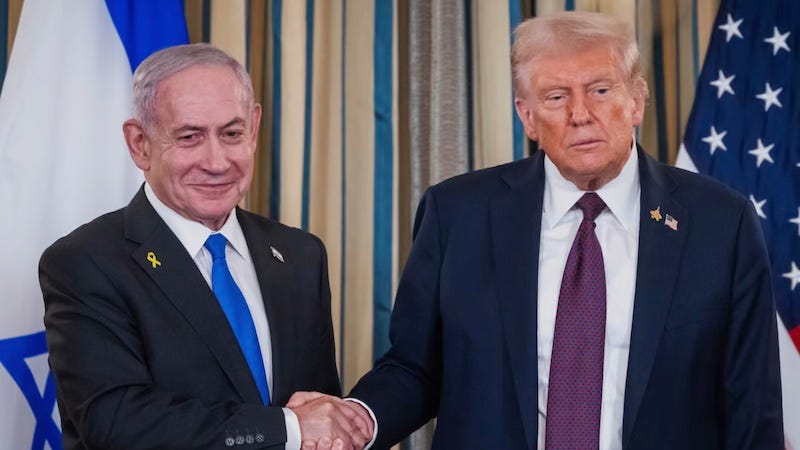
The Trump–Netanyahu proposal for Gaza is the 21st century “peace in our time” moment where if the parties agree – even though no one from Palestine or the Arab world has been involved in the proposal – the genocide will stop immediately, the Israel Defense Forces will retreat, and a phased withdrawal will proceed concurrently with a “demilitarisation” of Gaza. Within 72 hours of Israel’s acceptance of the deal, all hostages held by Hamas will be returned, and only then will Israel release 250 Palestinians serving life sentences and a further 1,700 detained since October 7, 2023, alongside a remains-for-remains exchange formula which, of course, heavily favours Israel.
Hamas and other factions must “decommission” all weapons, not have any role in any future government, and accept amnesty or safe passage abroad – measures that would be verified by independent monitors and underwritten by an “International Stabilisation Force”, which will then secure the Gaza Strip, train suitably-vetted Palestinian police, help seal the borders with Israel and Egypt, and enable a progressive Israeli drawdown. Israel, apparently (if anyone can believe it), will not annex or formally occupy Gaza, though a security perimeter may persist until Gaza is certified “properly secure,” a measure which the proposal does not define.
In other details, governance would pass to an unelected technocratic Palestinian committee handling day-to-day services, but under the supervision of a new international oversight body, the “Board of Peace”, which is almost as Orwellian as the Gaza Humanitarian Fund, which has so far killed over 2,500 Palestinians while they were seeking food. This interim structure is supposed to act as a bridge to the eventual control by the Palestinian Authority, contingent on reforms and “deradicalisation,” after which the pathway towards Palestinian self-determination might be discussed. Might be.
Under this proposal, a state of Palestine will be deferred, it’s fully conditional, and discretionary; there’s the possibility of a pathway – a half-hearted promise of a promise – not the recognition of an inherent right.
On reconstruction, the proposal promises immediate aid, such as restoration of power, water, hospitals, bakeries, rubble clearance – delivered via UN agencies and the Red Crescent and rebuilding what Israel has comprehensively destroyed – in conjunction with a “Trump-branded” development drive and a special economic zone to supposedly energise Gaza’s economy, while also stipulating that no one will be forced to leave and those who have left Gaza, can return.
This, however, is all political theatre, and it’s hard to call it a “deal” if it’s coming from one side alone: Israel has “approved” the plan; Hamas has not – they weren’t even a part of the process, nor was anyone else from Palestine or the Arab world, and first saw it when it was released through the media. It’s a one-sided fait accompli offered on a take-it-or-leave-it basis: Trump has publicly warned that refusal would bring full US backing for Israel to “finish the job” – code for completing the genocide, which Israel will probably do anyway – while Netanyahu has suggested the proposal will achieve Israel’s war aims.
The top-down nature of the proposal raises basic questions about consent, enforcement, and legitimacy, and continues that process of making Palestinians as invisible as possible: how can a supposed peace plan that doesn’t include the victims of Israel’s brutality and is at the behest of the two instigators of the genocide – Israel and the US – be regarded as a just outcome?
The massive contradictions and duplicity
If the Trump–Netanyahu proposal is presenting itself as a neat little roadmap to peace, its inherent contradictions and omissions reveal a dismal and depressing reality. The proposal calls for Gaza to be administered by a technocratic Palestinian committee, the supposedly neutral and apolitical “Board of Peace” which will be chaired by Trump himself and divisive figures such as former British Prime Minister, Tony Blair. The document fails to explain how this committee would be formed, who would choose its members, or how day-to-day decisions would be made. The division of authority between the committee and the board is left completely undefined, leaving open the risk of paralysis – or worse, a domination imposed by the United States – and Israel – purporting to be a neutral and benevolent entity, when in reality, it’s nothing of the kind.
The role of the Palestinian Authority is also ambiguous. The proposal suggests that once the Authority “completes its reforms” – whatever that is – it could reassume control of Gaza. It’s almost like Alice In Wonderland: there’s no timelines, there’s no schedules, and no indication of who would certify that the Authority has achieved these undefined reforms – it will just mean whatever the Board of Peace wants it to mean.
Netanyahu, meanwhile, has explicitly rejected the return of the Palestinian Authority to Gaza, contradicting the very framework he has agreed to. This contradiction exposes the worthless nature of the document, which promises a working political landscape – but can’t reconcile Israel’s categorical opposition to Palestinian statehood with the US commitment to keep that option alive, however conditional. In this scenario, every country in the world is expected to recognise the right of Israel to exist, but Israel refuses the right for Palestine to exist and, under Netanyahu, this right will never exist.
Security is another unresolved issue: the International Stabilisation Force is described as the guarantor of Gaza’s demilitarisation, training Palestinian police, securing borders and replacing Israeli troops. But the plan doesn’t identify which countries would provide the troops, under what rules of engagement they would operate or how they would interact with Israeli forces still maintaining a “security perimeter”. Would it act in the role of peacekeepers, a police force, or a parallel army? What would happen if they clash with Israeli troops and would they be asked to take on Hamas directly?
For Palestine, any aspirations they have, might be considered – might be – if after an unspecified number of years, they comply with an unspecified number of undefined measures, in undefined circumstances and in an undefined manner. And even if they achieve this undefined and impossible task, there’s absolutely no guarantee of anything. For Israel, it’s a lot easier and very specific, as it always has been: Hamas must be destroyed, the Palestinian Authority must be excluded, and security and state apparatus of apartheid must remain firmly in its own control.
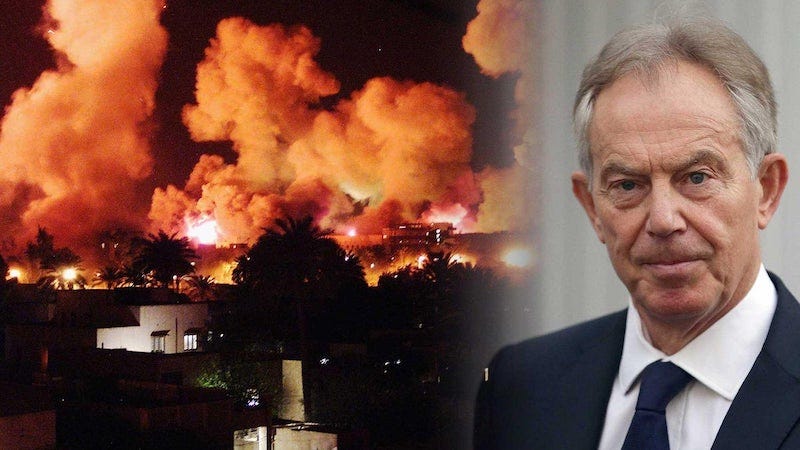
The credibility of the mediators also adds another layer of controversy. Trump as the chair is incredible, but Blair’s name is highly toxic in the Western Asia/Middle East region, after his role in the false claims of “weapons of mass destruction” in 2003, which led to an invasion of Iraq, and the violent deaths of over 655,000 people, possibly up to 1 million. Why then is Blair being proposed for this so-called “Board of Peace”? It would be like appointing Adolf Hitler to head the task force for creating the state of Israel after the Second World War.
Jared Kushner’s return as Trump’s informal adviser also raises the alarm bells, given his financial relationships with Arab monarchies in the Gulf and his openly stated view of Gaza as “valuable waterfront property” that’s ripe for redevelopment. Taking this into account, the plan looks less like a peace agreement and more like another imperialist intervention, where outside powers impose structures that serve their strategic and economic interests while sidelining Palestine: it’s a repeat of the brutal imperial behaviour from the 19th and 20th centuries.
Ultimately, the contradictions within the Trump–Netanyahu plan are not just drafting oversights; it’s a deliberate attempt to give Israel exactly what it wants and permanently subjugate Palestinians to an eternal state of servitude and slavehood. Instead of peace, it’s likely to be yet another blueprint for failure and will collapse under the weight of its own ineptitude. And, perhaps, that was always in the intention.
A shifting diplomatic ground
The regional response has been more varied, however. Saudi Arabia, Jordan, the United Arab Emirates, Qatar and Egypt have welcomed the announcement, although these states are politically compromised: their own survival is built on US military, financial and diplomatic leverage, and blackmail. This makes them structurally unable – and often unwilling – to take strong pro-Palestinian action beyond aid convoys, carefully managed mediation roles and issuing diplomatically supportive statements – which is what they have dutifully done on this occasion.
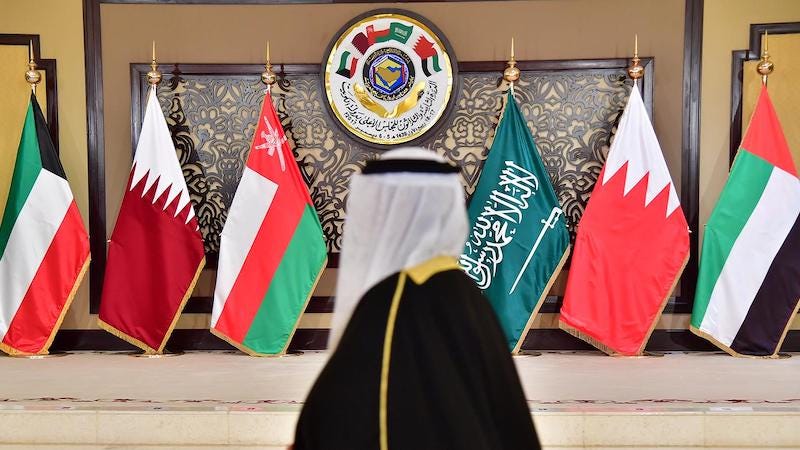
The Palestinian Authority have also given a cautious backing, characterising the plan as part of ongoing international efforts to end the war. Others, such as Palestinian Islamic Jihad, have rejected the proposal outright, calling it a recipe for further destabilisation and an erosion of Palestinian sovereignty, which it more than likely will be.
Netanyahu has apologised for the Israeli strike in Qatar that killed a serviceman in early September, promising not to repeat such actions. But this is classic behaviour from Netanyahu and Israel: commit an egregious act that kills many, promise not to do it again, and then repeat the action soon after. While this admission of an error revealed just how critical Qatari mediation remains to even the possibility of a move towards peace, it does raise serious doubts about how much Israel – and Netanyahu – can be trusted.
In the background of this is the broader diplomatic shift underway at the United Nations and beyond. A growing number of states have moved to formally recognise Palestine as a sovereign state, with Australia, Canada, the United Kingdom, France, Belgium and Portugal last week among the latest to link themselves up with more than 150 other UN members who have done the same.
These recognitions are largely symbolic – at this stage – and are not changing the realities on the ground at all, but at least they signal the mounting frustration with Israel’s conduct of the war and a willingness to assert Palestinian rights in international forums. In theory, they increase pressure for a genuine political solution; in practice however, they highlight the massive gap between the empty rhetoric and the deeply conditional, indefinite and undefined promises embedded within the Trump–Netanyahu proposal.
The rhetoric of emptiness
Netanyahu appeared in the US Congress last week – yet again – and was given multiple standing ovations and the type of long-standing applause that might be reserved for leaders of real substance, such as the ovation that was granted to Nelson Mandela in 1994, the anti-apartheid activist and politician who served as the first president of South Africa from 1994 to 1999, globally recognised as an icon of democracy and social justice, and a recipient of the Nobel Peace Prize.
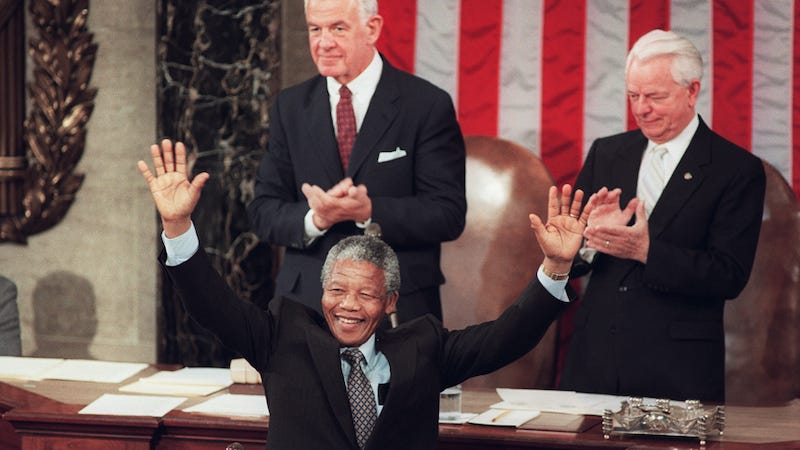
How can it be that Congress provides an even greater ovation for Netanyahu, who is a wanted war criminal, accused of crimes against humanity and genocide, and has been a maniacal stain on the politics the Middle East region since the 1990s, and done everything possible to avoid peace for Palestine? What does this say about America?
For Netanyahu, who was grinning like the Cheshire cat during the announce, this alignment with the US is essential: he can’t afford to have any daylight between him and Trump, Israel’s last dependable and most profitable ally. Yet even still, there are inherent contradictions. Netanyahu has convinced Trump that he’s “committed to peace”, yet he’s also committed to his far-right coalition partners in government that the war won’t end until Hamas is destroyed and Palestinians are removed from Gaza and the West Bank.
It’s classic Netanyahu double-speak – a promise of different things to different audiences. He’s always had the duplicitous stench about him and, whatever he might have to say – or agrees to – he simply cannot be believed. A ceasefire agreed in January this year collapsed within weeks when Israel resumed military operations, and the US raised no objections. Even now, he is already disputing the proposal that has been announced, saying that Israel Defense Forces “will remain in most of the territory”, and that Israel will “absolutely not” agree to a Palestinian state. The deeper question is not whether Netanyahu will comply with any agreement but whether Trump will enforce it, as past experiences suggest the United States will always allow Israel to breach commitments without consequence.
Palestinian groups have already suggested the proposal is essentially the terms of a surrender, a belief reinforced by the fact that the plan was drafted without Palestinian participation and is – more than likely – in defiance of international law. Previous negotiations for Palestinian envoys in Qatar were met with Israeli strikes, for which Netanyahu apologised – not for targeting negotiators but for failing to hit them. Netanyahu is never about peace: he is an extremely violent man and will use any violent tactic to achieve his political goals.
The timing of this Trump–Netanyahu proposal is also suspicious. Just as international momentum was building for initiatives such as Colombia’s “Uniting for Peace” resolution at the UN – which would impose sanctions on Israel and create a protection force in Palestine – along comes Israel and the US to pre-empt them and drown out all viable alternatives. This has happened before: in May 2024, when the International Court of Justice ordered Israel to stop its assault on Rafah, US President Joe Biden announced a phoney ceasefire to defuse any pressure on Israel, pushing away Algeria’s draft resolution to enforce the Court of Justice ruling. This plan functions in the same way: a distraction, buying more time for Netanyahu, and acting as a shield against accountability under international law.
Many reputable organisations – the United Nations, B’Tselem, Physicians for Human Rights, the International Association of Genocide Scholars, Amnesty International, Palestinian Centre for Human Rights, and Human Rights Watch – have recognised that Israel is committing genocide in Gaza. The Trump–Netanyahu plan isn’t a peace settlement that recognises this but, instead, it’s a managed capitulation that brushes over the killings and human rights abuses: the terms and conditions have been dictated by outsiders and the perpetrators of war crimes and crimes against humanity, is designed to preserve Israel’s impunity, and packaged as diplomacy for domestic and international audiences to keep up the appearances of doing something when, in fact, it’s a self-serving document that rewards the aggressor. Peace in our time.
It’s a plan which offers political cover for its architects – and for Trump too – while ignoring both the humanitarian crisis and the root causes of conflict. Like so many initiatives before it, it’s likely collapse because it was never about a real peace – bold declarations and high ceremony giving way to broken promises, a continued violence, and the ongoing reality of occupation.
“The Board of Peace “ , The Israeli Humanitarian Fund “ . 🤮🤮🤮Is it possible to be any more Orwellian than this further stage of Colonialism, with NO input from Palestinians ?? How does the Australian Prime Minister attempt to justify this
fabrication , and why does he insist upon insulting the intelligence of Australians with his continuing obedience to the US , UK and Israeli governments ?? He shames himself and this nation irredeemably .
While it would be great to see the fighting stop, the Netanyahu-Trump plan seems more like a demand the Palestinians unconditionally surrender.
As glibal opposition to Israel's genocide peaks, it is now Netanyahu-Trump vs the entire world.
Given that Netanyahu and Trump can't be trusted to even keep their own promises, the chances of a two-state solution - the only way to achieve real lasting peace - seem unlikely.
It is more likely that Netanyahu will invent some excuse to keep the IDF troops in Gaza indefinitely, and Trump will obediently pander to Netanyahu.