


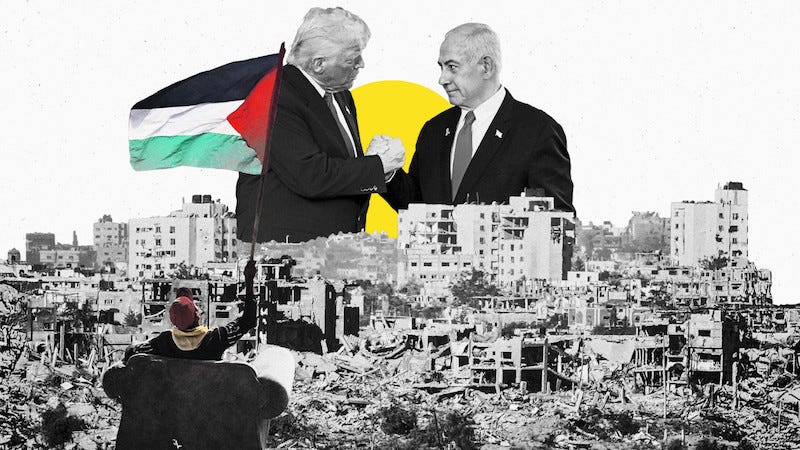
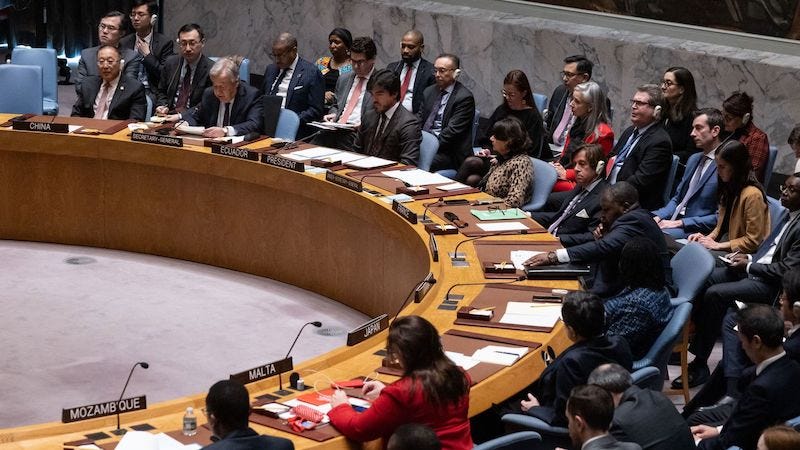
The United Nations Security Council has voted in favour of a US-drafted resolution endorsing Donald Trump’s so-called 20-point “peace plan” for Gaza – a plan that, despite the diplomatic niceties, entrenches external influence, sidelines Palestinian interests and legitimises, and rewards Israel’s ongoing destruction of Gaza and expansionist plans in the region.
The key part of this plan is the creation of the International Stabilisation Force and a vague, conditional and neutered “pathway” to Palestinian statehood. Trump quickly celebrated this vote on social media, framing the decision as a historic validation of a “Board of Peace” that he will chair until 2027, presenting himself as the architect of future global stability. Of course, this is typical of Trump’s bombastic and empty rhetoric but the realities on the ground suggest that the opposite is the case – as if this wasn’t already obvious – and justice for Palestine has been pushed far away into the neverland.
The Stabilisation Force is being sold as an international force for good, but it’s a condescending plan that dictates to Palestinians what’s best for them – the Palestinian people had no meaningful voice in the drafting of this plan, and the Palestinian Authority is expected to accept a list of undefined and shifting reforms and conditions that could stretch for years before any recognisable form of statehood is even mentioned. This gives the US and its partners enormous leverage in shaping the future of Palestine – if there is to be any – according to whim, and according to their own desires.
Governments in the West – including Australia – have embraced the plan as a diplomatic breakthrough but the contradiction at the heart of it is impossible to ignore: a resolution claiming to support Palestinian self-determination has been engineered entirely without Palestinian participation and it’s a plan written by those who have the most to gain, and likely will gain the most.
The reality inside Gaza is a further indication of how shallow this plan is: Israel continues to violate ceasefire terms every day, and the scale of destruction has left the population traumatised, displaced and still facing famine-level conditions. Any solution that does not address the root causes – occupation, blockade, settlement expansion, exploitation of natural resources and the continuous denial of Palestinian political rights – will virtually rubber-stamp the next round of conflict. A denial of justice is always the precursor to ongoing conflicts, and there’s no reason to believe that this won’t lead to the new Intifadas of the future.
Beyond geopolitics, the plan continues that Zionist settler–colonial project that began well before 1948 and continues through every policy that strips Palestinians of sovereignty while rewarding those who have committed the genocide. Giving the responsibility for the future of Gaza to a figure such as Trump – whose political alliances, donor networks and personal interests are deeply mixed in with authoritarian regimes and defence-industry corporations – should also raise so many alarm bells. With the legal and political mayhem rising in the United States – including the forthcoming release of the Epstein files that could reshape American politics – Trump’s role at the centre of this plan only adds to the instability surrounding this resolution.
Even if Trump is somehow removed from office, his successors are unlikely to deviate from longstanding US policy: securing Israeli strategic dominance, protecting American influence in the Middle East, and ensuring access to the valuable gas fields off the coast of Gaza. If these natural resources somehow didn’t exist, the US commitment to “stabilisation” would evaporate overnight – that’s why the rights of Palestinians and their aspirations are secondary and close to non-existent: this is all about grand power political gamesmanship and access to resources.
The forces behind the plan
Hamas has rejected the Security Council resolution outright, describing it as an instrument designed not to end the conflict but to eliminate Palestinian resistance and entrench a permanent Israeli authority. And their resistance is understandable when looking at history: disarmament is a central part of this plan, but every major disarmament imposed on a marginalised group in recent times has been followed by massacre or forced displacement. Srebrenica in 1995 (Bosnia), Sabra and Shatila in 1982 (Lebanon), the crushing of the PLO in Jordan and Lebanon, and numerous operations in Gaza and the West Bank across the past two decades all stem from the same imbalance of power. When one side is unrestrained and the other is defenceless, atrocities will always follow: history has proved this to be the case.
From Hamas’s perspective, disarmament under a framework that leaves Israeli military power untouched would turn Gaza into an open-air killing field, and what has happened over the past two years would be magnified ten-fold. And because the plan imposes obligations almost exclusively on the Palestinians while treating Israel as a security partner rather than a genocidal aggressor, their fears aren’t just paranoia; they’re grounded in the lived experience of Gaza and West Bank since 1948, but especially since October 2023.
There are also many contradictions that make this “peace plan” unworkable, although that was probably the intention: this Stabilisation Force will have responsibility for border security, co-ordination of humanitarian aid, training a new Palestinian police force, supervising demilitarisation and overseeing a phased Israeli withdrawal. In practice, these mandates can’t coexist politically.
On one hand, Israel wants indefinite military control; on the other, Hamas rejects this foreign influence. The Palestinian Authority has indicated that it wants to govern Gaza, but it has no legitimacy there and barely has any credibility within the West Bank. It’s likely to be a chaotic situation but the reality is, that this plan is all about securing Israeli interests and ensure that the United States retains the strong influence in Gaza’s political future.
This should have been grounds for Russia and China to veto this peace plan, but both recognised that blocking the resolution would isolate them diplomatically just at a time when China is trying to present itself as a responsible global actor, and Russia is seeking a resolution in the war with Ukraine. Of course, endorsing the plan would have legitimised what they view as a US-managed colonial project and their abstentions are essentially the diplomatic signal that they do consider the resolution to be illegitimate, but will not spend geopolitical capital by offering protection for Hamas. It’s a calculated sea of ambiguity – a refusal to endorse the actions of the United States – or Israel – while also refusing to carry the blame for “obstructing the peace”, which would have been the likely outcome.
Regional governments, meanwhile, have been forced into compliance. States dependent on US military support or from international financial institutions such as the IMF – Egypt, Jordan and the other Gulf countries – were told behind the scenes that rejecting the plan would have consequences: delays in weapons shipments, loans mysteriously held up, disrupted trade agreements or the frozen out of the diplomatic networks.
But beneath all of this lies a motive rarely discussed: the natural gas supplies off the coast of Gaza. The Gaza Marine field, estimated to hold over a trillion cubic feet of gas, has been a strategic prize since it was discovered in 2000 and whoever controls security arrangements will control the extraction rights. Although then Israel Prime Minister Ehud Barak granted an exploration licence to the Palestinian Authority, the issue of ownership has never been resolved.
Trump’s plan continues this ambiguity over borders and maritime jurisdiction, and it’s a deliberate tactic: by denying access to Palestinians and keeping Gaza politically weak and economically dependent, the plan ensures that the United States and Israel maintain leverage over one of the most valuable natural resources in the eastern Mediterranean.
The illusion of peace and the crimes of Israel
With the approval of this plan, the world is now being asked to forget what has happened over the past two years: the killing of over 70,000 people, predominantly women and children; the two million displaced; the obliterated neighbourhoods, schools, hospitals, and universities reduced to rubble; the ecological devastation; the trauma inflicted on an entire population, especially young children; and the deliberate destruction of Gaza’s infrastructure – electricity, water systems, farmland, fisheries, archives and cultural institutions – you name it; and it’s gone. A society has been dismantled and livestreamed in full view of the world, and the international community’s response is to hand the keys of its reconstruction to the man one man who enabled its devastation: Benjamin Netanyahu.
To call this a “peace plan” is an insult to the meaning of peace: it’s an assault to human decency. There’s no mechanism to hold Israel to account for the destruction and genocide it has caused in Gaza: there’s no mention of war crimes, reparations and sanctions, or any reference to the political and military leaders, including Netanyahu, who need to be sent to the International Criminal Court. Instead, the burden of rebuilding will fall to the same Gulf states that were pressured into accepting the plan: Israel is immune, but it’s everyone else who will pay, including the victims.
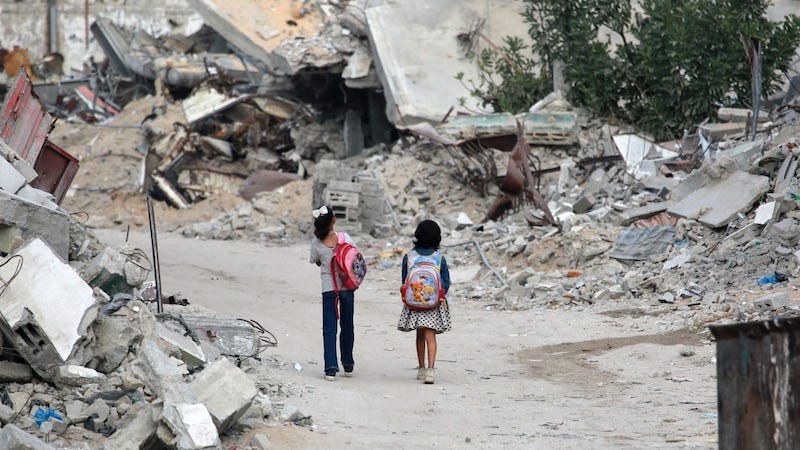
The humanitarian catastrophe is so vast that reconstruction itself will take decades and cost billions of dollars – but even this depends on resolving basic survival issues: access to clean water, reliable food supplies, functioning medical services, shelter and the removal of thousands of unexploded weapons scattered across urban and agricultural areas. Children will grow up with trauma, without schools, without safe play spaces, without stability. “Reconstruction” can’t occur in a vacuum that’s devoid of justice, yet this is the justice that Trump’s peace plan refuses to touch.
What comes next? Do political arrangements need to come in first? Or humanitarian aid? Does the reconstruction begin before a political settlement, or will politics dictate where aid flows? None of these questions are answered in Trump’s plan: there’s no real sequencing of events, there’s no inherent logic, no timelines for accountability – as we have seen with Israel’s daily breaches of the ceasefire agreement – and there’s no way to enforce any promises, especially when Israel breaks them.
This failure is part of a long historical pattern within the world community. While there have been some successes by the United Nations over the years, the world continues to fail the lessons of history, if we look at Bosnia, Chechnya, Sudan, Yemen, Rwanda, Indonesia – there are many more examples and the list is too depressingly long – and the state terror against Palestine is a continuation of these failures.
The numbers in Gaza speak for themselves: the scale of killing, displacement and destruction is there for everyone to see, and any plan that demands silence, compliance, or disarmament from the victims while protecting the perpetrators is not a peace worth having. This is a managed and state-sanctioned violence, but sanitised for the sake of international diplomacy and to create the illusion that everything is going to be alright. But it’s not: this plan is a total disaster.
Those responsible for the devastation and genocide – political leaders, military commanders, corporate suppliers and the states that enabled them – should be facing accountability. Instead, they are being rewarded with influence, legitimacy and given the control of Gaza on a platter. This is the obscenity at the heart of this peace plan.
The world community, once again, finds itself on the wrong side of history. And unless this cycle is broken – unless justice, accountability and genuine Palestinian statehood is placed at the centre, not some words placed on a page and stamped by the Security Council without any meaning – the devastation of Gaza won’t be the end, or as Donald Trump suggested, “bring peace to other parts of the world”, it will just lead to the first steps of the next catastrophe.
Ah yes, and they get control of all that offshore gas and oil that belongs to the Palestinian people. That's ALWAYS what it's about for the western empire.
Thanx again for your great understanding of the disgraceful international injustices that never cease to amaze me in respect of their horror and evil! 😥
May I add that you must stop writing articles with which I agree 100%! This must stop! 🥴