


In the lead-up to the 2025 federal election, housing affordability was perhaps the largest discussion point in the national conversation, dominating the news headlines and was a constant theme on the campaign trail. But after Labor’s landslide election victory in May, housing as an issue has almost disappeared – once the most pressing issue of the day, it’s disappeared from the national agenda, no longer splashed across the front editorial pages and the question of affordability has been missing in action from the political debate. But just because it’s no longer being talked about, it doesn’t mean the crisis has gone away.
A leaked and redacted Treasury report recently made its way – accidentally or otherwise – into the hands of journalists at the ABC, and outlined some of the government’s fears: that the ambitious target of 1.2 million new homes by 2030 – a target that was set in 2023 as part of the National Housing Accord – is unlikely to be met, and that’s less than five years away. According to the Property Council of Australia, this number could fall short by as much as 460,000 homes.
The government’s public messaging hasn’t changed though: the Treasurer Jim Chalmers was quick to remind people that billions of dollars have already been committed, there’s strong collaboration with state and local governments, reform of tax arrangements for build-to-rent schemes, and a desire to engage extensively with the construction industry. His argument is that it’s better to have an ambitious target and strive to reach it than to accept the failed complacency of previous governments – but even within his reassurances, he admitted that the government still needed to do more.
But a closer look reveals that money and ambition alone won’t deliver the homes. The National Housing Accord had promised $3 billion in incentive funding to flow through to states, councils and community housing providers. But this funding comes with conditions – many of which require structural and cultural reform. And while the federal government can send money through to different parts of the sector, it’s at the state and local levels where much of the work needs to be done. Planning laws are sluggish and complicated, with zoning disputes, “NIMBYism” and poor co-ordination continuing to stifle housing projects even before they start.
The deeper issue isn’t just about the number of homes: it’s about how Australia views housing itself, and whether it sees housing as a right or a commodity, and the latter seems to have been the case in recent decades. The federal target might call for 1.2 million homes, but what’s actually needed is a vision for compact, affordable, well-connected living that brings people closer to jobs, services, transport and community. That’s the vision that’s still missing.
Five years may seem like a long time in political terms – there’s at least one more federal election before 2030 – but in the housing world, that’s barely enough to get a large-scale project from concept to completion, and developers, councils, and state authorities already say that the pace just isn’t fast enough. And without major reforms and fast-tracked co-ordination, even the most ambitious plans will fall short – and that’s what’s likely to happen with the federal government’s plan.
The root of the problem can be directed towards the onset of neoliberalism where, like so many other places around the world, Australia turned housing into a commodity, rather than keeping it as a basic need for its citizens. Governments are now paralysed by the politics of housing: afraid to erode the value of existing homes, unwilling to upset developers, and unsure how to provide housing fast enough for those who need it the most. Public housing – once a central part of the modern state – has become a dirty word. It’s seen as being too expensive, too politically risky, and out of step with the profit motives of private industry. But without it, the housing crisis can’t be resolved.
There’s also a stigma issue. Housing stability is essential for social and economic wellbeing, yet living in public housing is still seen as somehow shameful or existing as a second-rate citizen. Until that perception changes, and until governments see housing not as a business item but as an investment in human security, the housing challenge will continue – not just as a crisis of supply and affordability, but as a moral failure.
Australia’s rental laws, while improving in some states, still leave tenants exposed. No-fault evictions are still legal in many parts of the country, and in many cases, renters can be pushed out simply because landlords want to get higher rents. These aren’t just policy failures – they reflect a fundamental imbalance in how housing power is distributed. It’s a system that punishes the poor, rewards speculation, and is increasingly leaving younger generations behind.
The housing debate that once consumed and dominated public debate has gone quiet, buried beneath the post-election glow and a media cycle that is now obsessed with other stories. But the crisis hasn’t gone away and, if anything, it’s getting worse. And without continuing pressure, serious reforms, and without a government that’s prepared to challenge entrenched interests – at a state, federal and territory level – Australia’s housing targets won’t just be missed, they’ll become a symbol of broader national failure.
Sydney, the city too expensive to live in
In Sydney, the problem isn’t confined to low-income households or the homeless. It’s now reaching into the lives of high-income professionals – people with stable jobs, postgraduate qualifications, and relatively strong earning power – can’t afford to rent near their places of work, let alone purchasing a property. It’s not just lower-income workers – young doctors, teachers, engineers, and public servants are being priced out of the inner and middle suburbs. The housing crisis has spread well beyond the margins; it’s embedded itself in the heart of urban life.
Rising wages alone won’t fix this. While increasing incomes is a necessary component of broader economic reform, the cost of housing is growing at a pace that wages simply can’t keep up with. It’s not just a matter of affordability – it’s a structural dysfunction in how housing is managed in Australia. Housing as an investment; wealth creation; a guaranteed capital growth. That mentality is so deeply ingrained that it has distorted not just the market, but also our cultural and political responses to the crisis.
Outlets such a like Domain and realestate.com.au certainly don’t help, nor do television programs such as The Block, which celebrate brilliant auction results, record sales, and a form of lifestyle porn. The message is consistent: housing is about how much it’s worth, how much it might go up in value, and how much you’ll make if you sell at the right time. And you, as a person, are defined by how valuable your house is, not how valuable you might be to the community. It’s a celebration of speculation, not of life itself, and the more we applaud these capital gains, the more we drift away from what housing is meant to be: a safe and secure place to live in.
The result is a city where housing is inaccessible to the very people it depends on. Currently, there are only five suburbs in Sydney – out of 650 – where someone earning the minimum award wage can afford to sustainably rent a home, and each of those suburbs is at least 40 kilometres away from the city centre. While the situation in Melbourne is slightly better, there’s only a handful of suburbs that meet this threshold and, as in Sydney, these suburbs exist on the outskirts of the city. Everywhere else, it’s unaffordable – this is not just a market failure; it’s a human rights issue.
And the tragedy is that too many of the powerful well-connected stakeholders with influence over policy and planning, don’t see this as a problem – or if they do, they see it as someone else’s problem to fix up. Vested interests – developers, real estate lobbies, investors, landlords – have no incentive to push for affordability, because the system works so well for them. Prices rising is seen as a good thing and a housing boom is something to be celebrated, yet every rise locks someone else out. Every surge in value comes at the cost of someone’s chance to live near where they work, where they grew up, or where their community is.
And it’s this dynamic that feeds back into politics. Governments are reluctant to push back against the investment mindset because they fear a backlash from voters who now see their property as their retirement plan. Any policy that might limit house price growth – even if it improves accessibility – becomes politically toxic and exploited by an opposition just waiting to pounce. This has created a strange dichotomy: politicians insist they want more affordable housing, but they can’t afford to allow prices to fall, and it’s a contradiction that seems to be impossible to close up.
There needs to be a cultural shift in housing
For decades, Australia has hovered around the same annual figure when it comes to housing construction: roughly 150,000 new homes per year. That’s a figure that represents a net gain – excluding homes that have been knocked down and replaced – so it’s a clear indication of how slowly the housing stock has grown. Over the past decade, this number has climbed slightly to around 180,000 per year, primarily due to population growth and shifts in economic and demographic trends but, to meet the federal government’s 1.2 million homes target by 2030, that figure needs to jump to at least 250,000 homes per year and has to stay at that level consistently for the next five years.
It’s not an easy task, and it’s not just about funding or political ambition – it’s about structural capacity and whether Australia actually has the physical, legal, political, and cultural infrastructure to build at such a scale. Of course, there will be disagreement about exact size of the shortfall. The Property Council of Australia – with its vested interests in ramping up construction activity – will use its figure of 460,000 to politically weaponise the issue and put pressure on the government, while also promoting the interests of the building industry that it represents. Other analysis suggests the real gap might be closer to 260,000 but, whatever the real number is, the problem remains the same: Australia is falling behind in the required level of housing stock.
And these homes or dwellings don’t just materialise out of nowhere: large-scale housing developments – especially the high-density projects in urban areas – take many years, where planning approvals alone can take up to five years; then there’s the construction time, material shortages, labour gaps, and funding. Then there are the entrenched inefficiencies in the planning systems across councils, with each local government area governed by a unique and often contradictory set of rules. Then, of course, there’s local resistance: higher density is a dirty word in many suburbs, even when it’s the only way to house a growing population near services, transport, and jobs.
The first barrier to overcome in this equation is legal: planning laws need to change to enable smarter, denser housing in areas where it makes sense to do so. That means adjusting zoning laws, cutting through red tape, and creating uniform frameworks across the many jurisdictions across Australia. The second barrier is psychological: Australia still holds on to this outdated ideal of the freestanding house on a quarter-acre block as the ultimate aspiration. It’s not only impractical – it’s exclusive and environmentally unsustainable.
The future of housing needs to embrace a wide range of sensible alternatives: modular housing, prefab builds, tiny homes and mixed-use developments. These options are already being adopted in many other countries that are facing similar housing pressures, and they offer faster build times, lower costs, and greater design flexibility when it’s done well. But they require a cultural acceptance that Australia might not quite be ready for – a willingness to let go of the notion that bigger means better. It doesn’t, and in this case, it might mean that less will result in more.
And that brings up another critical issue: Australia builds the largest homes in the world! Australian new homes are, on average, 236 square metres in size – or around 30 square metres larger than the next largest on record, the United States. And just as a comparison, the average size in the 1960s was around 100 square metres – and this was at a time when families were much larger, and household incomes were much smaller.
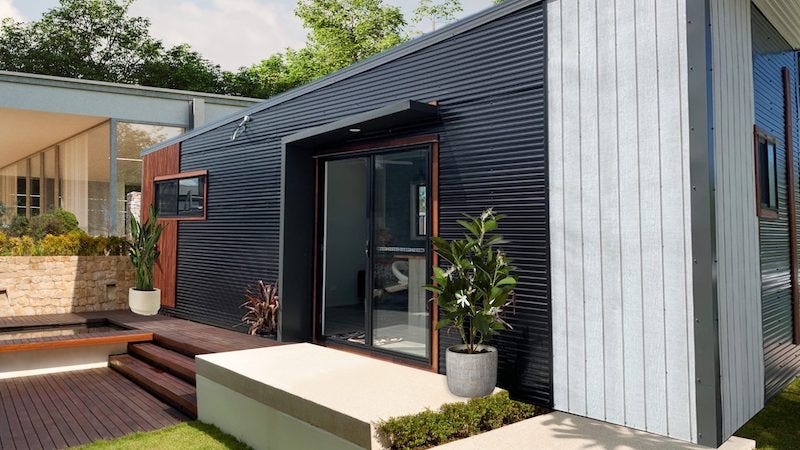
The solution isn’t just to build more homes – it’s the construction of smarter, smaller, more efficient and faster-to-build homes. We also need to have a national conversation about space, about function, community and climate – and that conversation needs to include architects, urban planners, renters, builders, and, most importantly, the people who can’t currently afford to live where they need to be.
But the more critical issue is that Australia’s housing crisis hasn’t disappeared: it’s fallen off the political radar, replaced by other headlines. But it hasn’t gone away – it’s still causing a lot of stress for too many people; it’s still locking out younger generations from affordable housing. And it’s damaging the social contract that needs to exist between government and the community. It’s not just an economic problem, it’s also philosophical, and it’s about what kind of country we want to live in, and how we define value.
We’re currently trapped in this binary housing model, where you either own and accumulate wealth – or you don’t – and, if you don’t, you remain locked out indefinitely. That’s the mindset that has to change. We need to build differently but, increasingly, we need to think differently. Because until we do, that number – whether it’s 1.2 million or whatever else it becomes – will never be enough.
When 10% of our homes are sitting empty because investors don't want them rented, something is wrong with our taxation system.
Local laws must also be changed to encourage tiny homes prefabricated and installed quickly. For many, they are all that is needed.
Many rural towns could easily have new suburbs added. Water tanks and septic systems lower public development costs and give owners more independence and lower costs.
Capital gains concessions should be limited to one investment property.
Public housing must be encouraged and properly funded.
Too many people are forced to live in vans because it's all they can afford.
THIS is the Prime Minister who boasts of growing up in Social Housing , and who had the benefit of a free Uni Education thanks to a TRUE Labor man , Gough Whitlam . Now it appears that he has pulled this ladder of opportunity up behind him .
HECS debts and the vanishing dream of being able to get into Social Housing , let alone afford to buy one’s own home have been normalised under this shrivelled , disgraceful version of a “Labor Party “. Meanwhile , the grovelling to placate foreign interests , the orders of the Trump regime , and Zionist lobby groups take precedence . How many houses , and improvements to Public Education could be achieved with the Billions of taxpayer funds being happily handed over to the US for the AUKUS scam/ catastrophe?? Public Interest ZERO.
Might I also add that at this time when at least one woman a week is being killed in Domestic Violence incidents , Albanese
prefers to spend funds of placating the orders of the “antisemitism envoy” he appointed ? No words 😶.