


The Envoy to Combat Antisemitism Jillian Segal has foisted herself into the national debate again – this time, she’s walked back on claims she recently made that the Sydney Harbour Bridge Walk in support of Palestine in 2025 is an example of antisemitism, which she then used to make the outrageous causal link with the Bondi terror attacks.
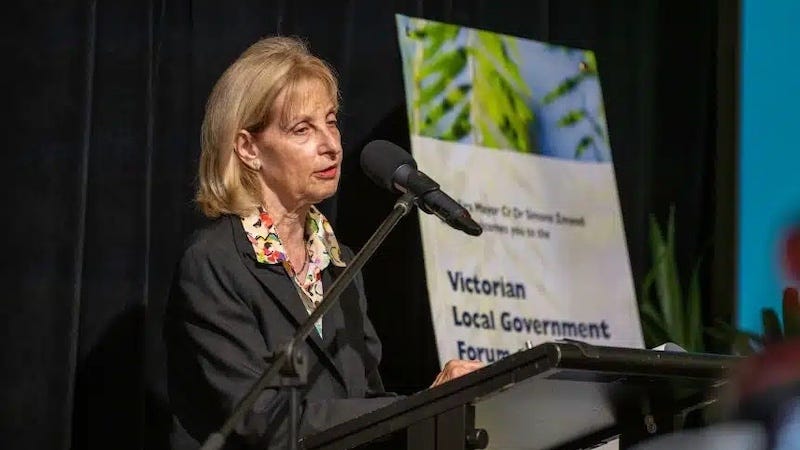
In recent remarks at the Local Government Forum on Antisemitism and Social Cohesion, Segal – whose actions seem to be adding to antisemitism in Australia and reducing social cohesion – has now conceded that this large pro-Palestinian march – one of the most visible acts of protest in the country since the outbreak of war in Gaza – was not, in itself, antisemitic. Yet even this acknowledgment came with a more ambiguous claim, that such protests, even if they are not antisemitic, still undermine social cohesion, which we can assume would be according to her own personal definitions about what this means.
Through this statement, Segal has widened the issue to encompass all forms of dissent as undermining social cohesion, and within this, you can virtually name your own issue – dissent against the state of Israel, against Zionism, against the arms manufacturers who are supplying weapons that are being used to kill Palestinians and to now attack Iran – and this can then easily move onto to targeting other forms of protest, such as climate change action, which the New South Wales government has revelled in punishing. In doing so, Segal’s argument places mass protest not as an inherent democratic right, but as a destabilising social force, even when it is peaceful, legitimate and legally sanctioned.
The comparison – whether it’s explicit or implied – between peaceful demonstrations and acts of extremist violence has been especially contentious, especially here in New South Wales. Segal’s initial rhetoric that made the link between a large-scale protest and events such as the Bondi attack, actually deepen divisions rather than easing them, and is her attempt to reshape public perception and government policy, and redefine what is considered to be acceptable speech.
Her rhetoric has also exposed divisions within Australia’s Jewish community itself. Progressive organisations such as Jewish Council of Australia have long been concerned at what they see as a narrowing of the debate, where particular political positions aligned with Zionist and pro-Israel perspectives are presented as the only perspective, whereas dissenting Jewish voices are marginalised or excluded completely, such as Jews Against the Occupation ’48. The absence of such groups from the public forum means that the conversation around antisemitism is being centralised and politicised according to the views of extremists, and not the wider community.
The bigger question here is about who gets to define what antisemitism is and, so far, it’s just been the one voice. Segal has pushed local councils to adopt the International Holocaust Remembrance Alliance working definition, whereas other groups prefer the Jerusalem Declaration on Antisemitism, which is specific to Jewish people and communities, and keeps the opposition to Zionism or critiques of Israeli policies as a separate issue. Why then do we never hear about the alternative Jerusalem Declaration within this debate?
There have also been the broader concerns about external influences, with allegations that overseas organisations – particularly those connected to Israeli advocacy networks – are seeking to influence local policy debates. While these claims are difficult to quantify – always mentioned under the catch-all banner of “mysterious overseas actors” – they reflect a growing unease in Australia about the links between domestic politics and international lobbying efforts, especially on issues such as race, identity and foreign policy. There is always this unease when any foreign entity interferes in Australian politics – China, for example – and it shouldn’t be any different when it comes from the government of Israel.
It’s also important to consider that Australia already has a National Anti-Racism Framework managed by the Human Rights Commission, and this is designed to address all discrimination, and strengthening these existing mechanisms would provide more consistent and equitable protections for all peoples, and if antisemitism exists as a distinct category according to Zionist definitions of whatever this could mean, it risks weakening the broader fight against racism rather than strengthening it.
The politics of atrocity and the ongoing battle over narrative
There’s also been a separate controversy developing over comments made by the 2021 Australian of the Year, Grace Tame, relating to the already volatile debate about truth, evidence and the political uses of atrocity in the aftermath of the October 7 attacks.
Claims about widespread sexual violence committed by Hamas during these attacks became a central part of Western media reporting and political rhetoric in the months afterwards. However, the evidence – or lack of – for those claims has been part of a contested debate for well over two years. While many analysts such as Norman Finkelstein have never ruled out that sexual violence may have been perpetrated, many investigations and reports from respected journalists have highlighted the inconsistencies in these reports, which were then used to justify the campaign of terror inflicted by Israel upon Gaza, while there is absolutely no evidence to support these claims – along with the claims of beheaded babies in ovens, which has been shown to be a hoax.
Tame publicly questioned the narrative of “mass rapes”, suggesting that the claims had not been verified and were used as a form of propaganda, which reflects what many analysts have suggested – that in wartime, claims of atrocity need to meet the highest standards of evidence if they are going to be used to justify such a large-scale military response.
Of course, any downplaying of allegations of sexual violence risks silencing victims and undermining the seriousness of such crimes, particularly in a context where gathering evidence is difficult – but in the case of Bosnia in the early 1990s, there was a massive amount of documentation and testimonies from the victims of sexual violence perpetrated by Bosnian Serb soldiers and paramilitaries, yet the international community barely lifted a finger to help and protect these women.
In Israel – no independently verified documentation of the sexual violence exists – yet hearsay and rumour became the pretext for the genocide and destruction of Gaza. At the very least, we should be able to question or examine why these two incidents in Bosnia and Israel – even if they are over 30 years apart – have produced radically different responses by the international community.
Tame’s comments have now had personal consequences. Her speaking engagements have been cancelled or withdrawn for the remainder of 2026, which continues that pattern of those public figures who speak up against the narratives presented by Israel – even when they are found to be untrue – and whenever they support pro-Palestine positions.
And it is now gone past the point of pro-Palestine commentary. The decision by Multicultural Affairs Minister Anne Aly to withdraw funding from the Taha Humanity Association of Victoria following reports about memorials they prepared for Iran’s Spiritual Leader Ali Khamenei – assassinated in the recent attacks by Israel and United States – over her concerns about “social cohesion” (and what a great way for a minister to promote social cohesion than to side with Israel and act according to their wishes), suggests that organisations associated with Islamic communities are subjected to far higher levels of scrutiny, whereas Zionist organisations are supported without question, despite how extreme their views might be.
It should be obvious to most people, but the advocacy that’s aligned with Israel – such as that from Jillian Segal – has institutional backing and access to power, while dissenting voices, particularly those critical of Israeli policy or supportive of Palestinian or Iranian perspectives – such as Grace Tame – are likely to be sanctioned, have their funding withdrawn, or be cancelled altogether.
Tame questioned the evidence from a powerful state whose entire existence depends on propaganda and misinformation, and she has been drowned out and shut down. In this type of environment, the risk is not only that misinformation spreads – and why wouldn’t Israeli and Zionist groups keep doing this when their behaviour is readily supported by our political leaders – but to have wars inflicted upon innocent people in an evidence-free zone, similar to what occurred with the fabrication of “weapons of mass destruction” to justify the invasion of Iraq in 2003, which resulted in the deaths of up to 600,000 Iraqis. That is unacceptable, yet the world community continues to accept these clear and obvious lies.
When everything becomes antisemitic, even the football
As the Royal Commission into Antisemitism continues its work, there’s a new issue that has arisen: the concept of antisemitism has become so diluted through its broad and inconsistent application, that we’re starting to lose track of what it actually is.
Of course, that’s not to deny that antisemitism is a problem, but so is every other form of discrimination. It would be better to place the issues of antisemitism within the frameworks that currently exist in Australia, rather than put it on a pedestal with its own rules and regulations, which can be bent in so many different ways, according to the likes of Segal and her supporters. When every controversy, no matter how small it might be, is drawn into the debate, then the ability to respond to genuine antisemitism – if that’s what the intention is – is weakened rather than strengthened.
During the week, political football and actual football merged into one, with the AFL club, the Sydney Swans, referred to the Royal Commission for, one assumes, antisemitic behaviours.
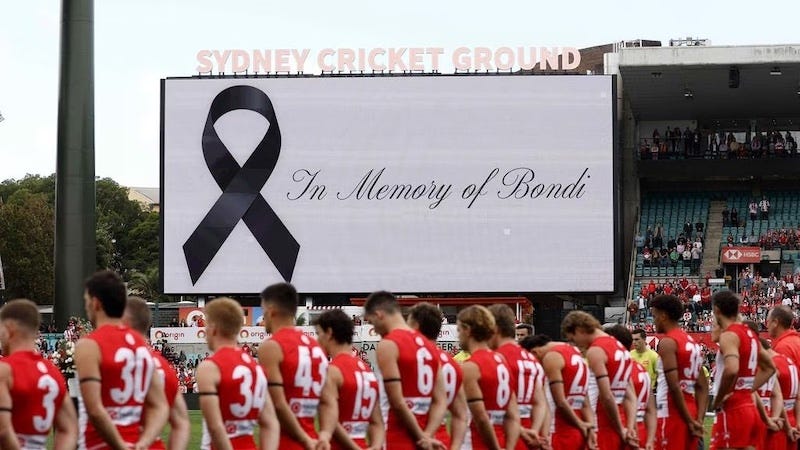
Being a club that is essentially based in the eastern suburbs, the response of the Sydney Swans to the Bondi terror attacks has been nothing short of exemplary. The entire playing group visited Bondi Beach to pay their respects to the victims and the Jewish community, issued a number of public statements, with their coach Dean Cox joining a team of high-profile sports stars calling for a royal commission into the attack. When their season opened just a few weeks ago, the Swans hosted a solemn pre-game tribute that acknowledged victims, emergency responders, and the broader community affected by the violence.
The controversy arose eight days later, when it was pointed out that the Jewish community had not been explicitly mentioned in the speeches and, never one to miss an opportunity no matter how small it might be, Senator James Paterson referred this point to the Royal Commission, magnifying what might otherwise have remained a minor or internal issue – remembering that no-one had brought this up until a sports journalist referred to it for unknown reasons eight days later – and turned it into a national political outrage and media circus. See, even the Sydney Swans are antisemitic!
The Swans apologised, gave the reason that they wanted the entire event to be inclusive of the wider community that was affected by the Bondi terror attack – and fully accepted responsibility, suggesting that it was an error of judgement. Yet the sequence of events prompted by a sports journalist, who probably received a few complaints by a disgruntled Zionist who felt they had not been acknowledged enough – and for these Zionist groups, too much support will never be enough – has brought up questions about Paterson’s intent, timing, and the incentives to refer this petty issue to the Royal Commission and waste its time.
Of course, there is also a broader political issue here: Paterson has accepted AIJAC-funded trips to Israel (as recently as 2024) and is the co-founder of the fundraising group, the Victoria Liberal Friends of Israel. When people like Paterson finds ways to insert themselves into the debate, and to create controversy on behalf of overseas interests – primarily it seems, for political fundraising purposes – it shows that Australia is heading down a dangerous path of acting on behalf of a foreign entity that is creating havoc in the Middle East/Western Asia region, and this will ultimately have consequences for its own citizens.
At the same time, public tolerance for the constant magnification of these issues of antisemitism, when they are clearly not, is wearing thin, especially when genuine attempts of showing solidarity with the Jewish community – which the Sydney Swans have clearly done since December last year – are frivolously ridiculed and admonished for not doing enough. It’s the same opprobrium and accusations of antisemitism that was dished out at Prime Minister Anthony Albanese last year for also not doing enough, but we can see that when everything is deemed to be antisemitic in this way, then nothing is.
If this label is applied to everything in the eyes of these influential beholders, then credibility in the eyes of the wider public will diminish, including those who would otherwise support strong measures to combat genuine antisemitic behaviour. And that’s the real risk here, where opportunist overreach in defence of a worthwhile cause will ultimately undermine it.
In the end, that’s what the real challenge is: not just to identify antisemitism, but to preserve the meaning of the word itself. Without that, the very effort to reduce it will become less effective, not more.
Thank you so much for this nationally important contribution . We are blatantly losing any concept of democracy and free speech when a Zionist “antisemitism envoy” has been chosen by the Prime Minister , effectively to dictate what can be said by any member of the public , what can be taught or discussed in school and University curricula , and which community groups are to be permitted a grant from Government to support their perfectly reasonable existence . ( Shame upon you ,
Anne Aly ! No doubt you are obeying orders from Above , but you have lost your integrity as you agree to OBEY ).
It can be clearly seen , even at this early stage , that the “Antisemitism RC “ will be just as hollow and meaningless in its outcome as was the Robodebt RC , thanks to the charade of the NACC . The Australian government appears little more than a puppet of Israel and America . For shame !!
Thank you Eddy.
The Albanese regime’s actions since last year to elevate Segal has created what we have feared: a religious censor to police civic life with the effect of limiting our civil liberties. Why undermine the existing legislation and elevate one hate above all others?
Both Segal and Albanese have done more to undermine secularism and civil liberties in the last 12 months than most governments can do in two terms.