


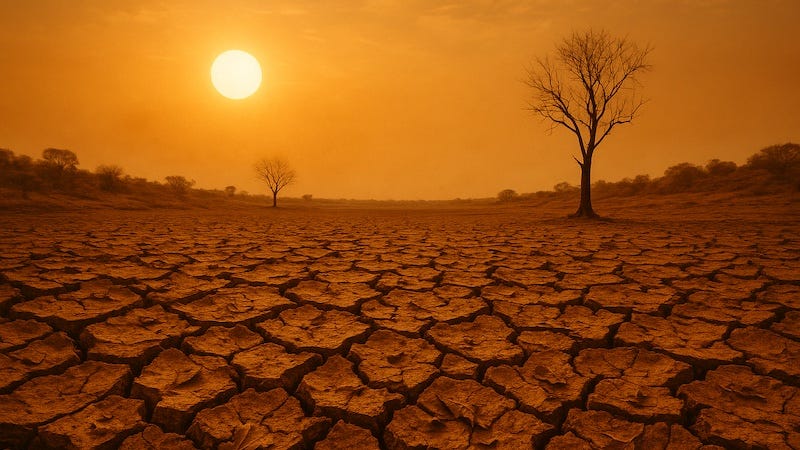
Cascading, compounding, concurrent. That’s how the Australian Climate Service has described the way climate change will affect every community across the country. Cascading, because the impacts will intensify over time; compounding, because each new impact will amplify all the others that preceded it; and concurrent, because no part of Australia will experience these effects in isolation – communities across the nation will need to deal with multiple crises at the same time.
Australia’s first national climate risk assessment, finally released by the minister for Climate Change and Energy Chris Bowen after a long delay, is the most comprehensive analysis of its kind. It’s a disturbing picture of what Australia is confronting, even in the best-case scenarios. This report was expected before the 2025 federal election but was delayed – a decision that now seems unsurprising given the severity of its findings and a government not wanting to be distracted during an election campaign, after suggesting they would definitely be doing a lot more to address climate change issues than their counterparts, the Coalition.
According to the report, by mid-century – just 25 years away – 1.5 million people in Australia will be at risk from rising sea levels; if global warming can be contained to 1.5 degrees, sea levels are projected to rise by around 0.15 metres; if temperatures rise three degrees, the increase could be closer to half a metre. Eighteen of the 20 most exposed regions are in Queensland, with northern New South Wales also among the danger zones, where flooding that was once thought to be a once in a century event is already occurring far more frequently, and by 2030 nearly 600,000 people could be living in areas vulnerable to inundation.
Northern Australia is also at a much higher risk: health, infrastructure, and ecosystems will be under intense strain, but the assessment makes clear that no part of the country will escape consequences. Heat-related deaths are projected to skyrocket: fatalities in Sydney could increase by more than 400 per cent, while Melbourne could see an increase of around 250 per cent.
These figures are not just abstract numbers – Sydney’s hotter summers will claim thousands of lives if adaptation and actions to mitigate climate change fail – and other cities such as Melbourne, Brisbane, Perth and Adelaide will face similar numbers.
Australia’s ecosystems also face dire consequences. Between 40–70 per cent of species will be forced to migrate, adapt – or perish altogether – if global warming increases by three degrees. Eucalyptus forests will be under threat, while coral reefs – already under severe threat from bleaching – are projected to suffer catastrophic collapse. There’s not much doubt in this report: biodiversity loss isn’t some distant concern that can be kicked down the road for future generations to deal with, but an immediate reality that’s going to affect many people who are alive today.
Of course, the political response has been polarised and the climate wars are never too far away. Climate sceptics have dismissed the findings as alarmist or a deliberate attempt to undermine the fossil fuel industry but for many others, there has been a shock at the sheer scale of the crisis outlined. The reports highlights all the climate change issues that has been known about for decades, yet consistently downplayed and ignored: Australia has had over 50 years of repeated warnings, but weak responses and action has followed. The longer deep emissions cuts are delayed, the harder and more costly the task of remediation will be, as well a smaller window for effective action, with some scientists now suggesting that the opportunity to avoid catastrophic damage has already passed.
