


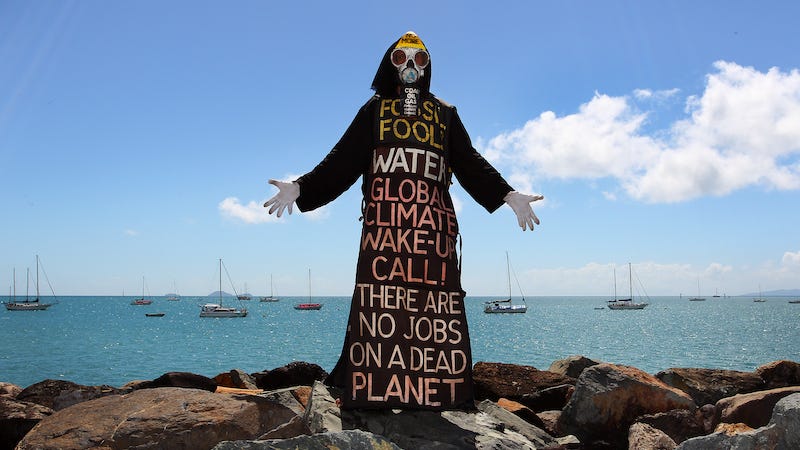
The Albanese government has released what could be one of its most controversial backflips yet – amendments to the Environmental Protection and Biodiversity Conservation Act that will open up more new mining projects and erode environmental safeguards.
Environment Minister Murray Watt has outlined his plans to return decision-making powers for coal, gas and water-intensive developments back to the states and territories, supposedly in an attempt to “streamline” project approvals and “cut red tape” – the same language conservative governments have used in the past when reducing legislative protections that relate to the environment. But behind the rhetoric of efficiency is a totally different reality: the weakening of national standards that were implemented to protect fragile ecosystems, water systems and traditional lands.
One of the more concerning amendments is the neutering of the “water trigger”, which was introduced in 2013 to safeguard Australia’s groundwater from large-scale coal and gas extraction. Under Watt’s proposals, these protections will be replaced by bilateral agreements with state and territory governments, the jurisdictions that are the most dependent on resource royalties. Queensland, Western Australia and the Northern Territory – governments that are heavily linked to mining revenues – will gain greater control over project approvals, and the risks of a conflict of interest are obvious – or, at the least, should be obvious.
Australian Greens Senator Sarah Hanson-Young has condemned the legislation as a capitulation to corporate influence, suggesting that “business has its fingerprints all over this draft – they get a fast track, cheaper and easier approvals for their projects”. Environmental groups have also supported Hanson-Young’s sentiments, arguing that these reforms are a “green light for destruction,” undoing the years of progress that have been made in the federal sphere.
The Albanese government insists the amendments constitute “essential environmental reform,” yet the evidence suggests otherwise: this is not environmental reform; it’s environmental regression. The government, which holds one of the largest majorities in recent history – 38 seats – could have used this majority to take Australia into a new era of ecological responsibility and protecting the future. Instead, it’s using that power to entrench the same vested mining interests that have dominated Australian politics for far too long.
Labor’s deep ties to the mining sector have long undermined its credibility on climate and environmental policy. The party that once championed its environmental credentials –going all the way back to the 1990 federal election, when they won the election on the back of state-based Greens preferences in key marginal seats – is now protecting the expansion and the profits of fossil fuel giants at the expense of both people and the environment. The “jobs” argument – that easing restrictions will support regional employment – rarely comes to fruition, with most mining operations trending toward automation and low-cost overseas labour. The wealth that’s generated by these industries continues to flow mainly to multinational shareholders, while local communities see fewer benefits and face greater environmental risks.
If this legislation is passed through Parliament, it will not just be a betrayal of Labor’s promises – which have been essentially made over the past two election campaigns – but a fundamental reshaping of Australia’s environmental laws, and shift the balance of power from the federal government over to the states and territories. And once those protections are gone, they might be gone forever.
The dangers of the “national interest”
There’s also the bigger issue of the government’s push for mining approvals vaguely deemed to be in the “national interest”. Legislation created for the benefit of the national interest was once a wartime necessity – such as the War Precautions Act in 1914, or the National Security Act created at the onset of World War II – but today, it seems to have become a political catch-all – a justification for whatever benefits those in power.
At the moment, there is legislation that relates to foreign acquisitions and critical infrastructure that requires a national interest test, and these amendments will provide the Environment Minister with the discretionary power to approve projects that would otherwise breach Australia’s environmental standards. It will create an open-ended loophole large enough for any major mining or gas project to slip through, no matter how damaging its impact might be to the environment.
