



Has AUKUS only ever been about the submarines? For many years, this is what the focus has been on: new/old submarines, will they arrive/won’t they arrive… and during this time, the political class and mainstream media has corralled the discussions in a child-like way towards the costs, delivery timetables, industrial capabilities and whether the United States will ultimately provide the nuclear-powered submarines that successive Australian governments have been promised. Yet underneath this charade – which has primarily been led by defence minister Richard Marles – is a much bigger development that has received almost no public attention at all.
And it’s something that we do need to pay more attention to and be deeply concerned about, because, if it all proceeds, it could be the end of Australia’s independence and sovereign defence capabilities, and a one-way funnel of taxpayer funds to prop up the US–Israel military industrial complex(es) that continues forever.
There’s a new provision before the US Congress at the moment – Section 224 of the 2027 National Defense Authorization Act – and it proposes a significant expansion of defence technology co-operation between the United States and Israel. Known as the “United States–Israel Defense Technology Cooperation Initiative”, it will establish new frameworks for joint research, development, testing, production and integration of military technologies across a broad range of emerging defence sectors, including artificial intelligence, autonomous systems such as drones, cyber warfare, missile defence, quantum computing and networked military operations.
It means that even simple Israeli innovations such as “skunk water” – a liquid spray with an odour worse than raw sewage and excrement combined, and can linger for weeks after being sprayed from armoured water cannons – can be used equally on the streets of the West Bank or at a No Kings protest in Minnesota, as the circumstances require.
This might seem like the logical extension of a nefarious and clandestine defence relationship that has existed for decades, certainly since the Second World War, but it will make the Israeli and US defence forces almost indistinguishable. Of course, the proposed legislation has been strongly supported by pro-Israel and Zionist organisations in the US, but there’s something more disturbing about this that’s taking place.
Since the state of Israel was created in 1948, the US has transferred over $330 billion in military aid directly to its defence forces, including two additional support payments of at least $34 billion since October 2023, authorised by US President Joe Biden, and continued by Donald Trump.
While their defence forces will technically remain separate if the Act is passed, the legislation will remove that requirement that Congress needs to approve any expenditure or aid granted to Israel, military spending essentially becoming a line-item in the US defense budget that can be increased at whim – and at the behest of the US Defense (War) Secretary, as though Israel exists as a special (and expensive) military outpost of the United States. And like a spoilt and demanding nepo-baby, the state of Israel will no longer need to ask for the funds to perpetrate its endless genocides, it will just take.
This is also an outcome that will fast-track Israel’s expansion into other parts of the West Asia region as well, something we’re already seeing in Gaza and southern Lebanon – at last count, 3866 civilians have been killed by the IDF; in response, just four Israeli civilians have been killed by Lebanese forces – and it will also bind the two countries’ defence industries, research programs and technology ecosystems together for decades to come, if not permanently.
It’s a strategic partnership so deeply embedded through a de facto merger that it would be extremely difficult for any future government to unravel. And after US President Donald Trump’s statement to Israel to say that “he is the one calling the shots” – a US president who was genuinely calling the shots would never need to make such a statement – it’s clear which country would create the difficulties if the United States ever sought to bring the arrangement to an end.
That’s where the issue lies between US and Israel, but it’s not where it ends. For Australia, that distinction about who is calling the shots might not matter too much, because it might end up being a case of Australia receiving the shot calls from either the United States or Israel. And this is the bigger question for us: what happens when Australia increasingly embeds itself so deeply into the American defence ecosystem at the same time that the United States is seeking a deeper integration into Israel’s defence systems? It’s also where AUKUS becomes a key part of this narrative, although it’s clear that it’s not one the Australian government wants to speak very openly about.
Since it was announced in 2021, AUKUS has gone way beyond submarines. Pillar I covered the much-maligned nuclear-powered submarines that we are never going to receive, but Pillar II encompasses the far broader agenda involving AI, autonomous systems, cyber capabilities, sophisticated undersea warfare and advanced military networking. These are exactly the same kinds of technologies outlined in Section 224 of the Act that’s now being discussed by the US Congress, and it’s not a coincidence that Pillar II is almost a replica.
The Albanese government, like the Morrison government before it, has argued that Australia must become “more interoperable” with the United States, in response to a “deteriorating strategic environment”, which has deteriorated only because they keep saying it has, ably supported by the hawks of hack journalism at the Sydney Morning Herald and News Corporation.
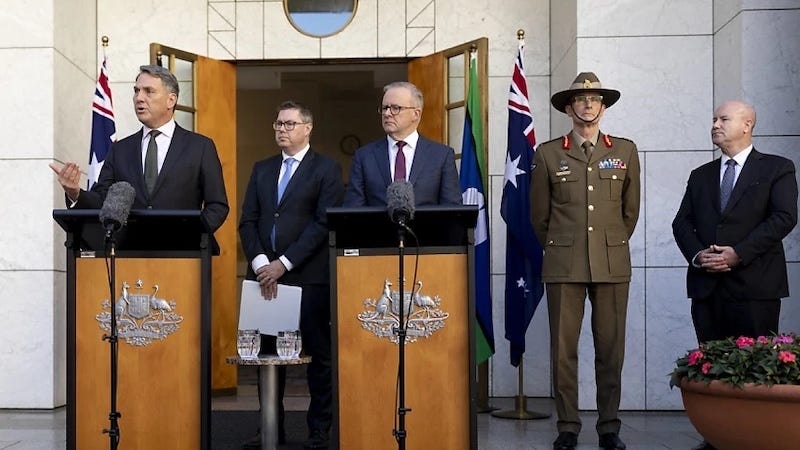
“Interoperability” has become one of the key buzzwords of Australian defence policy and it’s the word that Marles and Prime Minister Anthony Albanese like to keep using in the context of AUKUS: it might seem like a fancy and innocuous piece of defence terminology, but it also means that Australian defence forces will be communicating, operating and fighting seamlessly alongside US forces and, if the Act is passed by Congress – which is becoming increasingly likely – alongside Israeli F-35 fighter jets as they bomb yet another village of innocent civilians in southern Lebanon, or decide to revisit Gaza and continue with the genocidal campaign there. Or perhaps expand into the other areas that are outlined within their Greater Israel project.
This is what “interoperability” is in reality, and it’s something that has never been clearly discussed with the Australian public. According to Pew International, 79 per cent of the Australian public has a negative view of the state of Israel, including 49 per cent who hold a “very unfavourable” view. Before the accusations of “antisemitism” start to appear, the Australian public also has a similar view of the state of Russia – 79 per cent hold a negative view – but the Australian government is not about to forge a permanent military alliance with the Russian defence forces.
How would the Australian public react if its government did ally with Russia to perform massacres in the Ukranian cities of Mariupol, Kherson or Zaporizhzhia? Or ethnically cleanse the regions of Donbas or Crimea? Swap these Ukrainian regions with the Palestinian regions of the Gaza Strip, Khan Younis – or many of the hundreds of cities that have obliterated from the map by Israel – and this is what “interoperability” will look like for the Australian Defence Forces after 2027, if this Act is passed by the US Congress.
When military systems become so deeply interconnected, decisions that are made in one country increasingly do affect smaller partners elsewhere. Australia will never have the stature or relevance within the AUKUS deal – or Pillar II – to be able to object to the involvement of its forces in any US- or Israel-led war activity anywhere in the world. It will be a case, to paraphrase former Prime Minister Robert Menzies, where if the US or Israel declare war upon any country in the world, as a result, Australia will also be at war.
If the United States proceeds with deeper defence technology integration with Israel, Australia will also be directly connected to those same systems, programs and industrial systems developed by Israeli technology and expertise. Of course, this won’t mean that Australia will instantly become responsible for the actions of the Israel Defence Forces, but it would mean that it becomes a part of a defence system that reaches far beyond the Indo–Pacific region. And this is the reality that’s likely to become increasingly controversial within Australia once the public finds out what this AUKUS – Pillar II deal is really leading us towards.
Public attitudes towards Israel – as shown by the Pew International research – have shifted dramatically across much of the Western world since the beginning of the Gaza war. Allegations of war crimes, collective punishment and breaches of international humanitarian law have generated intense criticism from governments (not many but definitely not Australia), many human rights organisations and large sections of civil society. Whether these allegations are upheld by international courts is, of course, a matter for the respective legal systems, but the political controversy surrounding Israel’s conduct is undeniable.
For Australians who oppose the policies of the Israeli government – and it seems that 79 per cent of the population does – this deeper integration between the United States and Israel raises some serious questions. If Australian military systems increasingly rely upon technologies developed through joint American–Israeli programs, what level of political scrutiny should become a part of that process?
Should Australians have a say in whether their defence infrastructure becomes connected to partnerships extending into the Middle East/West Asia region, especially for a country they view so unfavourably? Shouldn’t Parliament be the national forum where the implications of these issues are debated and fully inspected before they become so deeply embedded that we’ll never be able to get away from them?
This is the issue that needs to be explored and it’s really concerning how little attention and coverage both AUKUS – Pillar II and the 2027 National Defense Authorization Act have received in Australia. Sure, the Act is an American piece of legislation debated in faraway Washington but the consequences – unintended or otherwise – will have great long-term implications for Australia.
The future of AUKUS isn’t just about boats in the water, or even not in the water. This is about how much autonomy Australia really has in its defence capabilities, and how much its government is prepared to inform its own public on what it’s just about it embark upon. And before these foundations become permanent and are set in stone, the public deserves to know exactly what we’re in for before it’s far too late to do anything about it.
Thank you, this needs much more media attention. The risk for genocide complicity is already there with AUKUS pillar II which happens behind a curtain with no red lines. If that US bill passes, which is likely, that genocide complicity risk will increase exponentially.
The challenge is not simply to preserve Australia’s sovereignty in a legal sense. It is to preserve Australia’s capacity for independent judgement in a world of increasingly integrated technologies, institutions and alliances. Will Australia retain the capacity to think and choose for itself?