


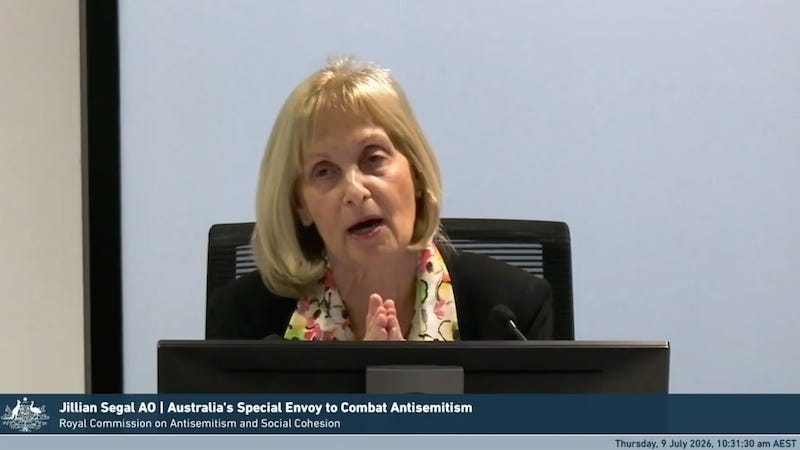
The Royal Commission into Antisemitism and Social Cohesion was established to examine exactly that – antisemitism and social cohesion – but it has become a vehicle for advancing political agendas from Zionist groups in Australia, rather than fostering the social cohesion that was promised. The latest round of material presented by Special Envoy Jillian Segal – calling for an independent body to scrutinise the ABC and SBS over their reporting of Israel and Palestine – is yet another step in the policing and censoring political debate.
Segal’s argument rests on her proposition that Australia’s public broadcasters should adopt the understanding of antisemitism based on the IHRA working definition (which they have so far not adopted, and for good reason) and, by implication, substantially change their editorial approach to the conflict. But this isn’t where her criticism stops. Complaining that coverage is “too negative” towards Israel and asking why broadcasters do not report more of “the good things Israel does” is moving journalism far beyond the goal of accuracy into an attempt to influence editorial decisions. The reason why public broadcasters exist is to make those decisions independently of governments, lobby groups and political appointees, but perhaps that’s something Segal either doesn’t understand or is not overly concerned about.
Her dismissal of the deaths of over 70,000 from Gaza raises the same question. If figures issued by Palestinian health authorities are to be rejected outright – even through Israel agrees that this number is broadly accurate – what independent evidence should replace them? Other reputable bodies such Lancet Global Health believe the figure is actually far higher – around 186,000 – and an epidemiological modeling study published by Australian researchers Dr. Richard Hil and Dr. Gideon Polya, suggests the number could be as high as 680,000.
The coverage of events in Gaza by the ABC and SBS – in fact, all mainstream media in Australia – has been weak and inept, and has generally supported Israel’s narrative and undermined that of Palestinians in Gaza and West Bank, or anyone else who offers support for this cause. Yet this is not enough for Segal and even this poor coverage has to be stamped out, where only propaganda promoting the Zionist cause is acceptable.
The broader danger is that social cohesion is being redefined according to the whims and desires of certain people and groups in Australia. A Royal Commission that was expected to reduce division increasingly appears to be generating new grievances, fuelling disputes over free speech, media independence and political influence. Rather than lowering the temperature, it risks creating the impression that criticism of a foreign government – Israel – is itself becoming subject to official scrutiny. If that continues, the Royal Commission will become less about social cohesion and more about the ability of Australia’s democratic institutions and the independence of the media to hold this type power to account. And that needs to be protected at all costs.
The price of speaking out
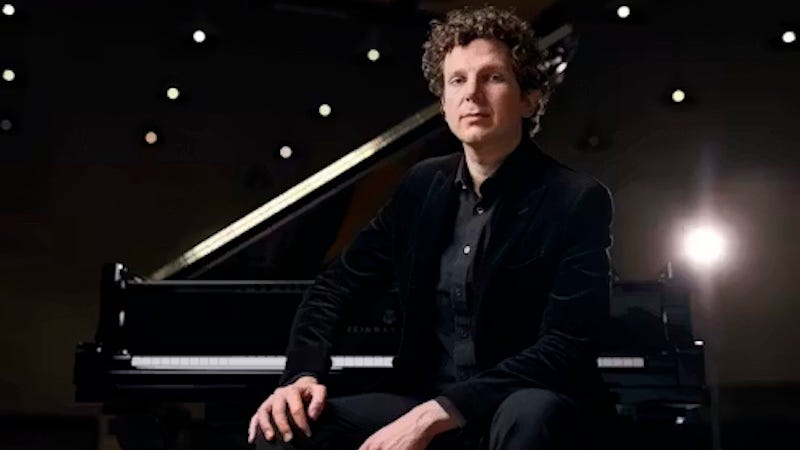
The Federal Court might have settled the legal dispute between pianist Jayson Gillham and the Melbourne Symphony Orchestra – ruling in favour of the MSO – but has done nothing to resolve the deeper issues that were revealed by the case. If anything, this judgement has reinforced the reality that Australia’s cultural institutions are increasingly being cowered and only willing to accommodate political speech when it falls within acceptable boundaries that are applied selectively.
Justice Graeme Hill accepted the MSO’s argument that Gillham’s concert was cancelled not because of his views on Gaza, but because management were concerned about the damage to the orchestra’s reputation and commercial interests. That might have been a line-ball legal argument but does little to answer the broader question of why some political statements are regarded as expressions of moral concern, while others blow up and become a major national crisis.
The court also suggested that the MSO would have responded in the same manner had Gillham spoken in support of Israel – which surely caused millions of eyerolls around Australia in unison and shouts of you have got to be kidding – and it’s also a suggestion that flies in the face of the orchestra’s own recent history.
MSO chair Edgar Myer publicly condemned Hamas following the October 2023 attacks without attracting any sanction or provoking claims that he had compromised the orchestra’s neutrality. Gillham, by contrast, briefly introduced a contemporary work by explaining that it was dedicated to Palestinian journalists killed in Gaza.
That short statement resulted in cancellation by the MSO and ultimately led to years of litigation. Whether or not the legal circumstances are different, the contrasting responses show that political speech is tolerated only when it aligns with the preferences of a cultural institution and, obviously, that needs to align with that of Israel and the Zionist movement. Does anyone really believe Gillham would have received the same sanction had he issued a short dedication about the journalists killed in Ukraine? Or if he had offered his support for the Israel Defense Forces? We all know what the answer is.
The wider consequences go far beyond the one pianist or the one orchestra. Arts organisations increasingly present themselves as champions of diversity, inclusion and fearless artistic expression, yet become cautious and cowardly when the subject matter veers over to Palestine. In this type of environment, the greatest threat to artistic freedom is not so much the formal process of censorship but the inherent understanding that some opinions carry serious professional consequences while others are welcomed as evidence of moral leadership.
When politics of protest runs out of road to drive on
Pauline Hanson has spent nearly three decades turning public frustration into political capital, even when she’s been outside of politics, but the latest polling suggests there are limits to how much the same formula can be recycled. After weeks of rising support, One Nation has lost ground following Hanson’s call for Australia to return to a more “monocultural” society – a reminder that while many Australians might be deeply dissatisfied with the political establishment, they are not interested in revisiting these ridiculous and dated culture wars.
The result also exposes a common misunderstanding in Australian politics: the anger in voter land is about economic issues, not cultural issues. Housing issues, wages, less public services and the belief that younger Australians will have a lower standard of living than their parents are structural failures within the economy. Diverting the attention towards identity, immigration and culture war battles might generate the headlines but resolves nothing.
For One Nation, this has become a trap. Every time the party appears to gain credibility by tapping into this economic discontent, it eventually returns to the rhetoric that reminds voters why they kept it at the political margins in the first place. Protest parties succeed all around the world when they expose the failures of the establishment; they then fail when they become consumed by their own ideological obsessions and show to the public that they really have nothing to offer.
The Coalition will be watching closely to this because it knows many conservative voters who previously supported them but have gone off to One Nation, still remain restless. Angus Taylor’s warning that One Nation’s policies would bring “a world of pain” suggests that he’s come to the realisation that it’s better to fight One Nation, than to simply copy their rhetoric and policies, which exist in a threadbare cabinet.
The lesson here is that Australians are still searching for alternatives, especially on the conservative side of politics. One Nation might have been a beneficiary of some of this discontent but its drop in the polls suggests that it won’t be a serious contender until it starts to develop serious policies. Eventually, even protest voters expect more than just the slogans.
When the joke becomes more serious than the politicians
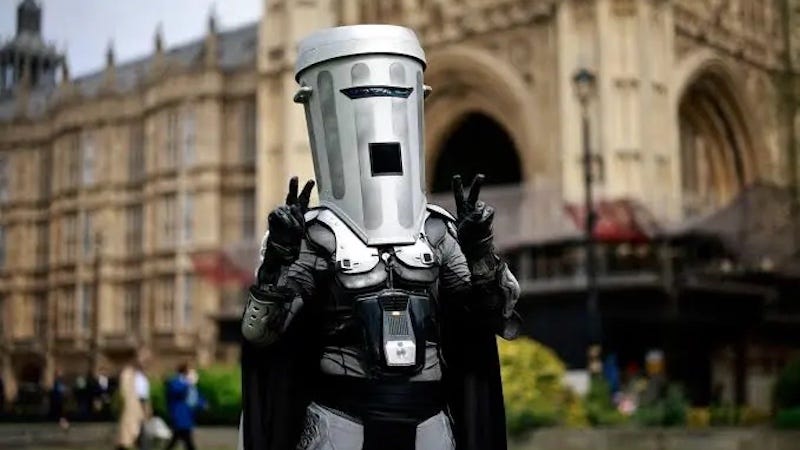
The spectacle of Count Binface in the UK emerging as Nigel Farage’s main opponent in a byelection says far more about the condition of modern politics than it does about satire. The Reform UK leader’s resignation was carefully choreographed as another act of anti-establishment theatre but, instead, it’s become the theatre of the absurd, where the campaign will be dominated by a man wearing a silver bin on his head.
Count Binface’s policies are intentionally ridiculous – nationalising the British singer Adele, capping croissant prices and promising to build “at least one affordable house”. And like all satire, it works because it reflects what many voters understand as the failures of mainstream politics. Politics has been increasingly performative, and highlighted by personalities and outrage, rather than having serious debates about declining public services, inequality, housing affordability or falling living standards.
There is a lesson here that goes far beyond Britain. Politics depends on the public having enough confidence to believe that elected representatives and governments can solve real problems, rather than ignore them or create new ones. And there is a belief that the political class is going out of their way to ignore them. When a man dressed up as a bin can dominate the political conversation, the joke isn’t on him – it’s on the system itself that has failed to live up to any of its promises.
Thank you Eddy and David.
We have rapidly seen, without public consultation, the imposition of Segal as the supreme de facto public censor.
The Mayor of Marrickville has unleashed a force he thinks he can control. Instead he has elevated someone of a specific non-secular background to potentially have unlimited power over our discourse, overturning case law from our Judiciary which has found repeatedly that criticism of Israel’s government is not antisemitism.
This type of article raises my temperature and makes me want to not cohere with anyone. Least of all Australian politicians and Zionist watchdogs.
Can we get a Count Binface here as Shooters/Fishers/Farmers, Legalise Cannabis etc don't do it for me.