


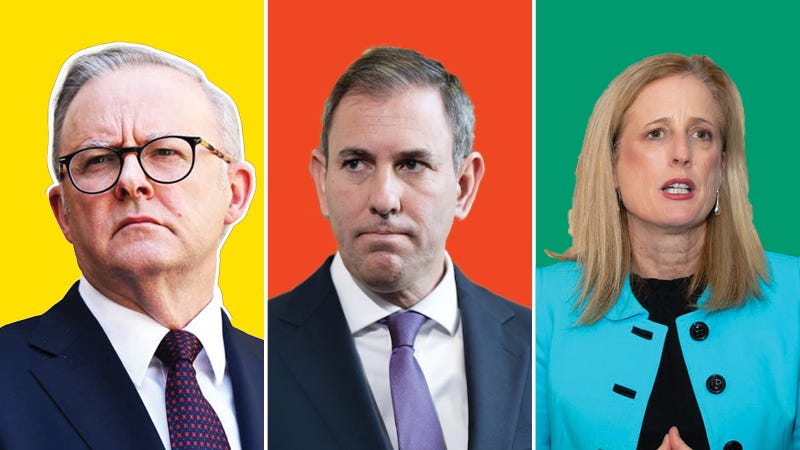
The final week of Parliament for 2025 arrived without the drama of the expected leadership challenge against Opposition leader Sussan Ley, and while the internal machinations of the Liberal Party continue to attract attention, there’s an increasingly obvious and painful truth: the Liberals are largely irrelevant in Australian politics right now. Sure, they might be interesting to watch on as political theatre, but they’re no longer relevant and not doing much to change that perception. But what mattered in this final sitting week wasn’t what the Liberal Party failed to do, but what the Labor government itself continues to delay, stymie or avoid altogether.
Gambling reform, long promised and widely supported by many people in the community, once again failed to appear in any meaningful way. On environmental policy, Labor’s ongoing friction with the Australian Greens finally produced a deal on the last day of Parliament, allowing key legislation to pass but only at the last minute, through constipated and long-winded negotiations, and under political pressure after failing to get any traction on this legislation with the aforementioned irrelevant Liberal Party.
But there are familiar patterns of caution everywhere else: Finance Minister Katy Gallagher’s call for a 5 per cent “efficiency dividend” across the public service are ringing a few alarm bells. At the same time, the CSIRO is facing the loss of around 350 jobs, on top of the almost 800 positions already lost over the past 18 months, although the government argues that their overall budget has not been cut. But, for those within the CSIRO who are losing their jobs, it’s pretty much a political debating point when its their job that going, and the organisation’s capacity to do its work is being sucked away.
It’s a very obvious contradiction: during the 2025 federal election campaign, Labor campaigned aggressively against the Coalition’s proposed slashing of the public service – a plan that would have resulted in around 41,000 job losses – presenting itself as the defender of public institutions and the public service. Yet within seven months of the election, the Liberal Party’s language of “efficiency,” “restraint” and “streamlining” has returned, although this time it’s coming from a Labor government. Whatever it’s going to be called – fiscal discipline, managerialism, reality – many voters will see this as a government implementing the practices that it previously condemned.
This, of course, looks at a deeper and increasingly common question: not just what the Labor Party stands for, but why it exists in its current form. Historically, Labor defined itself through ideology, the politics of social change and reformist ambitions. Today, it’s often defined through a comparison with whatever has been achieved by the Liberal Party – essentially managing what’s already there, but more stable, less scandal-ridden, more competent – and this is an important factor: yes, competence should trump everything else, especially after the scandals and the incompetence of the Coalition between 2013–2022. But competence alone is a weak foundation for a party whose origins lie in collective struggle and systemic reform.
There is no denying that the Albanese government is vastly preferable to its predecessor, the Morrison government: the 2025 federal election result confirms this point. The chaos, corruption and institutional corrosion of the former government are no longer daily features of national life: Cabinet discipline has replaced the dysfunction of Scott Morrison; policy development, where it occurs, is measured and deliberate. And there are achievements worth acknowledging and any serious critique of this Labor government needs to recognise this.
But comparison to the disastrously low benchmark set by Morrison is not the same as a purpose for being in government. Previous Labor administrations – flawed and far from perfect – left behind clear evidence of positive reform. The Rudd and Gillard years delivered the school halls program, direct household stimulus payments, expansions to Medicare, the creation of the NDIS and major royal commissions that reshaped national conversations in a meaningful way. These were tangible expressions of Labor values, actions that answered the question of why Labor? in practical terms.
By contrast, the defining characteristic of the current government increasingly appears to be caution and being in office for as long as possible: there’s no recklessness, no ideological zeal, but there is a level of managerialism and restraint. Of course, the lingering shadow of the Whitlam dismissal still shapes Labor’s institutional psychology even though that time ended 50 years ago, resulting in a government deeply wary of bold moves. The internal scars of Rudd and Gillard, and the memory of Keating’s reform agenda coming against electoral reality – and Labor stopped talking about Keating after his 1996 election loss as if to forget all about his achievements – reinforce the instinct to slow down and to manage rather than to transform.
And yet the risk runs in the opposite direction. A government that offends neither side ultimately inspires neither, taking in the worst of both worlds. For sure, there is that old adage that if a government is being attacked from both the left and the right, perhaps it’s doing something right and there is an element of truth in that. But from a leftist perspective in particular, this analogy wears out when the structural forces of inequality that were created primarily by the Howard government remain largely untouched.
Perhaps it’s too much to expect that to fully rework the economic system to benefit the people that the Labor Party would traditionally target, will occur within a single term – or even two – and there have been some piecemeal changes since 2022 that have worked in this direction. But it’s not the economic revolution that is so desperately needed in Australia. Tax reform remains the most obvious area: mining super-profits, long-standing concessions to vested interests, and a revenue base mismatched to modern social needs all sit there, all acknowledged by the Treasurer Jim Chalmers, but avoided and left hovering in the background.
As the Parliament rose for 2025, the overwhelming impression of this government isn’t one of chaos or crisis, but the exact opposite: inertia. Labor governs competently, but cautiously: that’s not saying anything new, the Prime Minister Anthony Albanese has trademarked his leadership with caution and made this abundantly clear. The question now is whether this caution and competence without conviction is sustainable – or whether, in trying to offend no one, Labor risks missing the chance to do something substantial when it had the numbers, the mandate and the moment to create something of substance.
Why does Labor refuse to make these political choices?
Gambling reform is one glaring example of the areas where this Labor government refuses to act upon, but if there is so much overwhelming public support for reforming gambling advertising – as there is on many other issues – why does the government avoid the issue?
The hostility toward gambling advertising appears to be visceral across all groups within the community. This advertising is constant and widely recognised as harmful – particularly to children and vulnerable people. On the surface, restricting or banning gambling advertising should be political low-hanging fruit: popular, defensible and supported by extensive evidence. Yet the government continues to drag its feet.
