


Fighting prejudice is now becoming a struggle over democracy
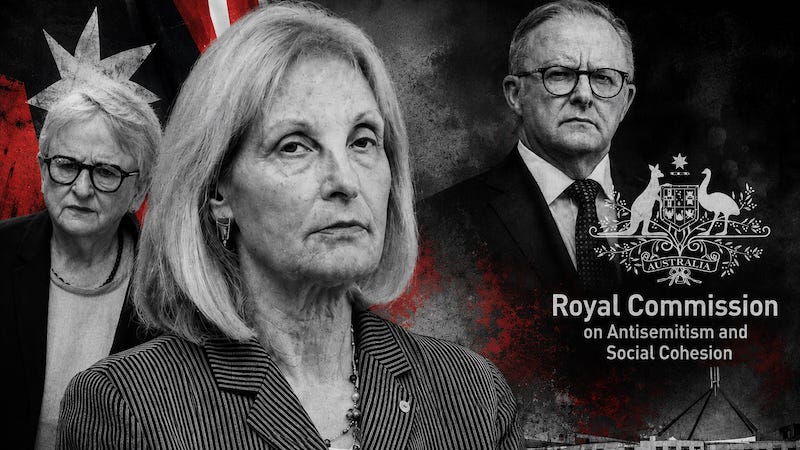
The Royal Commission on Antisemitism and Social Cohesion has become something far bigger than an inquiry into antisemitism. What began as an examination of discrimination and social cohesion is now becoming a plot to reshaping education, public institutions and the boundaries of acceptable political debate. The proposal by the Special Envoy to Combat Antisemitism, Jillian Segal, for a National Centre for Education Against Antisemitism with its curriculum commencing in preschool is highly contentious and needs to be resisted as much as possible.
As we need to always point out, antisemitism need to be confronted wherever it occurs. The real question is now about how this Commission is quickly moving from addressing genuine prejudice into dictating a broader ideological framework that reaches deep into schools, universities and public life. Once governments begin deciding not only what children should learn but how contentious international conflicts should be understood – and according to one side of the conflict – the debate is moving far beyond combating discrimination to one of regulating opinion.
That presents Prime Minister Albanese with a dilemma. Public sympathy for the Israeli government has collapsed, as the humanitarian catastrophe in Gaza and Israel’s rogue behaviour continues, with opinion polling suggesting 79 per cent of Australians now hold an unfavourable view of Israel. With this in mind, Segal’s proposals are more about restricting the scrutiny of a foreign government, as well as further restricting political protest, public criticisms of Israel and implementing a comprehensive curriculum at the behest of an extremist activist subset of 0.14 per cent of Australia’s population.
No group of people in any country should have this level of control, or be in a position where they can dictate the educational requirements for the rest of society.
The danger is that, in trying to protect one community – and it’s doubtful whether Segal’s proposals will lead to greater protections for the Jewish community anyway – governments create precedents that weaken democratic freedoms for everyone else.
The game the president never stops playing
Donald Trump’s latest claim that he’s called off planned military strikes against Iran because nuclear negotiations are progressing, and because the Strait of Hormuz has reopened, sounds simple enough. But the problem is that this is all following a very familiar pattern: create a crisis, threaten a catastrophe, declare victory when the catastrophe is temporarily avoided, and then move on before anyone asks what actually happened. And then rinse and repeat. It has become the defining modus operandi of Trump’s foreign policy – escalation followed by de-escalation, crisis followed by not a crisis, mayhem again, and a lack of a coherent long-term strategy beyond dominating the news cycle.
Since the confrontation with Iran commenced in February, Trump has treated the Middle East/West Asia like a geopolitical reality television show, where unpredictability is mistaken for strength, and confusion is presented as some kind of strategic genius. The markets react, allies all around the world panic, military planners prepare for war, and then, on cue, the White House announces another diplomatic breakthrough. Yet these breakthroughs have an extraordinary habit of becoming another round of threats within weeks, and sometimes within days, or hours.
Ironically, one consequence of Trump’s brinkmanship is that the rest of the world has begun adapting around it. Energy markets have diversified, alternative shipping arrangements have been explored, and governments have become less inclined to believe Trump’s threat. And that might end up being Trump’s greatest foreign policy achievement – normalising the idea that American ultimatums are now a part of a political pantomime act.
The danger is that one day, the pantomime will become real. Trump’s credibility is already shot, but international stability can’t be built upon this kind of insane improvisation. Eventually, allies will stop believing the warnings, and the adversaries will stop fearing the threats – and perhaps they already have.
Corruption could swallow up another Liberal leader
The NSW ICAC’s Operation Rosny hearings are once again exposing an uncomfortable truth about Australian politics: scandals involving money, influence and internal party power are becoming so common, it’s as though the entire political system is based on scandal and corruption.
The allegations surrounding the NSW Liberal Party’s religious-based conservative Reformers faction, together with questions about fundraising and developer influence, are significant, not just because of who might have broken the rules, but because they show that modern politics increasingly operates through donors, factional operators and private influence that goes far beyond the reach of public scrutiny.
The Leader of Opposition, Angus Taylor, has not been accused of wrongdoing so far, but politically, the inquiry is placing more attention on the culture surrounding the faction he has been associated with, and will inevitably raises broader questions about judgement, transparency and the company political leaders keep.
Whether or not Taylor has any role in this directly is not the main issue here – the bigger issue is that Australian politics now has a funding model that depends on wealthy donors, factional warlords and access granted to the vested interests with deep pockets. Politicians regularly declare that they support integrity – and who wouldn’t – while also defending a political culture in which fundraising dinners, private lobbying and well-connected go-betweens have become appendages to government.
The hearings within Operation Rosny will be running for another seven weeks but it’s more than just about whether certain individuals have acted improperly – it’s about the issue of the normalised activities within politics that would be considered to be corrupt in any other profession.
Until political finance is completely reformed, every new corruption inquiry will follow the same script: expressions of outrage, huge promises of making reform, weasel-word denials – and then another investigation a few years later to prove that nothing has actually changed.
A new Premier, but the same rulebook?
Ben Carroll’s elevation to the position of the Premier of Victoria has been presented as a fresh start, but Australian politics has this great ability of confusing a change of leadership with genuine political renewal. Change the Premier, reveal a new slogan, reshuffle the frontbench, make the grand promise to “listen”, and everything will be alright. Except it won’t. The years of political fatigue, declining trust and assorted failures won’t simply fade away just like that.
Carroll has emphasised integrity, competent economic management and restoring public confidence. Of course, these are sensible objectives, but they’re also the motherhood statements that we’ve heard so many times before. Every incoming leader promises honesty, competence and accountability – how could they not – but voters are unlikely to be persuaded unless those promises translate into visible changes on housing affordability, overstretched public services, transport, cost-of-living pressures and the growing perception that governments spend more time managing the headlines than solving problems. And with a state election due in November – just four months way – it’s hard to see many inroads being made into any of these issues.
The broader political lesson goes far beyond the borders of Victoria. Modern political parties are increasingly like marketing organisations, convincing themselves that poor opinion polls are a sign of a branding problem, rather than a problem with the government.
Federal Labor will be watching to see how political events unfold here, because Victoria has long been one of its strongest electoral bases. It’s never a clear correlation between state and federal politics but a decisive rejection of the state government will inevitably fire up the questions about whether the broader Labor brand is beginning to wear thin. The real test for Carroll isn’t so much about not whether he can project an air of competence, but whether he is prepared to change the political lethargy that produced the government’s problems in the first place. A new Premier can always buy some time, but only new and workable ideas can rebuild trust.
Thanks Eddy and David.
As mentioned before, without legislation or any consultation, Albanese has elevated Segal to become the public censor. Segal is clearly non-secular and is looking to exercise power over our civil society and what remains of our civil liberties.
Albanese has with his usual ham fisted approach pushed onto the public realm a divisive figure and then shouts about social cohesion (whatever that means to his middle management style) when that divisiveness has been criticised in good faith.
With respect to the Reformers, I long for the days when Liberals were Protestant and the ALP were Catholics.