


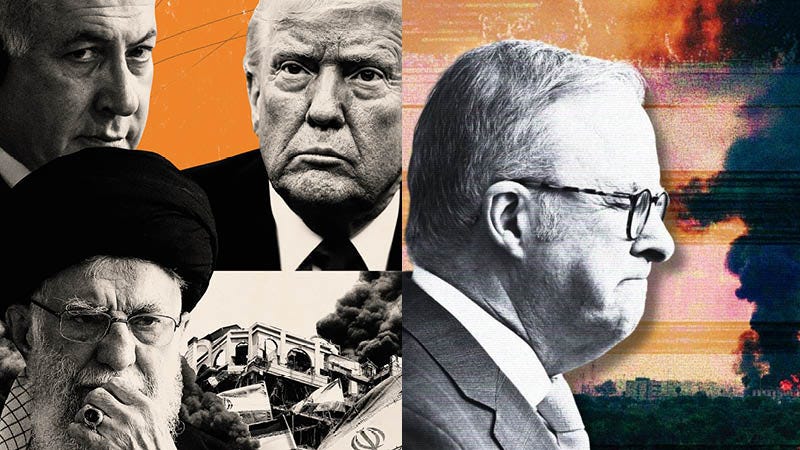
One month after the United States and Israel attacked Iran, the conflict has expanded far beyond its undefined objectives and into well into the unknown, reshaping the landscape of the Western Asia/Middle East region – perhaps forever – and dismantling the long-standing assumptions about deterrence, control and the regional order. What was being pushed in Washington as a supposedly short-term and limited operation designed to create stability has instead triggered a sustained retaliation by Iran – with Yemen now joining the conflict – and putting the global oil and energy markets under extreme strain.
Iran’s response has been direct and deliberate, and should have been entirely predictable. Thousands of missiles and drones have been launched over the past month, targeting Israeli and U.S.-linked military bases in the region, as well as other critical infrastructure across the Gulf. While missile defence systems have intercepted many of these attacks, a significant number have actually gone through, inflicting material damage and suggesting that there’s a new reality within this region: Iran retains both the capacity and the willingness to escalate this conflict far beyond what Israel and the United States expected and the scale of their response has challenged the assumption – which seemed to be widely held within the U.S. military – that Iran would act with restraint to avoid a broader war, mainly because they didn’t have the capacity to retaliate.
As we’ve seen, the major issue to arise from this conflict has been Iran’s effective disruption of the Strait of Hormuz, which has created chaos through global energy markets. And it’s also difficult to accept that the United States could not have seen that this would be the logical action for Iran to take on, unless it’s part of a longer-term agenda that not even the United States seems to be aware of.
Around one-fifth of the world’s oil supply goes through the Strait of Hormuz, and this level of disruption has driven up insurance costs, clogged up the shipping lanes, and created volatility with global energy pricing. While the strait has not been formally “closed” in a legal sense – strictly speaking, it’s not in international waters, as the 12 nautical mile zone for both Oman and Iran intersect each other at the 21-mile width of the strait – the practical effect has been the same: an increased risk and a clear demonstration of the type of leverage Iran does have over the global economy.
Across the Gulf states, the conflict has led to many flight cancellations, displacing thousands of passengers and complicating the movement of labour forces that support the economies in the region. Missile strikes have also targeted areas hosting foreign personnel and military infrastructure, especially those facilities that are linked to U.S. operations.
Despite this, the Gulf states haven’t responded with direct military retaliation against Iran and their responses have instead called for diplomatic solutions. Publicly, these governments have condemned Iran’s actions as violations of international law and threats to regional stability but privately, they’re furious with the United States for undertaking this war, and undertaking it without any warning, and leaving their states vulnerable.
For decades, the presence of American military bases across the Gulf has been framed as a guarantee of security in a volatile area but, essentially, they’re primarily about the U.S. keeping that strong control in the region, even if it is mainly using Israel as its proxy. Also under consideration is the situation that these Gulf states are now bearing the costs of decisions made by the United States – and not having any guarantee of security – and if that’s the case, what is the purpose on these long-standing alliances?
Four weeks into the conflict, the severity of attacks has diminished, but the frequency hasn’t. Iran has almost played out a textbook asymmetric war game here, and the United States has been caught with its pants down, figuratively speaking, although with Trump, you’re never quite sure, and it could literary be the case.
But what has emerged during this first month is the short and sharp conflict the United States promised has failed to materialise and, instead, a widening crisis has exposed the limits of U.S. military planning and an underestimation of the motivations of the government of Iran. The United States and Israel initiated this confrontation, but it’s no longer theirs to control, and this is where the dangers lay for them.
The cost of following Washington into the abyss
Locally, Prime Minister Anthony Albanese has been exposed politically on this issue, not because of the war itself, but because of the way he responded when the United States and Israel first attacked Iran. By aligning himself too closely, and too quickly, with Trump in the early stages of these attacks, Albanese gave up the opportunity to create an independent political narrative at home, an approach that would have insulated him and the Labor government from domestic criticism and the subsequent and costly policy responses on fuel excise.
The initial decision to back U.S. strikes and commit Australian military personnel and resources to the region, of course, is a familiar bipartisan pattern in Australian foreign policy: the quick action to support the United States in these circumstances, without having the foresight to think about how it might affect domestic politics. And in this case, Albanese has made a serious misjudgement.
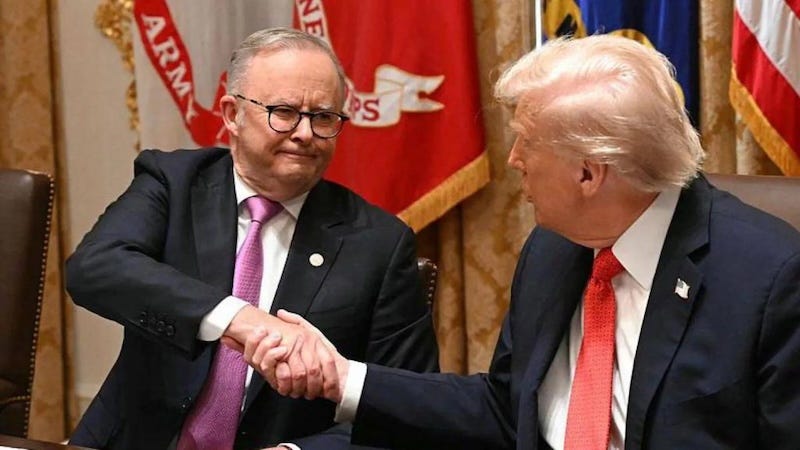
Rather than drawing a clear distinction between Australia’s national interest and the actions of the United States, Albanese tied himself to a radically changing and often strange U.S. strategy. His recent calls for “greater certainty” around American objectives further highlighted the foolishness of his quick jump to side of Trump and raised the obvious question: why did Albanese not demand this greater certainty before Australia offered its support?
This is in contrast with someone like Canadian Prime Minister Mark Carney – who has demonstrated a willingness to publicly push back against unpredictability of Trump, even going on to win an election based around this – just highlights the political advantage Albanese chose not to take. In a climate where voters often reward strength and assertiveness, the Prime Minister appears reactive and weak, asking the pertinent questions way after the consequences had begun to appear.
Those consequences are now not just rhetorical. The government’s decision to halve the fuel excise for three months – at an estimated cost of around $2.6 billion in foregone revenue – represents a first direct response to rising fuel prices linked to the U.S. attacks on Iran. While such a measure might provide short-term relief to households, it also exposes the Budget to additional strain at a time when structural pressures on spending and revenue are already quite significant. Aside from this, Albanese seems to excel at implementing plans that benefit the public, without getting a political win: consumers will save 26 cents per litre, but no one will thank him for it, and the government will lose $2.6 billion in forgone revenue.
By failing to establish a clear and independent position early, when he should have attacked Trump and apportioned all blame onto him – as Carney did in Canada – Albanese has reduced the political space for him to move around in. The fuel excise cut, while politically expedient, can be seen as the cost of his earlier hesitation – a reactive policy designed to manage domestic fallout rather than a proactive strategy grounded in defined national objectives and principle.
In the end, the issue is not simply whether Australia should support its allies, but how and when that support is given. Leadership in such moments requires more than saying “yes” to everything the United States wants; it requires clear thinking, clever timing, and an ability to anticipate the domestic consequences of international decisions.
On all three fronts, Albanese’s approach has left his government carrying both the political burden and a multi-billion-dollar hit to the Budget. It would have better for him to listen to what the former Labor leader Simon Crean said to U.S. President George W. Bush in 2003, that “on occasions, friends disagree… but, such is the strength of our shared values, interests and principles, those differences can enrich rather than diminish, strengthen rather than weaken, our partnership… friends must be honest with each other.” And it would appear that aren’t many votes lost in attacking Trump, as Mark Carney has already discovered, but, it appears, Albanese has not.
Toward an uncertain future: The limits of American power
How this conflict ends is still an open question, but the shape of a resolution is beginning to form – and it won’t be through a decisive military victory, but through a gradual reworking of the regional alignments and careful mediation. It’s obvious that the belligerents in this case, the United States and Israel, won’t be capable of offering mediation as a solution.
The war has also exposed not only the vulnerabilities of American bases in the region, but also the political limits of these regional alliances, which now appear to be fraying at the edges, and certainly not helped by Trump suggesting that Saudi Crown Prince Mohammed bin Salman “didn’t think he’d be kissing my ass”.
One critical consideration for the Gulf states is whether this alignment with the United States – which also means an alignment with Israel – enhances their security or increases their risk, and it’s been clearly shown that the promises of American protection have not come to fruition.
This has prompted a quiet but significant shift in thinking within these Gulf states, where rather than acting as passive hosts under coercion from the United States – which is causing internal anger within the region – there is a growing argument and confidence that they should pursuing more political independence, which includes removing these foreign-controlled bases, while opening up diplomatic communication with Tehran.
The government of Iran has consistently stated during this conflict that its main adversaries are the regimes of United States and Israel, not the Gulf states themselves. By taking these statements at face value, Gulf countries can create a certain level of insulation from the conflict, repositioning themselves not as lackies of the United States but as regional players acting on their own behalf. Whether that would be allowed to happen is another matter, but direct dialogue with Iran, even if it is limited, could be the tool that prevents further escalation on their own territories.
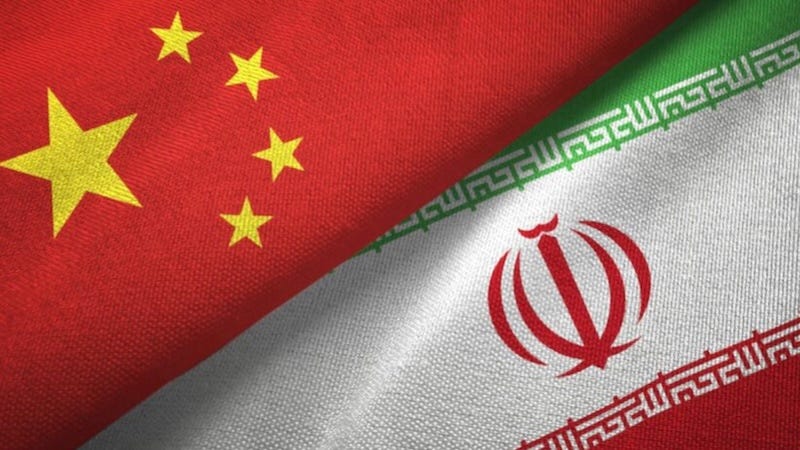
This is where another external player could have a role in this war: China. Unlike the United States, China has maintained economic relationships across the region without the same level of direct military involvement as the United States. Its dependence on Gulf energy supplies means that it has a large interest in a de-escalation, while its diplomatic history of restraint and longer-term speculations allows it to act without the short-term political pressures faced by Western governments.
Ever since these attacks on Iran commenced, China has been relatively quiet, but as these disruptions affect global markets and China’s own economic interests, the incentive to take on a more active role – diplomatically – will increase. China is also one of the few external powers capable of engaging all sides in a conflict with a degree of credibility, as was shown in 2024 when it brokered the Beijing Declaration, a unity deal with Fatah, Hamas and other Palestinian factions, an act that no other government had been able to achieve.
China is the ultimate pragmatist on the world stage, and its role wouldn’t be driven by altruism alone, but through a range of interests including securing energy supply chains, stabilising markets, and reinforcing its status as a global diplomatic actor. Not that the United States will simply roll over and allow China to intervene in an area where it’s had a strong sphere of influence and control over – and hasn’t that been a disaster over the past 80 years or so – but it’s clear that the geopolitical structure of the region needs to change.
Even so, mediation might not produce an immediate or clean resolution, as this war has already gone down a path that can’t be easily reversed. The involvement of an external mediator such as China – if it comes to that – might establish the frameworks for communication and restraint, but it won’t eliminate the underlying tensions that gave rise to the conflict, and not while the malevolent influence of the United States remains in the region.
The United States still remains the central actor here but the unexpected retaliations by Iran have shown that it’s in a weakened position and has never had a long-term interest in securing a lasting peace anyway: that’s not the American way. What began as a show of short-term force by the United States and Israel has now evolved into a test of long-term endurance, strong diplomacy, and adaptability, and history has shown that these are not the types of conflicts where America prevails.
When they start reeling out the obvious obfuscation in Parliament on a regular basis, and not standing up for at least some principle – even just the one would be good – it’s time for them to go. Albanese in Parliament for 30 years, Wong for 24, Marles for 19.
Well said , on Albanese’s catalogue of errors of judgement since becoming Prime Minister . In contrast to John Howard,
“The Times do Not suit him “ . He does not do well at the Sharp End . We are ill served by his failures of leadership .