


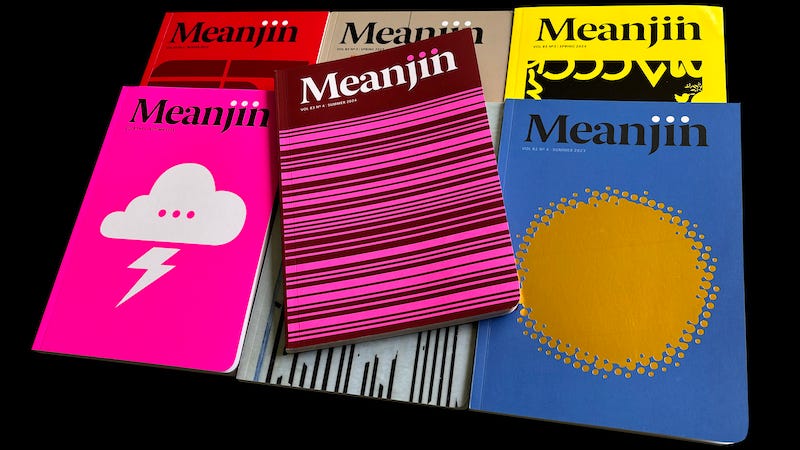
For decades, Australian intellectual and cultural life could be charted through four key journals: Southerly, which was largely apolitical and open only to Australian and New Zealand authors; Quadrant, a conservative journal of political and cultural ideas whose editors included Peter Coleman, Robert Manne, and P.P. McGuinness; Arena, which introduced new writers, particularly those of the New Left and its successors; and Meanjin. Many other literary journals were significant, but these four stood out. In September 2025, Melbourne University Press announced the closure of Meanjin.
Meanjin, Australia’s venerable literary quarterly, has been a cornerstone of cultural discourse for more than eight decades. Founded in December 1940 in Brisbane – named Meanjin after the Indigenous word for “the city” – by Clem Christesen, the journal emerged amid the upheaval of World War II. Christesen, a Queenslander with a passion for promoting local voices, envisioned a platform for emerging writers, drawing inspiration from international modernist journals.
The title, inspired by Lawrence Durrell’s idea of “place as a determinant”, symbolised an Australian identity both rooted and expansive. Beginning as Meanjin Papers, it quickly became a national force, publishing early works by Judith Wright, Xavier Herbert and Vance Palmer, while tackling then-taboo topics such as migration, Indigenous rights and postwar reconstruction.
By 1945, amid Brisbane’s wartime bustle, Christesen relocated Meanjin to Melbourne, where it found a more sympathetic home at the University of Melbourne. This move marked its institutionalisation: in 1947 it shed “Papers” from its title to become simply Meanjin, and in 2007 it integrated fully with Melbourne University Publishing as an editorially independent imprint.
Over the decades, editors such as Jim Davidson (1970s–80s), who infused it with progressive politics, and Sally Heath (from 2011), who modernised its design, steered its evolution. Meanjin chronicled Australia’s literary maturation, from the Jindyworobak movement’s Indigenous focus in the 1940s, to the multicultural vibrancy of the 1980s, showcasing writers such as Helen Garner, Peter Carey and Michelle de Kretser. Its pages examined not only fiction and poetry but also television’s social impact and the realities of urban sprawl, sparking debates that shaped national identity.
Meanjin’s power lay in its role as a “cultural barometer”, bridging academia and the public sphere. Unlike commercial outlets, it valued depth over marketability, amplifying underrepresented voices – women, migrants, and First Nations writers – long before inclusivity became mainstream. In an era of digital fragmentation, it embodied slow, thoughtful engagement, each issue a curated artifact of intellectual rigour. Its survival through funding squeezes and editorial controversies testified to its resilience, outlasting peers like Southerly in influence, if not in longevity. Yet this independence left it vulnerable; subsidised by MUP, it operated on the margins of profitability, embodying the tension between cultural value and financial sustainability in Australia’s underfunded arts sector.
On September 4, 2025, MUP announced Meanjin’s closure after 85 years, effective from December 2025. The decision, attributed to supposed financial unviability amid MUP’s broader restructuring, has provoked outrage. Writers and critics condemned it as “utter cultural vandalism”, arguing that axing a non-profit institution for short-term savings ignores its intangible contribution to national heritage.
Editor Esther Anatolitis lamented the loss of a space for “dissent and discovery,” while Richard Flanagan described it as symptomatic of universities prioritising commerce over custodianship. The Media, Entertainment and Arts Alliance rejected MUP’s justification, stressing how such cuts weaken Australia’s cultural influence abroad. There were even suggestions – reported by Crikey, though not fully confirmed – that pro-Zionist forces pressured Meanjin in response to a series of essays sympathetic to the Palestinian cause. Against a backdrop of declining public funding and post-pandemic austerity, the shutdown reflects a deeper malaise: the commodification of culture, where literary journals are deemed expendable.
The demise of Meanjin is more than the end of a publication; it is a blow to Australia’s intellectual and cultural fabric. As one of the world’s oldest continuously running literary journals, its absence leaves a void that digital ephemera cannot fill. In an era when vacuous commentary is rewarded, when “balanced debate” often elevates radical but intellectually shallow ideas, and when Australian culture is increasingly threatened by foreign far-right influence, Meanjin remained a vital organ of intellectual life.
Reviving it – through crowdfunding or patronage – seems unlikely, with MUP declaring it not for sale, which seems peculiar, given its claim that it was not financially viable to publish Meanjin, yet has not explored options for others to continue with its legacy.
Its preservation or revival would reaffirm a national commitment to the arts. Without it, we risk erasing the voices that defined us and silencing those that might redefine us. Its closure is as un-Australian as rioting on a beach to drive out those you dislike. We must not accept this.

Thank you David Lewis for this message in defence of an Australian institution.
You are a better writer than a speaker.
The great news is that the University of Queensland has decided to bring Meanjin back home and will continue its publication. We still have to be vigilant against those who value nothing.