


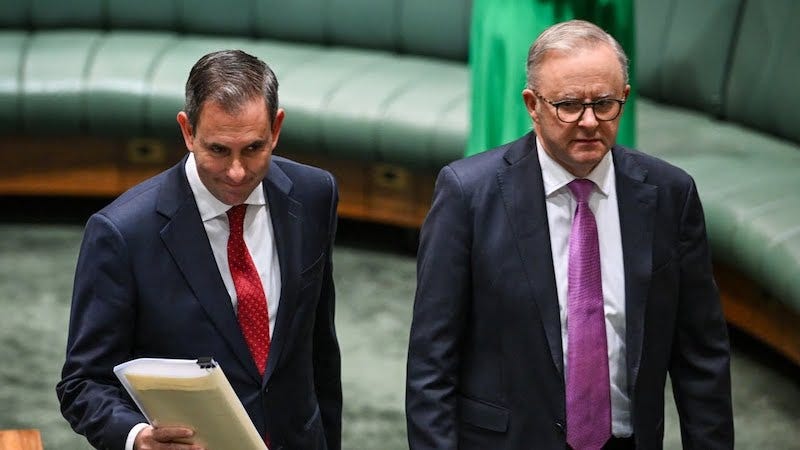
The Labor government’s decision to water down its own superannuation reforms is yet another retreat from meaningful reform of the taxation system. The original plan – taxing superannuation earnings above $3 million at 30 per cent instead of 15 per cent – was hardly radical, and it would have affected less than 90,000 of the wealthiest people in the country, but at least it was a small step towards a fairer tax system that has long favoured high-income earners. Despite this, the changes have been watered down and long-term reform has been put onto the backburner.
Treasurer Jim Chalmers has defended the amendments, claiming that the amended plan will still meets the same objectives and ensures a fairer system “from top to bottom”. The numbers tell a different story though: the government has chosen to index the $3 million threshold and introduce a 40 per cent tax rate on balances above $10 million, the plan has been delayed by a year and will now raise only $2 billion instead of the originally forecast $2.7 billion. Once again, the most well-heeled Australians – those who need support from the government the least – have successfully lobbied for a change will result in them paying less tax.
The original plan itself wasn’t that radical and was just a small step that would barely address the structural inequities that exist in superannuation. Yet even this small plan proved to be too much for a government that seems terrified of its own shadow. The message is clear: when powerful people make enough noise, Labor will back down, always. And if a government with the largest parliamentary majority in modern history can’t make such a minor amendment, what chance is there for implementing the sweeping reforms Australia so desperately needs?
The broader concern is what this says about the Albanese government: we’ve known about this government’s infamous caution for some time but after almost four years in office, it remains cautious to the point of paralysis – a government that prefers a muddied and undefined consensus rather than follow its convictions. While Chalmers insists the changes were made after “considered and methodical” consultation, the optics suggest something completely different: a Treasurer overruled by his ever-so-cautious Prime Minister, a Cabinet spooked by getting negative headlines, and a reform agenda that’s been thrown away even before it begins.
What makes the government’s backdown even more unacceptable is the contrast with previous Labor governments: Whitlam’s sweeping social reforms and Hawke and Keating’s economic restructuring were often accused of being too bold but this government is guilty of the opposite. It has the numbers, the political capital, and the public goodwill, but lacks the will to use it. When even the most modest policy changes are discarded after pressure from the usual suspects, the idea of tackling the far bigger challenges – housing affordability, tax reform, climate transition – becomes increasingly remote.
Labor claims to be the party of reform, and that’s certainly what’s contained within the Labor National Platform. But reform requires courage – the willingness to take risks, to confront the vested interests that have traditionally opposed the labour movement, and to stand firm when the predictable backlash arrives. By backing down on this minor superannuation measure, the government has let everyone know where it stands: the appetite for reform ends as soon as the conversation becomes uncomfortable for these vested interests.
How Labor governs: Let the powerful set the agenda
The opposition to Labor’s proposed superannuation changes came from the same players that always come equipped with their megaphones – wealthy individuals, industry lobbyists and business groups with something to lose, irrespective of how small that loss might be. Their responses were predictable: yet another fear campaign based on a litany of stories about “cash-poor farmers” and retirees supposedly being forced to sell their homes to pay the tax. But in reality, the change would have affected fewer than half a percent of Australians and, even still, the increase represented only a modest and affordable change to their tax obligations.
Instead of holding its ground and explaining that these changes are about fairness and equity – which most people would accept – the Albanese government backed away at the first sign of pressure. There’s also the question of what exactly these “struggling farmers” are doing with multimillion-dollar farms held within their superannuation accounts. That, in itself, suggests using the system in a way that it wasn’t designed for – superannuation being used as a tax shelter, not as a mechanism to ensure a dignified retirement.
It’s now a very familiar pattern, and suggests that Labor is still spooked by the mining and carbon tax campaigns that were run against it by the mining industry in 2010, which helped end the prime ministership of Kevin Rudd and, ultimately, caused it to lose office in 2013. When pressure comes from powerful business interests – the banking sector, the property lobby or the mining industry – Labor’s default position is to cave in – and the wealthiest 1 per cent of Australians, and the industries that serve them, have now learned that even a modest protest is enough to send this government scrambling for cover.
Meanwhile, the media has played its usual supporting role. Instead of challenging the absurdities of the scare campaign – the notion that multimillionaires were somehow the victims of government overreach and the Treasurer was “after your super” – most outlets either echoed the fear or stood back in silence. The result is a public debate where misinformation thrives, and governments feel justified in backing down.
Week after week, the same cycle repeats: powerful interests protest, the media amplifies their grievances, and Labor loses its nerve. A party that once prided itself on standing up for ordinary Australians now seems more comfortable managing the stakeholders of society, through cautious, fear and constantly looking over its shoulder for the next issue that needs to be avoided at all cost.
Political capital and wasted opportunity
Former Prime Minister Paul Keating’s frequent message to Anthony Albanese has always been simple but effective: use your political capital while you have it. History’s great reformers understand that power is ephemeral, and that the purpose of political capital is not to bank it up, but to spend it on the long-term wellbeing of the nation. Yet the current Labor government doesn’t seem to understand this: instead of leveraging its massive majority to drive meaningful reform, Albanese keeps his political capital for the rainy day that’s never going to arrive, certainly not for the foreseeable future, given the current political landscape.
