


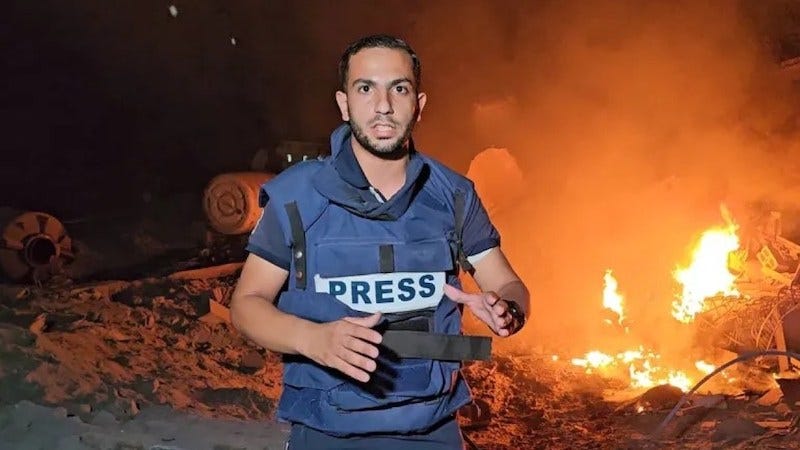
The conflict in Gaza has continued to bring of death and destruction to the people of Palestine, with more than 60,000 people killed and 145,000 injured, including a disproportionate number of women and children. It’s very clear now – if there was ever any doubt – that this is an act of genocide – and there’s a heavy weight of evidence, coming in from UN experts, human rights groups all around the world, including from within Israel. The deaths, the ethnic cleansing, lack of medical care, a lack of food, forced and continuous displacement, the destruction of homes, businesses, schools and hospitals – these are the internationally agreed conditions of genocide, whether Israel accepts this or not.
And in the midst of this genocide, the very voices that are documenting the suffering – journalists – are being deliberately murdered and silenced by the state of Israel. Gaza has become the deadliest place for media workers, where fatalities among journalists and media personnel ranges from at least 178 confirmed by Committee to Protect Journalists to well over 237, according to the local Gaza Media Office.
The most recent murders were of Al Jazeera’s Anas al‑Sharif and four of his colleagues –Mohammed Qreiqeh, Ibrahim Zaher, Mohammed Noufal and Moamen Aliwa – in a co-ordinated strike on their press tent outside al‑Shifa Hospital in Gaza City, where the Israeli Defense Forces allege Al‑Sharif was a “Hamas cell leader”, despite the lack of any evidence at all to support their claim.
And this is the modus operandi of the state of Israel – besmirch the reputation of a journalist through a total fabrication, and then use that fabrication to justify the killing – Hossam Shabat was killed in the same manner in March, with a wave of unverified accusations followed up with an Israeli airstrike. Reporters Without Borders, the CPJ, and other press freedom advocates have denounced these acts as “intentional” and “unprecedented”, warning that the systematic murder of journalists in Gaza is an assault on global press freedoms and humanity. However, there is usually a comradery amongst international journalists when one of their own is killed in a conflict zone, but nearly every journalist in the mainstream media in Australia has been quiet over the past two years, even though there have been at least 178 occasions when they could have raised their voices. So why the silence?
Silencing the newsroom: Gaza’s journalists are being killed twice
Israel’s consistent practice of branding journalists as militants, without presenting any evidence that could be independently verified, is a debasement of international law, the key tenets of press freedom and the free flow of information. Journalists are protected civilians under the Geneva Conventions, yet in Gaza they’ve become routine target practice for the IDF. This continuous blurring of that distinction between combatant and correspondent – even though most of the people that Israel has killed in Gaza have been civilians – not only endangers journalists but undermines the key element of independent reporting in a conflict zone.
The killing of these five journalists came after weeks of public vilification by Israel, making claim after claim about a supposed relationship with Hamas – again, no evidence was provided – to build up a narrative that would justify these killings in retrospect. It’s clearly a tactic used by Israel to kill journalists and, just before their deaths, Al Jazeera Media, the United Nations, and the CPJ each issued separate statements calling for the protection of these journalists. These appeals, however, did nothing to stop these killings by Israel.
The death toll in Gaza exceeds the number of journalists killed in any other conflict over the past century – 150 journalists were killed during the Iraq War, over an eight-year period, and 81 during the first four years of the war in Syria, and now, 237 journalists in Palestine in less than two years. Despite this, the reaction from Australia’s mainstream journalists has been close to invisible. The Media, Entertainment and Arts Alliance – the union representing journalists – has issued sporadic statements, condemning the Australian government’s support for Israel’s “genocide assault on Gaza”, a handful of media releases calling for the safety of journalists, and the creation of a solidarity fund in 2024. But that’s it.
From within the ABC – the unpublic public broadcaster – there has been some level of concern, with News Director Justin Stevens publicly urging Israel to allow international journalists – especially the Palestinian freelancers the ABC relies upon – to move freely in and out of Gaza. The ABC’s Middle East correspondent, Matthew Doran, recently described the physical toll on these freelancers, including one who lost 34 kilograms and was too weak to hold a camera or even speak. Yet even within these acknowledgements, there was the obvious omission: no explicit reference to the killings of journalists, and no attribution to Israel for being responsible for this. Whether this silence stems from editorial disinterest, fear of political backlash, or direct pressure from media executives, the result is pretty much the same – the most dangerous campaign against journalists in living memory – possibly ever – and Australia’s mainstream media journalists, for most part, just want to pretend that it’s just not happening.
The last word will belong to Palestine
The history of modern war reporting shows a slow but steady tightening of state control over the media. For many journalists, the Vietnam War was the high-water mark for reporting from a conflict zone – reporters moved freely between sides, spoke directly with civilians and soldiers alike, and were rarely targeted – although, clearly, journalists did die while reporting on the conflict.
Of course, this openness proved to be catastrophe for the public image of the United States, as the uncensored coverage eroded domestic support for the war in the US and, ultimately, helped to end the presidency of Lyndon Johnson, who decided not to run again for office in the 1968 US election campaign. In the decades since, governments have learned from those experiences of the Vietnam War that information and soft power can be more destructive than the actual firepower. Since that time, media access to conflict zones has been increasingly restricted, from the Pentagon’s “embedding” program during the 1991 Gulf War to more recent policies warning that the safety of journalists could not “be guaranteed”, effectively excluding them from these zones.
Israel has taken these measures to an extreme. Since October 2023, all foreign journalists have been banned from entering Gaza, leaving coverage to the internal Palestinian reporters already on the inside – journalists who then became direct targets for the Israeli military. At the same time, Israel maintains some of the most restrictive media control laws in the world; its High Court upheld the government’s right to limit press activity in Gaza on the grounds of “operational security” and broader “strategic goals” – provisions so broad they allow for the removal of any outlet that Israel chooses, and for any reason, whether it be a factual or fabricated reason. These legal frameworks reinforce near-total control of the narrative: preventing coverage of their war crimes, enforcing pre-approved footage, and silencing dissenting voices.
The killing of journalists in Gaza is more than a tragic by-product of war – it’s a direct attack on the important principle of bearing witness. The leaders of the wars in Bosnia in the early 1990s – Slobodan Milošević, Ratko Mladić and Radovan Karadžić – were found guilty of crimes against humanity largely because of the massive weight of evidence that was documented by the actions of many brave independent journalists who upheld those key principles of journalism: speak truth to power and make people in positions of this power accountable for their actions.
It’s unacceptable conduct for any state, let alone one that presents itself as the “sole” democracy in the Middle East (even though it’s not) with a supposedly free press. If Israel considers its actions in Gaza to be defensible, why not allow unrestricted media access and then we can see for ourselves? If its accusations linking reporters such as al-Sharif to Hamas leadership are true, why not present credible evidence? For a state celebrated for its intelligence capabilities and surveillance reach, especially the draconian control over the Palestinian people in Gaza and West Bank, the absence of any proof at all is quite telling.
These repeated claims, unsupported by verifiable evidence, function as propaganda designed to justify otherwise indefensible actions. But despite the suppression, the intimidation and the killings, Israel’s control over the narrative is fraying and falling apart quite quickly, with Israeli Prime Minister Benjamin Netanyahu now facing a global shift in political will.
The Prime Minister, Anthony Albanese, recently announced that Australia will recognise the state of Palestine at the United Nations meeting of the General Assembly in September and said that it’s a step towards a long-overdue recognition that is needed to end the violence in Gaza and the West Bank.
Predictably, Netanyahu has condemned such moves from Australia and European nations as “shameful”, insisting they won’t alter Israel’s stance in Gaza. But that’s what he always says, and we’ve come to expect this from a leader who shouldn’t be speaking as the Prime Minister of Israel but speaking at the dock at the International Criminal Court in The Hague, and taking up his place in the hall of infamy, alongside all the other war criminals who have been indicted by the Court.
Palestine has been disappointed by the international community many times before, ever since the disaster of the Balfour Declaration was released in 1917, the document that gave rise to the misguided colonialist Zionist project of Israel and set itself on a path of continuous genocide. There’s no guarantee that this disappointment won’t continue.
But the point is that the symbolism of Albanese’s announcement can’t be ignored: the weight of numbers is there, and Australia will join the other 147 countries around the world that have decided to be on the right side of history, even if it has taken some of these countries some time to work this out. It also indicates that despite Israel continuing to silence and kill many Palestinian journalists who have been reporting from Gaza, the truth will find a way to come to the surface, as it always does. Their efforts haven’t been in vain.
Great article Eddie, I agree with you. It’s “interesting” (appalling) that the Australian government has taken so long to recognise the brutality of the Israeli government towards the Palestinian people.
My question to all Australian governments is why are they still arresting protesters who support the Palestinian people being subjected to such illegal brutality and horror?