


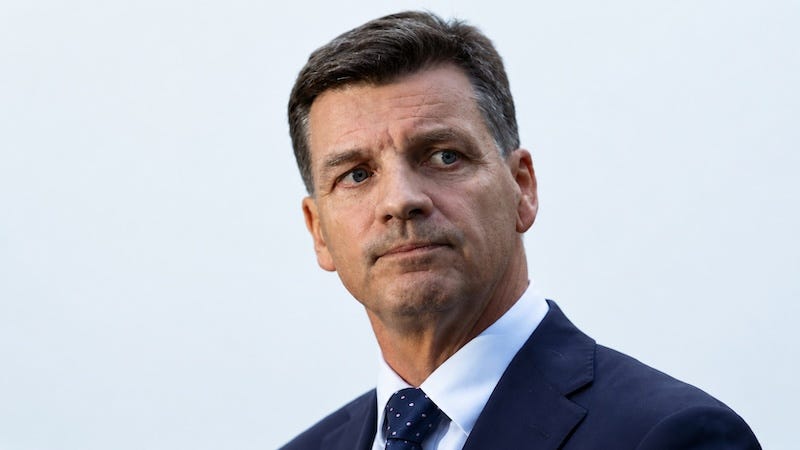
There are two answers to the question of whether Angus Taylor is finished. The first is the usual Canberra answer, which is the least interesting. No, he’s not finished in the narrow sense: he’s still Liberal leader, and his deputy still backs him, which is what we’d expect him to say, publicly at least. His colleagues haven’t walked into the party room and removed him. Not yet. Politics is filled with leaders who looked terminal one week and indispensable the next, and the Liberal Party is hardly overflowing with alternative leaders capable of uniting its factions, of rebuilding its suburban vote and confronting Pauline Hanson and the threats from One Nation at the same time.
But the second answer is more important. Taylor might not be finished as leader, but he is perilously close to being finished as a plausible alternative prime minister. Opposition leaders can’t just simply survive; they need to define the political contest. To be effective, they must make governments react to them and convince voters that they represent the next government. At the moment, Taylor doesn’t look like that leader. Instead, he appears to lead a once-dominant political movement that has lost both its political argument and its emotional connection with voters, while increasingly finding itself dragged behind One Nation, despite the fact they hold 42 seats in parliament, One Nation with just the two.
The great opposition leaders who became prime minister did more than exploit government fatigue – they redefined Australian politics according to their will. Robert Menzies rebuilt the non-Labor side around security, enterprise and stability after the war. Gough Whitlam modernised Labor around education, cities, culture and national confidence. Kevin Rudd defeated John Howard by making Labor appear competent, moderate and ready to govern.
That is the standard by which Taylor must be judged on. The question is not so much whether he survives another bad poll or another week of internal criticism: it’s whether he’s making the Coalition look like a government-in-waiting. He isn’t and, instead, he leads a diminished party still trying to work out how much of Hanson’s politics it can adopt without admitting they’ve become dependent upon her.
From opposition to political emergency
The latest polling indicates the scale of the crisis. A primary vote in the high teens is not just a bad result; it’s an emergency. Labor remains comfortably ahead, One Nation continues to poll strongly, and Taylor now trails not only Anthony Albanese as preferred prime minister but also Pauline Hanson. That should concern every single Liberal strategist out there. The party that once regarded itself as Australia’s natural party of government is now struggling to remain as the main force on the non-Labor side of politics.
To be fair, Taylor inherited a party already in a steep decline. The Liberals have been losing inner-city moderates to teal independents, younger voters to the Labor Party and the Greens, and many outer-suburban and regional voters to One Nation, and it’s a damage that stretches back well before his leadership commenced. The party never fully recovered from the Morrison years, when political marketing replaced trust, culture wars overshadowed basic competence and political management increasingly lacked any form of imagination at all.
Nor can this be blamed on Tony Abbott, however tempting that might be, who became leader in 2009. In opposition, Abbott engaged in a nihilistic and permanent state of political warfare – extraordinarily effective as an opposition leader, but dragged this behaviour into government, and never really articulated a coherent vision of what Australia could look like. His priorities were ideologically driven, and he struggled any form of trust with the electorate.
The leadership of Malcolm Turnbull offered an opportunity for the Liberal Party to reconnect with a modern and multicultural Australia, yet he also failed to bridge that gap between aspiration and political reality. He understood many of Australia’s long-term challenges but possessed neither the authority nor the determination to carry his party with him. On issues such as climate policy, energy and institutional reform, he appeared trapped between personal conviction, party constraints and political caution that seems to afflict prime ministers once they get to their cherished goal. Scott Morrison ultimately held the Coalition together longer than many expected, but his emphasis on marketing, resentment and permanent campaigning further narrowed the party’s appeal rather than renewing it as a broad and acceptable government.
That’s the crisis that Taylor has inherited and now confronts. He’s attempting to lead a party that has spent years encouraging distrust of moderation, expertise, compromise and institutions and it’s hardly surprising that many conservative voters now decided that if they want the politics of grievance, they may as well go to the original supplier. One Nation doesn’t need to get into government to inflict lasting damage upon the Liberal Party – all it has to do the emotional home of the anti-Labor vote.
To Taylor’s credit, he is totally correct when he says the trust with the electorate needs to be rebuilt. Since the pandemic commenced in early 2020, many conservative voters felt that governments had become too intrusive and dictating how people should live their lives. Some of those concerns might be genuine, others have fallen into the deep hole of conspiracy theories and following the grievances pushed by media, but they are politically significant. Taylor is attempting to speak to these voters without surrendering the agenda of the Liberal Party entirely over to Hanson. It’s an incredibly difficult balancing act and there is no easy path.
The multiculturalism test Taylor couldn’t pass
Leadership is judged not by whether the circumstances are difficult but by whether leaders still understand the country they are seeking to lead. Taylor’s handling of the recent debates over multiculturalism suggests he cannot. Australia’s multicultural makeup is not some kind of abstract slogan that can be sneered at by the far right, but exists as a lived reality: it’s who we are. It’s visible in our schools, in workplaces, businesses, sporting clubs, religious communities and families all across the country. It’s not an optional addition to an older Australia; this is modern Australia itself.
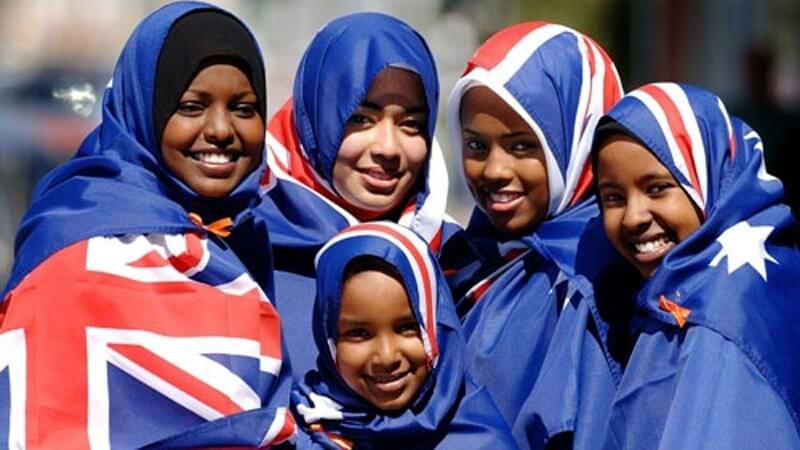
That is why Taylor’s equivocation has proven to be so damaging to his standing. It wasn’t an issue about trying to avoid Labor talking points, it was as issue about whether he can speak comfortably about the country as it exists today. Instead, he appeared trapped – by Hanson, by internal party pressures and by fears that any defence of multiculturalism would be interpreted by sections of the right as a sign of weakness. For a Liberal leader, this is a serious political problem, and the party that once claimed to represent aspiration across all communities now appears uncertain about the social reality of contemporary Australia.
What would a leader of a mainstream political party seek to curry favour with such a dilettante, ignorant and uninformed politician such as Hanson? Her politics is divisive and historically dishonest, yet it remains emotionally coherent, despite it being a patchwork of thinking-out-aloud though processes. People know what she believes, whom she blames and whom she claims to defend. That clarity gives her political strength, even when the story she tells is misleading. Taylor, by contrast, hasn’t offered an equally compelling alternative. Instead, he has assembled his own fragments – removal of “toxic” taxes, smaller government, warnings about spending and cautious cultural messaging – but no broader national story.
This is Taylor’s greatest weakness – it’s a cliché, but he lacks a cohesive narrative. The Albanese government has genuine vulnerabilities, with cost-of-living pressures severe for many people, housing affordability continues to deteriorate, and health, education and aged care all face significant challenges. On top of this, Labor’s caution and timidity on policy frustrates many people in the community. There’s so much material for a strong opposition leader to work with, yet the main political story today is not about Labor’s shortcomings: it’s all about the collapse of the Liberal Party and the rise of One Nation. That reflects poorly on Taylor’s leadership.
Survival is not the same as leadership
“Finished” is a dangerous word in politics. Hanson herself has repeatedly been declared politically dead before returning after an 18-year hiatus from politics. Albanese spent years being underestimated. Even John Howard, who once compared his prospects to “Lazarus with a triple bypass”, eventually became Australia’s second longest-serving prime minister. Politics is dictates by timing, circumstances – Harold Macmillan’s events, dear boy – internal factional movements and the absence of obvious alternatives.
Taylor may survive because there’s no rival who offers a clearly superior difference, in the same way that caused the insufferable survival of Peter Dutton: there is no alternative. Andrew Hastie might energise parts of the conservative base but that could further deepen the same strategic dilemma. A moderate revival might appeal to teal voters while further alienating conservatives drifting over to One Nation. The Liberal Party isn’t choosing between the good and bad options; it’s choosing among different versions of a decline, or the least-worst options. It’s such a bad political position for a party to be in.
That may ultimately be Taylor’s strongest protection – not public enthusiasm (because there is none), political momentum or confidence, but simply the absence of a more convincing option.
So is Angus Taylor really finished? Not yet, despite all the evidence that have been provided to support his removal. But the more significant question is whether he has already failed the essential test of leadership. He hasn’t made the Liberal Party appear ready for government. He hasn’t established himself as the obvious alternative prime minister. He hasn’t contained the rise of Pauline Hanson: if anything, he wants to become Hanson. He hasn’t forced the government onto the defensive. Above all, he hasn’t given disillusioned voters a good reason to return to the Liberal Party fold, rather than continue that slide towards degenerative grievance politics.
Taylor might yet recover. Might. Menzies and Howard are the constant reminders that political comebacks are always possible. But the odds are increasingly against him.
That’s the real danger. Taylor can remain Liberal leader while losing the only authority that ultimately matters: the authority of the electorate. He can retain his title while surrendering the political arguments over to One Nation. He can survive inside the party room while losing the rest of the country. And in doing so, he risks leading the Liberal Party into a vortex that’s becoming larger and deeper: a conservative politics in which One Nation supplies the anger, Labor supplies the government, and the Liberal Party supplies only the mirage.
I think the Liberal Party is still coming to grips with the fact they are no longer the go-to for electors on the far right.
I agree that PHON have no policies but they are riding on the US MAGA coat-tails as shown by PH's alacrity in accepting gifts (bribes?) from Gina and the MAGA-sphere.