


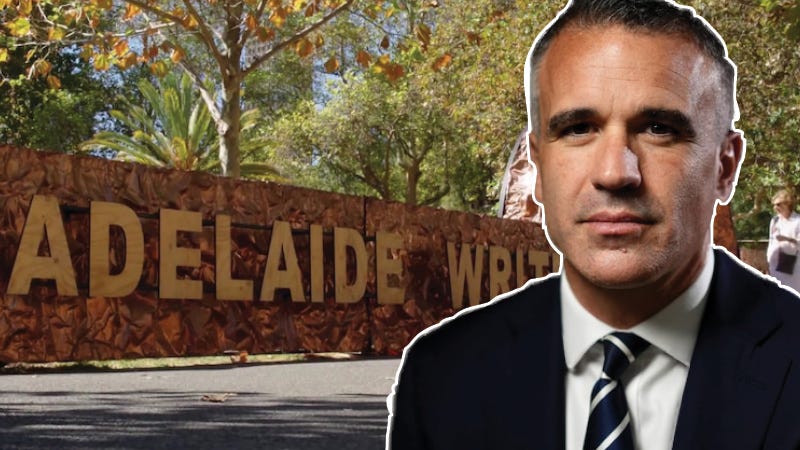
Until recently, Peter Malinauskas stood out as one of the most popular premiers in Australia, perhaps the most popular still holding office across Australia. He is young, charismatic and at least seen to be achieving positive outcomes for South Australia, while having a sense of confidence that other leaders have struggled to maintain.
That reputation has taken a serious blow, following the cancellation of the Adelaide Writers’ Week.
The author and academic Dr Randa Abdel-Fattah was removed from the event, following a request from the Jewish Community Council of South Australia to do so, and this removal prompted more than 180 authors and participants to withdraw from the event, and the subsequent cancellation of the festival, a process which has left Malinauskas politically damaged, irrespective of his repeated denials of any direct involvement.
Both Louise Adler – the festival director who also resigned from her position – and Abdel-Fattah have publicly suggested that pressure from the Premier’s office influenced the festival board’s decision to withdraw Abdel-Fattah’s invitation. It was that decision that triggered the collapse of the program, with many high-profile national and international writers – including Yanis Varoufakis and Jacinda Ardern – withdrew in protest. Abdel-Fattah has since commenced legal proceedings against Malinauskas, and this suggests the controversy won’t be fading away quietly.
Once the withdrawals reached a critical mass, the festival became untenable and was ultimately cancelled. It’s unclear whether Adelaide Writers’ Week will return in any meaningful form in the future – we always have to remain optimistic about that – but that optimism has to be tempered by the scale of the damage that has been done.
The central political question that needs to be asked is: why would a Premier intervene, even indirectly, in such a culturally sensitive space? If Malinauskas did exert pressure, he surely would have understood the risks involved. Writers’ festivals are not sporting events or trade expos; they operate on moral authority, trust and intellectual goodwill. Once figures such as Helen Garner withdraw, followed by the many others, the credibility and appeal of the event collapses almost immediately, and the pool of writers capable of drawing national and international audiences shrinks dramatically.
This is not a small financial issue either. The South Australian government reportedly contributes close to $10 million to the broader cultural event of the Adelaide Festival, with the expectation that this investment is recouped through tourism, taxation, economic stimulus, as well as the longer-term branding of Adelaide as a cultural capital of high reputation. That a Premier would risk undermining one of the state’s flagship cultural events – particularly one with such an international standing, and especially so close to a state election – is difficult to understand.
Malinauskas might offer the defence that he neither intended nor anticipated such an outcome, and although that’s hard to believe, we have to accept that it might be true. But politically, the intent matters far less than the actual consequence – and the consequences here have been massive.
This controversy is yet another example of something far worse: the increasing perception that public debate is being shaped by pressure from small but highly organised and influential lobby groups. We’ve seen this story so many times recently – we’ve seen events cancelled, speakers “uninvited” and careers destroyed across universities, arts institutions and media organisations. Fear has replaced reasoned disagreement, even before the debate commences. Even tragedy – and most grotesquely, the mass violence that we see in Bondi – has been weaponised in the act of silencing dissent, and at the request of these lobby groups.
If a state Premier is now seen to be directly accommodating or validating this style of interventionist politics, it suggests not just an individual misjudgement but a deeper systemic failure. Institutions that once prided themselves on independence now appear weak and easily spooked. Political leaders, rather than defending cultural independence, seem increasingly eager to avoid confrontation and acquiesce to demands from these lobby groups – even at the cost of either their own credibility, or the long-term legitimacy of an organisation, in this case, the Adelaide Writer’s Week.
For those who care deeply about Australian culture – in all its messy, chaotic, multicultural and sometimes uncomfortable reality – what has happened this week is deeply troubling. Culture isn’t some kind of dispensable luxury item. It’s not meant to just be a pretty decorative picture that hangs on a wall. It’s about how a society interrogates and scrutinises itself, renews its values and resists becoming a hollow shadow of what others want it to look like. Without it, we risk devolving into a nation of consumerist drones, valued only for productivity and spending power, rather than spirit of imagination or creativity.
Within this type of vacuum, culture and public rituals lose their meaning. ANZAC Day and Australia Day cease existing as opportunities for genuine reflection about history, responsibility and national identity, and become instead, empty performances of uncritical nationalism. This might suit much of the mainstream media perfectly: simplified narratives, with no nuance and no discomfort, but what about the rest of us who after the complexities of life?
There is also a great irony at the centre of this issue for the Labor Party, both federally and at the state level. A party that officially supports the recognition of Palestine – at least within the Labor Platform and, presumably, most of its rank-and-file membership – should, in principle, welcome the opportunity to hear from one of the most prominent and articulate advocates of this issue. Yet Malinauskas has acknowledged that while he did not force the board’s hand – which, again, is hard to believe – he did suggest the cancellation of Abdel-Fattah’s appearance. For a Labor Premier, this raises a fundamental question: what was the end game?
There was no clear political upside to this action. No lasting constituency has really been appeased, although there’s certainly one lobby group that would be claiming the victory. And there’s certainly no controversy on this matter that has been definitively resolved. What remains however, is a weakened cultural institution, potentially several legal disputes and expensive court cases, a fractured arts community and a Premier whose judgment is now being openly questioned.
It’s way past the time that Australian politics grew up. These toxic influences – whether they’re ideological, financial or reputational – need to be removed from the machinery of government. Cultural institutions – like all institutions – must be defended, not managed through fear or destroyed with the strokes of bureaucracy by unelected and self-interested lobby groups. Public debate needs to have the public space to float in, even if some of the discussions are too uncomfortable for some of us to listen to.
And only once Australia allows these public debates to move more freely will it become the nation that it claims to be, rather the risk-averse and anxious nation that it’s increasingly becoming.
This disgrace applies equally to the PM and NSW Premier who appear not to be able to kowtow obscenely enough to every order and demand of foreign ( and hugely wealthy ) lobby groups . They shame this nation, and ALL sections of this multicultural society . With what terrifying consequence can they have been threatened if they fail to obey demands about WHO can be heard , and WHAT is permitted to be discussed ? Our very cautious and timid Prime Minister claims he has
“Listened to the community “ in calling his RC . It appears that he has listened only to one small section of it before
obeying demands . He looks more and more like a useful puppet . The public interest has become a very low priority. 🙄
Malinauskas has made a complete bumbling fool of himself in appeasing the Zionist lobby. Conflating criticism of Israel with antisemitism is simply a lie. To believe it or act on it, you’d have to be extremely gullible.