


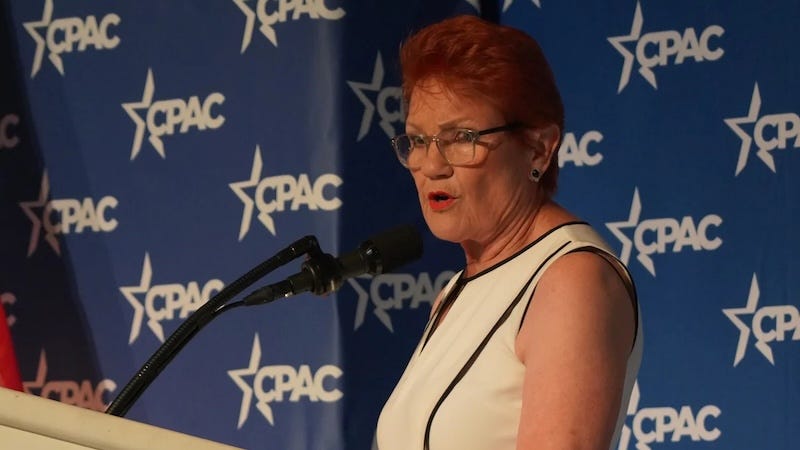
Pauline Hanson has used the UK Conservative Political Action Conference – speaking in a room where there were far more empty seats than people – to announce that she was “sick of hearing about white privilege”, would “not apologise for being white” and held “fears for England”. Seemingly wanting to become Australia’s greatest cultural export since Rolf Harris, her prime evidence of the collapse of British civilisation is that London is a multicultural global city, Muslims live there and not everybody shares her brand of repulsive and divisive far-right politics. She also warned that Australia is heading towards the same supposed catastrophe, despite Melbourne, Sydney and Adelaide consistently ranked as the world’s most liveable cities – third, fourth and eighth respectively – and Australia ranking second in the world for its safety, healthcare, political and economic stability, after Canada. That’s how bad things have become.
Hanson appeared on this international grievance circuit with the failed politicians Nigel Farage and Liz Truss, and convicted far-right activist Tommy Robinson (assault, fraud, stalking, and multiple contempt of court rulings), importing the familiar Trumpian formula of idiocy and incoherence: blame migrants, Muslims, transgender people, net zero and “globalists” for every economic and social failure that conservative governments and their wealthy supporters have helped to produce over many years.
We’ve always maintained that Hanson is sowing the seeds of her own demise, and going overseas to besmirch the reputation of Australia, and associating herself with political failures, known spivs and convicted criminals is a prime example of this.
And it didn’t stop there. Before lecturing ordinary Australians about our apparent national decline and cost-of-living pressures, the self-appointed champion of the battlers was photographed enjoying a Dolce & Gabbana spectacle in Sicily with billionaire Gina Rinehart – Hanson and Rinehart obviously share similar far-right political ideals – and then going off to relax in the pool at the five-star Grand Hotel San Pietro. Nothing reflects the hypocrisy of modern right-wing populism quite like railing against privileged elites from the comforting pool deck of a luxury hotel.
The Nationals join the One Nation grievance industry
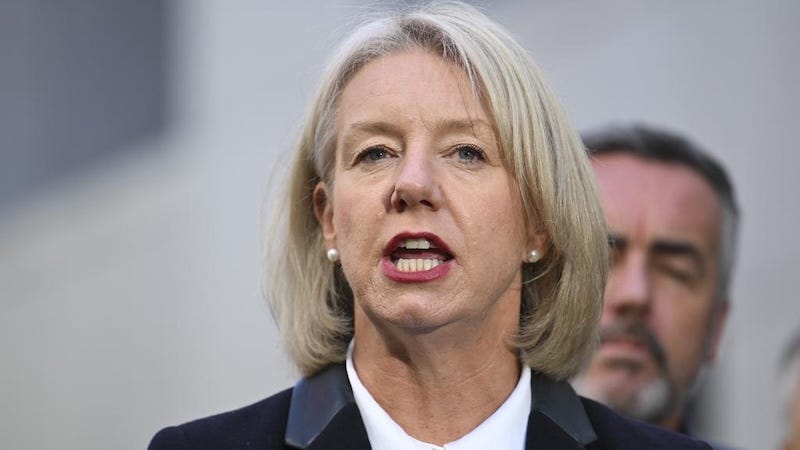
In the competitive race to outdo One Nation – and to also “value-add” to Australia’s exporting of reactionary politics – the Nationals Senate leader Bridget McKenzie has announced that conservatives are “in a war” against “leftwing globalists”, mass immigration and “woke institutions”. Forget about the war between the United States and Iran – this is the war that we really need to start paying attention to.
This is actually more consequential than Hanson’s performance at the same conference because McKenzie is from the supposedly mainstream Coalition, not an idiot populist fringe movement. McKenzie told the CPAC gathering that conservative movements across the English-speaking world must organise collectively, described Australia as the “most woke” country in the Anglosphere, before the predicable rants against migration, transgender rights and net-zero policy.
And it’s so predicably boring: the organ grinder and monkey need to find some new material, because the audience is getting bored. Many Australians would be surprised to learn that affordable housing, functioning public services that serve the community, and stagnant wages are apparently less urgent than defeating this mysterious international woke conspiracy.
The bigger problem here is an intellectual one, as much as it is a political issue. These really are stupid and insane policies, and while some in the electoral are entertaining these ideas, it will dissipate before the next election, as it did in the 2022 and 2025 elections.
But the Coalition is not learning the lessons of these defeats: rather than developing policies for Australia’s actual economic, social and environmental challenges, the Australian right wants to import a prefab Trump–Farage–CPAC culture war that has never borne any electoral fruit in the past. So why do they keep doing it? Because it’s cheaper than developing the serious policy work, it’s far more angry than decent democratic debate, and it’s a lot easier than governing competently.
Can Burnham bury Thatcherism?
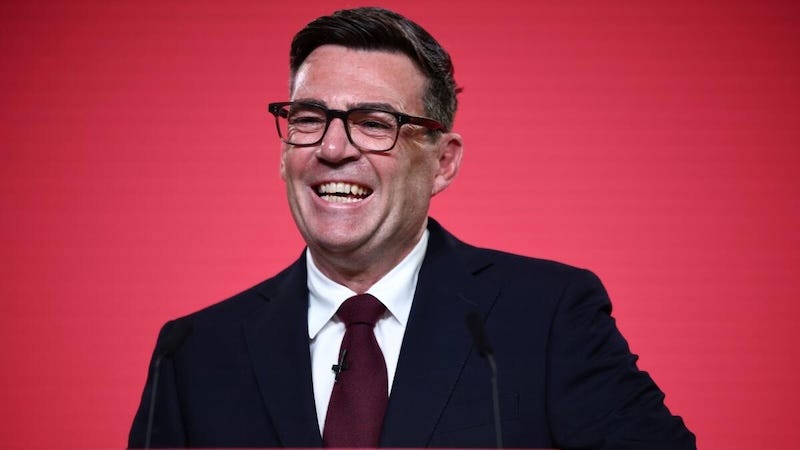
Andy Burnham will become Britain’s seventh prime minister in a decade, in a bizarre game of political musical chairs in a country that still pretends to offer stable government. He’ll be replacing Keir Starmer and is promising a stronger focus on cost-of-living relief, social housing, regional development and devolving power away from London. The bigger question is whether this represents a genuine economic break from the disasters of neoliberalism, or just a repackaged form of language that will end up being the same economic policies from the past.
Although Britain is far away, the Burnham government will be an important test for Anthony Albanese: can a nominally progressive government recover public support by intervening directly in the economy and improving people’s lives? Australia rarely creates a unique economic direction, and mainly follows the prevailing international cycles.
Thatcherism forced through the neoliberal revolution that created gross privatisation, weakened unions, concentrated wealth in the hands of fewer people and eventually hollowed out public institutions across the Western world, including Australia. It would be fitting if what started in Britain, could also end in Britain.
Burnham’s positions on Donald Trump, Gaza, China and defence spending will also be carefully scrutinised, and a more independent British foreign policy could give Australia greater room to move diplomatically. But, first of all, he needs to show that he’s willing to stand up to the interests that have benefited from the massive changes that have occurred over the past five decades.
Labor’s conference of carefully managed disagreement
More than 2,000 delegates will gather in Adelaide for Labor’s 50th National Conference, where rank-and-file members and union delegates will demand stronger action over Gaza, restrictions on gambling advertising and policies that challenge corporate power. The federal government, meanwhile, will create the right language that sounds principled when repeated in news soundbites, satisfies the competing factions and binds nobody to anything.
Labor conferences have become highly professional exercises in manufacturing consent: some debate is permitted, some shouty passion is displayed and potentially troublesome motions are rewritten until they no longer threaten government policy, are then rubber-stamped, and sent off to the National Secretariat and filed under “not to be re-opened”.
The bigger issue is: what does Labor membership mean now? If delegates can debate Palestine, gambling, AUKUS and gas export policy but cannot materially change the direction of the federal government, what’s the point?
The conference risks becoming the standard political theatre – a place where the party remembers its principles for three days before the leadership returns to governing as though they were never discussed in the first place or even exist.
Are we the AI nation or a corporate data colony?

The Labor government is presenting its national artificial-intelligence framework as a plan to create economic opportunities, while also including controls on government decision-making, stronger privacy protections, safeguards for artists and publishers, and bureaucratic oversight of the massive amounts of electricity and water demands that are created by these data centres. These are worthwhile promises, but the government remains very vague about who will own this infrastructure, who will profit from it and who will carry the costs.
Why the sudden rush to build these data centres, and whom will they ultimately serve? Their civilian uses are extensive, from cloud computing to generative AI, but data infrastructure also has obvious strategic, intelligence and military applications. There is no public evidence at this stage that the government’s plan is designed to synchronise Australian, American and Israeli military systems, although our dependence on US technology companies and its expanding defence integration makes the demands for transparency entirely reasonable.
This not a battle between technological progress and irrational fear: it’s about finding the balance between multinational companies that want access to copyrighted work, public resources and favourable regulation, and citizens wanting consent, compensation, secure employment and democratic control. So far, it’s been working against the public interest.
AI policy cannot be reduced to yet another industry-development announcement embellished with the word “innovation”. Before Australians give up their creative work, personal information, energy and water, the government needs to explain what is being created here, who it’s for, under whose control – and why the public should trust it.
The social cohesion™ circus continues
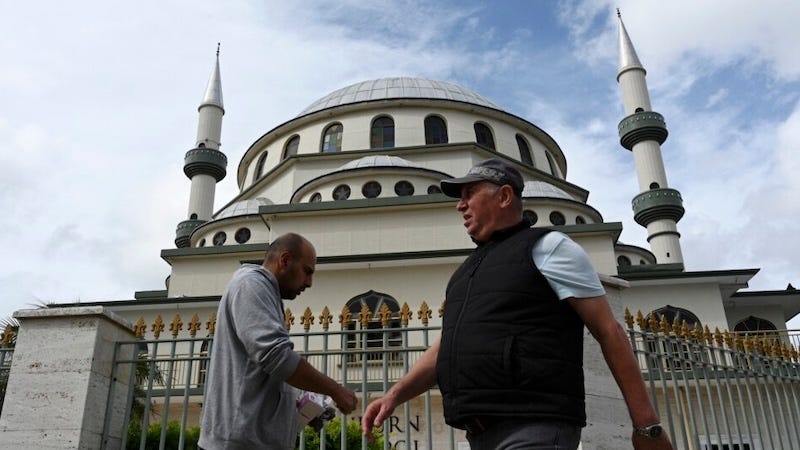
The Royal Commission into Antisemitism and Social Cohesion will go through its fifth block of hearings by examining security for Jewish institutions, events and community leaders, including policing, government funding and community security organisations. Jewish Australians should have protection from violence, intimidation and discrimination – as should every Australian citizen – but security cannot become a blank cheque for surveillance, secrecy or the classification of lawful pro-Palestinian activism as a constant threat.
These hearings coincide with Labor’s long-delayed response to Islamophobia envoy Aftab Malik’s report. The government has accepted 35 of its 54 recommendations – which sounds great – however, it rejected all of the more important proposals, including to hold an inquiry into anti-Palestinian and anti-Arab racism and changes to counterterrorism laws that disproportionately target Islamic communities.
There’s an obvious discrepancy here: Labor has committed to acting on every single recommendation from the antisemitism envoy’s ambit claims, while Muslim Australians have had to wait for ten months for a half-hearted and almost invisible response to Malik’s report. Evidently, some forms of racism will result in royal commissions, sweeping institutional reforms and immediate political urgency; others receive scant regard and an inane promise to just keep talking.
If “social cohesion” is to mean anything, protection must be consistent and provided to all communities equally. A government cannot credibly oppose antisemitism while treating Islamophobia and anti-Arab racism as a side issue – particularly while the likes of Hanson and mainstream conservatives openly show their hostility towards Muslim Australians.
“Are we the AI nation or a corporate data colony ?” . Magnificently well said , and upon every issue you raise . My disgust with this Albanese version of a “Labor government “ continues to deepen . The secrecy on matters of public interest , the refusal to adopt so many important recommendations from Royal Commissions , the refusal to do anything significant about the scourge of gambling
as it effects so many in the community , the list goes on . This is in direct contrast to the grovelling to corporate donors , and every dictate from our beloved “antisemitism envoy” on policies domestic and foreign , to support the interests of the Israeli government .
The level of racism involved here can be seen from space . In every spineless way , we have become a corporate colony . 😡😡
How is she still polling 30% on the latest newspoll?
Wtf is wrong with people?