


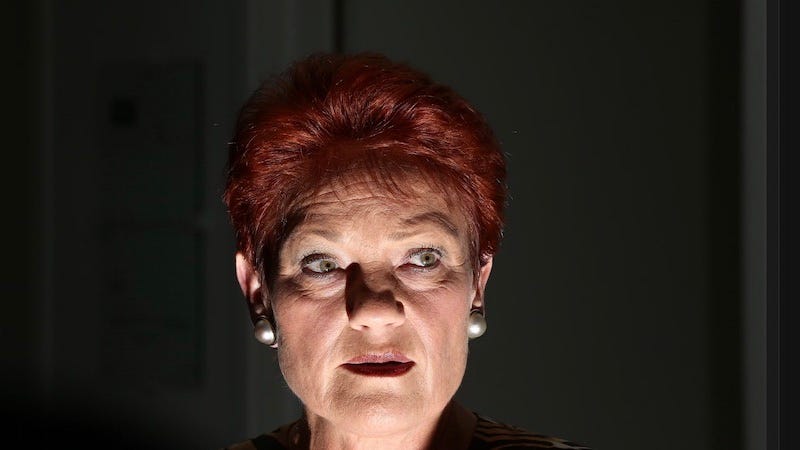
In Australian politics, debates about immigration usually flare up in ways that say more about political posturing than anything to do with clear-headed policy, and this week was a good example of one of those moments. The Liberal Party has sharpened its rhetoric around “good immigration/bad immigration”, language that reflects the long tradition of the right of dividing migrants into who’s acceptable and who we need to be suspicious of. As usual, the spark for this came from the leader of One Nation Pauline Hanson, who once again has put Muslim communities at the centre of a national controversy, for no other reason than to score political points.
Hanson’s political fortunes rely on bagging suburbs such as Lakemba in south-west Sydney – a suburb often portrayed by right-wing commentators as an example of the supposed failures of Australia’s multiculturalism. Lakemba is one of Australia’s most visibly multicultural communities, with a large Muslim population and people of Lebanese, Bangladeshi, Pakistani and Indonesian descent, and if you’re after a white bread life or traditional Australian monoculture, this is not the place to find it. During Ramadan, the main strip of Haldon Street is home to the Lakemba Nights festival, a council-approved food and cultural event that draws tens of thousands of visitors from all across Sydney, and it’s one of the best public expressions of contemporary Muslim Australian life.
Yet Hanson always frames the suburb not as a thriving multicultural community but as evidence of social breakdown and the collapse of “Australian values” which, of course, she seems to be the sole arbiter of whatever this might mean. She repeated long-standing claims that Muslims are seeking to impose a “caliphate” and suggests that Lakemba is one of those scary places in Australia where ordinary citizens feel they’re unable to go to.
These simple and false assertions have been a feature of her rhetoric since the 1990s, when she first rose to prominence arguing that Australia was being “swamped” by Asian immigration. Over the past 30 years, her targets have shifted from Asian migrants to Muslims, but the premise of the argument has remained the same: immigration isn’t presented as a necessary policy that works in Australia’s favour, but as a threat to civilisation.
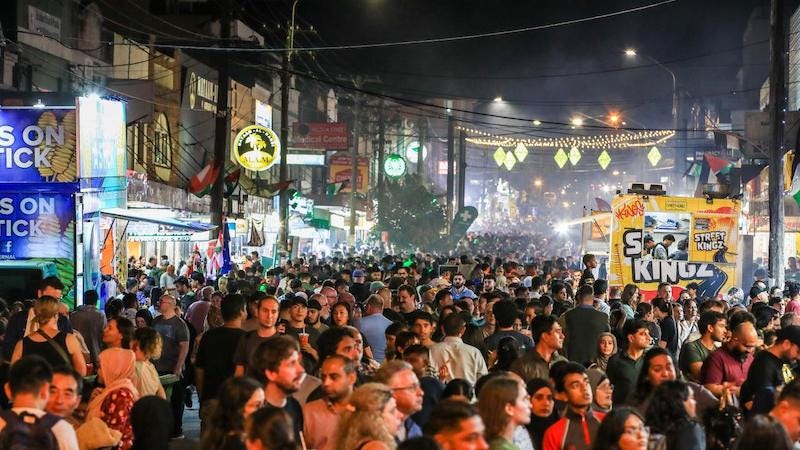
The reality of Lakemba is quite different to Hanson’s narrative. It’s a working-class, diverse suburb with all the usual hallmarks of urban life – it’s busy, there’s lots of traffic and related parking issues, there’s a diverse retail strip – but it’s not closed off to anyone, nor is it lawless. The Ramadan festival is open to everyone. It’s a well organised event, well regulated, and co-ordinated through local council. And the key is that many non-Muslims attend in large numbers – Christians, Hindus, secular Australians and visitors simply drawn by the food and the festive atmosphere.
The more significant political development was not Hanson’s comments themselves – we’ve come to expect this over the years – but how quickly the broader immigration debate has shifted. Within days, senior Liberal figures intensified their language about migration levels, supposedly “low standards” and how this relates to social cohesion. Opposition leader Angus Taylor has argued that overall migration numbers are too high and that the government has lost control of our borders. Those arguments should be framed as economic issues – housing supply, a strain on infrastructure, visa backlogs – yet they often follow the cultural agitation that’s initiated by the far right.
This is the pattern that has defined parts of the Liberal Party’s relationship with One Nation for years. One Nation articulates the more extreme version of grievance – often couched in terms of Western civilisation coming to an end. The Liberal Party then transforms this anxiety into more a formal language about “standards”, “capacity” and “integration”. It’s a rhetoric that’s less openly racist but retains the underlying implication: that any form of migration is socially corrosive, and destroys our way of life.
Australia’s immigration system is already highly selective, and has been like this under different governments for many decades. Permanent migrants are chosen through points-tested skilled streams, family reunion categories and humanitarian programs. Net overseas migration varies each year, depending on economic conditions, student numbers and temporary visa holders, and is always in Australia’s national interest.
Governments don’t just open the doors and let people in for no reason, it’s based on the requirements of the nation at a given point of time, and predominantly based on the economic needs of this country. It’s not an open-door system, nor is it structured along religious lines, there’s certainly no official distinction between “good” and “bad” faith within migration law, and any government that reduced Australia’s immigration intake just to pander to the extreme right or to the idiot whims of One Nation would be shooting itself in the foot, as well as destroying the economy. But explaining this to an already radicalised audience takes up too much time, and it’s clear that this is an audience that’s not up to the task of listening to clear reason.
What arrives in moments like this is not the law, or economic sense, or commonsense, but the dulcet and soothing tones of racism and the far easier task of blaming migrants. When suburbs such as Lakemba are singled out as somehow a warning to the rest of the country, entire communities become symbolic battlegrounds for the right. Muslim Australians – most of whom are citizens – are portrayed not as participants in national life but as symbols for whether multiculturalism has gone “too far” and part of the never-ending culture wars that the right keeps fighting, even though they keep losing these battles.
There’s a certain electoral logic behind all of this, despite how despicable the tactics might be. As the Liberal Party searches for a pathway back to electoral competitiveness, particularly after losing so many metropolitan seats at the 2022 and 2025 federal elections, there is a temptation to consolidate support in outer suburban and regional areas by leaning into cultural conservatism and the hostile pathways created by One Nation. Immigration has become a convenient tool for that strategy, as it’s easier to use these emotionally hooks, than doing the hard work of formulating clear and coherent policy.
But it’s a disaster of a strategy. The risk is that once immigration is inserted into the public debate through race or religion, that’s where the nuance ends and the hysteria begins. Communities that have been here for generations have their loyalty questioned, and whether they really should be here, even after all that time. First, it was the Italians, the Greeks, and then the other peoples of Eastern Europeans. Then it moved over to the Chinese and South-East Asian communities. Now it’s the Islamic world and Western Asian communities who bear the brunt from the right, eager to move on to new convenient scapegoats, once they’ve extracted as much political poison out the debate as possible.
