


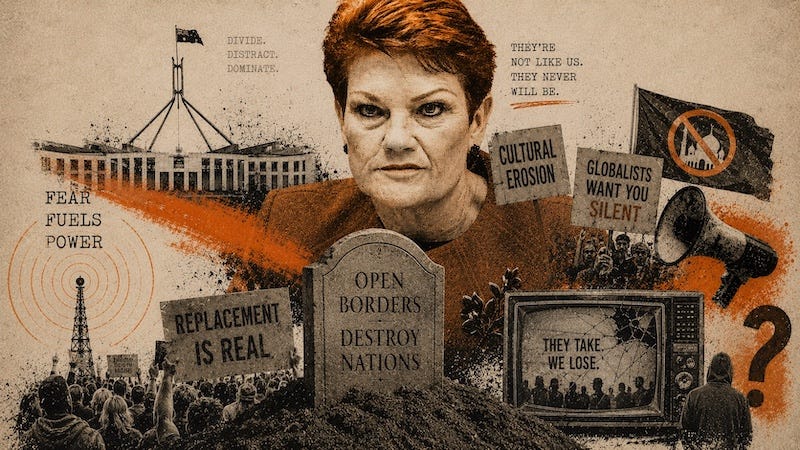
Pauline Hanson is often described as angry, but the anger in itself is not the problem. We’ve seen historically that anger can be one of the great drivers of democracy: it has exposed the humiliation, exploitation and abandonment of people by terrible governments in the past, will continue to do so in the future. The question isn’t whether anger belongs in politics, but what that anger is hoping to achieve: is the purpose to shine a light on the behaviour of the powerful, or is there to hide the power? And is to identify who has caused these problems, or is it transforming this anger into resentment towards those who have even less power in society?
Hanson’s politics belongs firmly to the latter tradition. Rather than helping Australians understand the economic and political structures that have produced this sense of insecurity, it offers a simpler story in which migrants, Muslims, Indigenous Australians, trans people, public broadcasters, academics and assorted “elites” become the cause of a national decline. It’s a politics that creates problems without offering resolutions and solid grievance without an analysis, transforming genuine frustrations into suspicion of the people in the community who least responsible for creating them.
The common defence of Hanson is that she has identified real grievances but has misdirected them. But even that is being too generous. The grievances might be real, but her explanation of them was wrong from the beginning. Over the past four decades Australians have experienced insecure work, weakened unions, privatisation, regional neglect, housing speculation, declining public services and the growing power of the wealth class over democratic institutions.
Hanson has seen these developments over the years, but instead of identifying the political and economic order that produced them – and the underlying principles of neoliberalism – she has racialised their consequences.
The legacy of racial nationalism
In this sense, Hansonism didn’t emerge from nowhere in 1996. Australian political commentary often treats each eruption of right-wing populism as a shocking deviation from an otherwise tolerant national story, but the historical roots are much older. Australia was federated with racial exclusion close to the centre of its national identity, where The White Australia policy wasn’t a side issue of the newly created Commonwealth; it was one of its founding principles. Race, labour and nationhood were bound together through the promise that white workers would be protected, not by democratic control over economic power but by racial boundaries based around citizenship and employment.
Hansonism has inherited this tradition in a degraded form. It’s an style of thinking that speaks constantly of protection, but not protection from economic insecurity or concentrated wealth. Instead, it promises protection from cultural and demographic change, and nothing else: that’s it. The result is a politics that preserves existing economic arrangements while directing popular anger away from those who benefit most from them.
There is also a deeper lineage running through sections of the Australian far right, from the League of Rights and anti-communist conspiracies to the fear of international institutions, hidden elites and a betrayal of the nation. Hansonism is not just a continuation of those movements, but it draws upon the same political vernacular. Ordinary Australians are imagined as virtuous producers, constantly threatened by the external forces that do not truly belong: internationalists, bureaucrats, globalists, multiculturalists, human rights advocates or whichever group currently occupies the role of national enemy: they are not monoculturalists. The names change, but the structure remains the same.
Queensland provided much of the political theatre for this tradition. Former Queensland Premier Joh Bjelke-Petersen demonstrated how anti-Canberra resentment, hostility to unions, suspicion of the ABC and an aggressive law-and-order politics could be repackaged as “common sense”. Hanson has inherited many of these instincts and adapted them for the age of television, talkback radio and social media.
Her rise coincided with the onset of neoliberalist thinking in the 1980s and 1990s, where protection for critical industries was removed, many public services were privatised, unions were neutered and employment became far less secure. At the same time, political leaders suggested that the third wave of globalisation that arose from neoliberalism was inevitable. Hanson’s “achievement” was to separate multiculturalism from neoliberalism in the public imagination, where she has persuaded many Australians to blame cultural diversity for economic changes that had little to do with migration and everything to do with political choices.
Subscribe to read the full article
This article continues by examining how Hansonism operates as a form of “racist neoliberalism”, why culture wars benefit powerful economic interests, the myth of a monocultural Australia, and what a genuine alternative to Hansonism might look like.

