


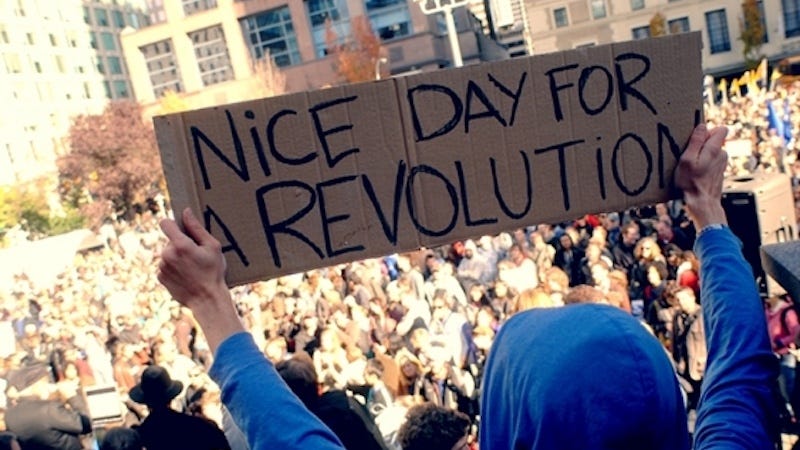
The most politically significant images coming out of France are of the crowds who have decided that their government is no longer listening, and that the economic conditions that they are repeatedly told to accept are failing to deliver a viable and acceptable future.
Last week, hundreds of thousands of people demonstrated across France over the issues of education, rising living costs and the inequality that exists throughout society. The rioting, clashes with police and the arrests attracted all the attention, but these incidents obscure the demands that brought people onto the streets in the first place.
The protests – which extended into other parts of Europe as well – raise a question that goes far beyond the day-to-day survival of any government: how long can an economic system have the consent and the support of the public, when the promises that governments keep making fail to materialise?
The familiar story of austerity is as follows: have the restraint today, and you’ll get the prosperity tomorrow. And to get that prosperity, governments need to contain spending, public institutions must somehow become more efficient through brutal cutbacks, and workers need to accept greater flexibility. Once confidence in the economy returns and growth improves, the benefits will supposedly follow. Just wait and see.
Financial sustainability and management is important, but these arguments become shallow when the austerity appears to be enforced for the many, but negotiable for the select few. A household struggling with housing costs receives little reassurance from improving national accounts when its school needs repairs and public services remain difficult to access. Political failure begins when the government’s definition of success – figures related to GDP, inflation rates, or statistics produced by a bureaucracy – loses contact with the everyday life that most people experience.
France’s unrest started off with student grievances about staffing, facilities and university admissions, and developed into broader protests over deteriorating economic conditions. These remain substantive concerns, regardless of the violence from some of the participants. Demonstrations elsewhere in Europe have also been caused by housing pressures, rising prices and corruption, and although this shouldn’t be seen as a coordinated movement, the connecting factors are that there’s a growing conflict over what governments are providing to their citizens, whose interests they are actually protecting, and whether political participation in the more traditional method – voting at the ballot box – can produce the meaningful change that people are after. And, so far, that’s just not happening.
Policing dissent while postponing reform
The French response shows how a dispute about social conditions can then transition into a confrontation over democratic rights. In response, authorities imposed bans on protests, local curfews and restrictions on movement, and the French President Emmanuel Macron advocated placing limits on demonstrations: a violence they helped to create, responded to with more violence from the state.
Of course, governments need to protect all people from violence on the streets, but if a growing dissatisfaction from the community becomes just another justification for governments reducing rights and abilities for democratic participation and voicing opinions, the public’s ability to demand much-needed change is being weaken at the time when it’s needed the most.
This is a familiar process: the grievances from the public start to build, the dissent escalates, and governments reduce rights and demand that people sit down and shut up, before they can start to address the problems. And it’s a similar formula that applies in Australia: the Minns government in New South Wales expanded restrictions on public assemblies after the December 2025 Bondi Beach terrorist attack, essentially to eliminate the regular pro-Palestine events in the Sydney CBD, with the bonus of being able to clamp down on other protests, such as those on environmental and coal mining issues, or nurses and hospital workers calling for wage increases.
It’s an odd response for a Labor government to extend police powers and use repressive tactics to silence dissent, especially for a party that emerged as a collective movement to make challenges to established power. In France, it’s not such a wise move from Macron, considering the country has gone through two major revolutions – and more repressions and bringing out the riot police and water cannons are not really going to offer any relief for the people who are suffering from weak economic conditions and wanting a far better future than what’s on offer at the moment.
While politics is a difficult grind – and we’re not suggesting these issues are easy to resolve – there is a basic function of government: not necessarily giving people what they want, but giving them what they need. People rarely take to the streets – whether it be in Europe or Australia – because they have nothing better to do; it’s because they are genuinely hurting as a result of government policies.
The recent election in Serbia shows that there are other possibilities. That election resulted in the Student List winning an absolute majority of 140 of 250 seats, defeating the authoritarian and autocratic government of Aleksandar Vučić. Student List is not even a political party, has no leader, was formed on the day the election was announced, yet managed to win enough seats to form government. That’s how thoroughly sick of establishment politics the people of Serbia are. They wanted change and they voted for it.
The message is: the governments that try to suppress dissent while leaving the causes of that dissent intact, if they don’t provide suitable responses to public sentiments – as was the case in Serbia – they’re not likely to be in office for too much longer.
Neoliberalism will not disappear just because it fails
Are these demonstrations the beginning of the end of neoliberalism? It’s been called for over the years, and there have been criticisms that the policies that favour unbridled free markets, privatisation, weaker organised labour and austerity are inflicting too much damage upon communities, and after almost 50 years of these failed policies, it’s time for radically different economic thinking that favours these communities, rather than the balance sheets of corporations and vested interests that have created a highly inequitable society.
These criticisms are not only come from the left: as far back as 2016, economists from the International Monetary Fund questioned whether the benefits of neoliberalism have been oversold to the public, identifying the inequality and continuous growth risks associated with austerity plans and the endless quest for financial liberalisation. It’s not a complete rejection of the markets, but it does suggest that while the collapse of neoliberalism is not imminent, it’s primacy as a key economic philosophy is being challenged.
The argument for change doesn’t need to naively pretend that institutions are woefully inadequate and implementing new thinking will automatically improve material issues: reform is genuinely hard work. But the political will and the courage have to be found first: first and foremost, governments need to decide what economic activity is meant to achieve. Housing should be considered an essential piece infrastructure where people can live, education should be treated as a contribution to the public good, and healthcare as a service that’s organised around need.
The onset of the COVID pandemic in early 2020 demonstrated how quickly governments can intervene when it’s absolutely necessary. It was a short-lived venture which essentially became a de facto test of several of the main tenets of modern monetary theory – or a new form of Keynesianism – but it was directed in a way that supported the status quo, rather than trying to install a lasting change to a dysfunctional system.
Recreating an idealised postwar economy probably isn’t the right to proceed, as applying Keynesian principles in 1945 is radically different to what needs to be achieved in 2026. But it needs to start somewhere. A contemporary version needs to address climate change, social services and health care, the concentration of technological assets in the hands of the few – including the increasing use of artificial intelligence – and housing insecurity.
For Prime Minister Anthony Albanese and Treasurer Jim Chalmers, this requires more than just a better slogan or the tinkering at the edges that have been symbolic of this government since it was formed in 2022. For sure, the government has introduced tax relief, housing measures and additional health investments, but those measures are not enough; that’s been made very clear in opinion polling since the Labor government won its massive majority at the 2025 federal election, and the rise of the support for One Nation.
Serious reform also needs the government to identify which vested interests they are prepared to challenge. Providing the public with what they need – expanding public housing, reducing speculative incentives and confronting excessive market power – will involve confrontation and conflict with those interests – and, potentially, the loss of political capital (which, by the way, is being lost by avoiding those confrontations).
Labor needs a purpose that goes far beyond just being better than its opponents, or offering the least-worst option: it needs to show that good government can improve material conditions and build institutions that people can rely upon.
Neoliberalism survives it ongoing failures, because it’s the easy way out for many governments around the world, and opponents of it haven’t provided an organised alternative – the solutions are out there, but until there’s a co-ordinated challenge – we’ll keep following this least-worst option, instead of seeking the best solutions.
Europe’s demonstrations make the demand for change more visible. What follows depends on turning that dissatisfaction into new and credible policies and creating a more durable pathway towards a better future. For Australia, it’s a very clear message: public patience is an opportunity to build something better, but it will definitely not last forever.
Albanese’s government is a text book example of tinkering at the margins, and a blueprint for Neoliberalism’s survival. What Albanese doesn’t consider is how long the fuse is on inequality’s ignition. Patience is a wonderful trait, right up until it’s not.