


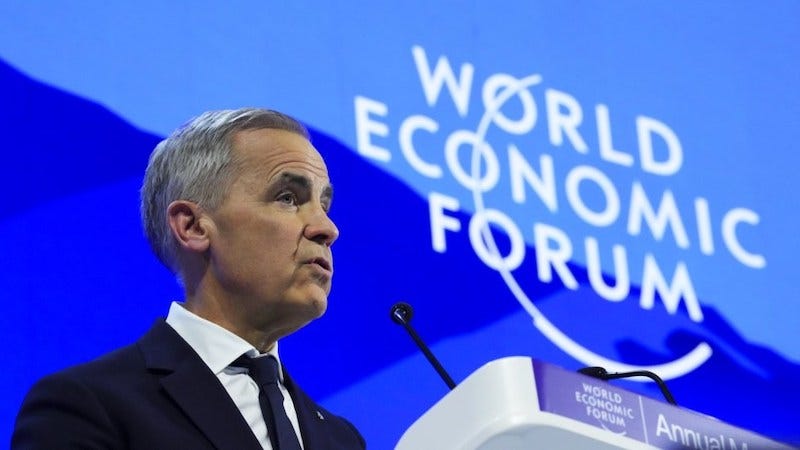
The Canadian Prime Minister Mark Carney gave a speech the World Economic Forum in Davos last week, and it was the moment that the establishment conceded what parts of the Australian left have been arguing since 1945: don’t build your foreign policy on somebody else’s fantasies (as in, the United States). Carney said it in more technocratic language, but the meaning was direct and very obvious. The post-Cold War arrangements are all but over. The great powers, especially the United States, are coercive again and the middle powers around the world can choose to be strategic in these new unfolding arrangements, or choose to become irrelevant.
Australian diplomacy has resisted this choice for decades. Since Curtin and Chifley, Australia has relied on the United States for its security, Asia (especially China) for its economic growth and international forums and institutions for legal and diplomatic legitimacy. This model worked while the United States was stable and the third wave of globalisation in the 21st century had its momentum. But it doesn’t work in a world order that’s fractured away, as it has at the moment.
Carney’s bluntest point was that the so-called order was never a structural process based on sound legalities, but was a dependent alignment of power that suited nations such as Canada and Australia. And right now, it’s dissolving, and the middle powers that think it’s a permanent arrangement are indulging themselves in nostalgia, rather than applying a clear-headed strategy.
Australian history is littered with critique about this issue. In the 1940s, H.V. Evatt argued the case for genuine management of these geopolitical issues through the United Nations – a body which he was strongly involved in creating – rather than deference to the major power blocs around the world. In the early 1970s, Gough Whitlam reworked foreign policy towards Asia, recognised China, and questioned Australia’s default position of an alignment with the United States.
During the Vietnam War, the Moratorium movement and figures such as Jim Cairns challenged the notion that US strategy should be defining Australian interests. In the 1980s, there were debates about Pine Gap and whether hosting US facilities compromised our sovereignty. In 1991 and again in 2003, opposition to the Gulf War and then the invasion of Iraq revived this same issue.
Paul Keating also sits within this list, although more through the frame of diplomacy, than a political protest. His goal in the 1990s was to entrench Australia in the Pacific region as a key participant rather than an outpost of either British or American interests. The APEC leaders’ meeting, the cultivation of Jakarta as a key partner, and the insistence that Southeast Asia was of strategic importance all rested on a simple proposition: Australia could not be prosperous or secure if it treated Asia as an American diplomatic and military playground.
Keating has since been dismissed as anachronistic by some and lionised by others, but the underlying premise – that flexible strategy is far more important than loyalty to an alliance that might not be working any more – has lost none of its relevance in this new era that Carney is refering to.
Carney’s speech reflected these historical warning that different leaders have made in the past. He stated that the United States can no longer assumed to be a reliable partner, implying that a world of coercion – which is the way that the US is behaving, as it always has, but more so now – will make nations more redundant and less autonomous. And this feeds directly into the logic of AUKUS.
AUKUS has always been presented as deterrence through submarine capability, although it’s starting to morph into other areas. China is building ships, therefore, the logic is that Australia requires nuclear-powered submarines to deter these adversary vessels within the Asia–Pacific region. But beneath this logic, AUKUS is the choice of a binding alignment with the United States, in the structure of military force, defence spending and diplomacy – and according to the preferences of the United States, rather than our own.
The supporters of AUKUS describe this as good sense, but it’s a strategic dependency. If this Trump era is being defined by coercive diplomacy – a good example of this is Greenland – then outsourcing Australia’s military interests to a state that fluctuates between self-interested universalism and destructive unilateralism is not realism, it’s avoiding the problems that many other nations, such as Canada, are starting to see.
The timelines with AUKUS will only make these problems worse. The promised submarines will supposedly arrive in significant numbers in the 2040s, but the window of risk for Taiwan and within the South China Seat sits in the late 2020s and 2030s. Australia is prioritising future and undefined capabilities, while leaving the immediate defence requirements under-resourced.
As we’ve said many times before, it’s highly unlikely Australia will ever receive these submarines, or have outright ownership and control of these vessels. The industrial base in the United States is already failing to meet its own naval schedules, the United Kingdom’s capacity is marginal, and Australia has neither the nuclear workforce nor the political durability to sustain a forty-year procurement cycle without this being interrupted.
AUKUS assumes all of these constraints will clear up simultaneously, but there’s no evidence for this assumption. And aside from this, major defence procurements in Australia have a habit of mutating, stalling, or dying altogether, and the replacement of Collins-class submarines has already wasted years of strategic development, including the cancellation of the French-built submarine system in 2021. There’s no reason to assume that AUKUS will break that pattern.
The issue of Australia’s sovereignty is perhaps the most serious that we need to consider. There are no treaties that force Australia to fight in a war, and it always has that right to refuse, although this would probably create diplomatic tensions if it did come to that. But sovereignty itself isn’t just the legal right to refuse – it’s the practical ability to refuse without suffering a catastrophic penalty, and it’s obvious that under the current Trump administration, it would probably come to that if the issue ever did arise. If the US did take Greenland “by force”, what would be the punishment for Australia if it refused to join in, or if it admonished the United States?
If reactors, weapons, training and software require the assent of the United States, Australia’s operational independence will become nominal, or non-existent. In a crisis, the United States won’t need formal obligations, it will have all the leverage that it will ever need to enforce its own will.
Carney’s speech should be seen as a model for conduct of middle-power in this new Trumpian world. It favours a diversification of interests and increasing domestic capabilities, rather than deference to an unreliable and maniacal Trump administration. Applied to the Australian context, this suggests treating the US alliance as important but not the only one. It also suggests a stronger engagement with Japan, South Korea, India, Indonesia, Vietnam, Canada and the European states, without assuming that the United States needs to be central to those relationships.
It also suggests treating Southeast Asia as a strategic centre of important, not just a stage for diplomatic announcements and niceties, and then left at that. It suggests acknowledging China as a structural rival without reducing the region to a moral game about who’s historically right or wrong, or more important. And it suggests investing in more effective defence capabilities in our region instead of relying on distant procurements from the United States and Britain.
There’s also the secrecy that we have to take into account, and that’s not appropriate for a supposedly democratic country like Australia. AUKUS was unveiled in 2021 by the Morrison government through a bipartisan process with limited parliamentary scrutiny, and now continued by the Albanese government. There was little debate about long-term nuclear commitments or the cost of this project. The public hasn’t been asked whether it supports fighting over Taiwan, whether this back-door nuclear industry is acceptable, or whether submarines are the best means of supporting our defence capabilities over the next 50 years or so.
Carney’s speech should be a circuit-breaker in all of these discussions, causing us all to rethink the idea that the United States is stable partner and, if it isn’t, that middle powers can’t do too much about it. In this context, AUKUS is the sign of an immature nation. It’s the product of outdated thinking from the 1990s and before – that belief that American strength and support is permanent and that Australia’s role is to support this permanence.
A more serious and independent Australian strategy for this era would do three things. First, it could invest in more effective defence capabilities for the late 2020s and beyond – long-range missiles, autonomous undersea systems, cyber, space, and maritime surveillance and a stronger northern Australia infrastructure.
Second, it should start using regional diplomacy to build stronger coalitions of interest in Southeast Asia, and in the Indo–Pacific regions, and treat Indonesia as a strategic equal, not public enemy number one that can be whipped up for domestic political purposes.
Third, it should build more domestic resilience, including industrial capacity, adapting to climate change, better supply-chain security and investing in human capital.
Of course, all of these take time but, more importantly, none of them requires leaving the US alliance. The United States remains important, but it wouldn’t be definitive. China, of course, is assertive in its own affairs, but a conflict is not inevitable or even likely. The region is multipolar, whether Australia likes this or not, and in this type of world, AUKUS narrows the options at the moment, when having more options are what make middle powers such as Australia viable.
The speech Carney gave at Davos has made it harder for Australia to pretend otherwise.
It would be really good to see Australia grow up and stand as an independent nation, instead of just swapping the UK for the US. We have seen glimpses of the progressive and diplomatic actions we are capable of, we need to see more of it.
Well said, David.
I think it’s no exaggeration to say that to continue on this course would be the greatest strategic failure of policy in Australian history.
As a nation, we continue to be extremely poorly served by the current crop of incompetent political elites and their arrogant complacency