


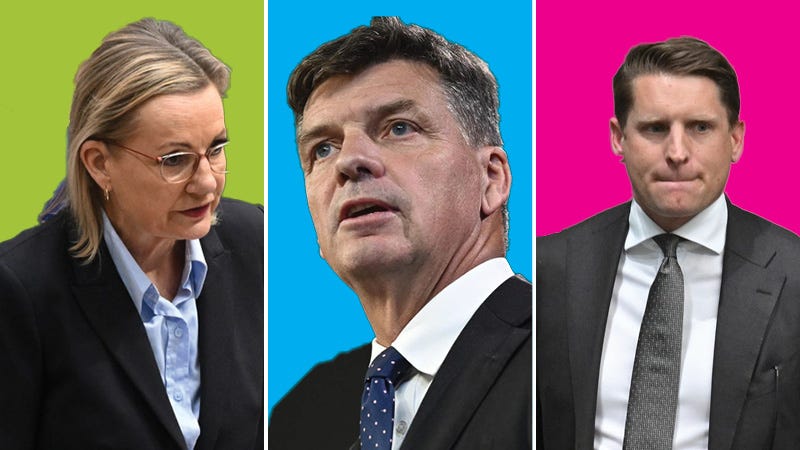
The Liberal Party’s lurch towards an anti-immigration campaign has come very quickly after its rejection of net-zero by 2050 – a position that already alienated the business community, moderates and much of the electorate. As the party deals with chronic internal conflict, sliding opinion poll numbers, and the lingering stench of a humiliating defeat at the 2025 federal election, it has once again reached for the same emergency button conservatives all around the world push whenever they run out of ideas: blame the immigrant.
It’s not a new tactic: when parties of the right feel cornered, they ignore policy and turn instead to an inane brand of retail politics – a shallow, transactional sense of pandering to prejudice, fear and misinformation. This strategy from the Liberal Party isn’t about preparing for governing or solving actual problems, it’s about scavenging for votes among the disaffected, especially those drifting toward One Nation and similar bottom feeders from the right. It’s a very simple goal: inflame, distract and hope the scattergun tactic lands somewhere electorally useful.
The irony is that Australia’s immigration program has been relatively stable for decades, regardless of which party is in power. Under the Coalition from 2013 to 2022, net migration consistently sat between roughly 180,000 and 250,000 per year – the spike in numbers up to 550,000 in 2023 under the Labor government wasn’t an ideological push but a correction that reversed the collapse in migrant arrivals at the start of the COVID pandemic, when net migration plunged to minus 94,000.
For the current financial year, the government has returned the target to 185,000 – the same figure former Prime Minister John Howard maintained across his final eight years in office up until 2007. Far from a radical “big Australia” program, immigration numbers today look almost exactly like they did 20 to 30 years ago.
Yet the Liberal Party now claims that immigration poses an existential threat to housing, services and cultural cohesion. This narrative isn’t supported by data but by a selective, unspoken hierarchy about which migrants are “acceptable” to the right. This narrative will comfortably welcome arrivals from Britain, Europe, Canada or the United States – these are the right countries – but changes quickly when the origin shifts to Asia, the Middle East, or Africa; the wrong countries. It’s the familiar and cynical sound of the dog-whistle: cut immigration not because of numbers, but because of who the numbers represent.
Of course, it’s a narrative that’s a political sleight of hand and clearly feeds into misinformation and disinformation. Migrants don’t steal jobs; they actually create them. According to the Australian Bureau of Statistics, the Australian Institute of Criminology and research produced through the Parliament of Australia, crime rates among migrant communities are actually lower than among people born in Australia, and variations tend to reflect social context rather than cultural traits.
Many migrants come to Australia to contribute, either through meaningful employment, building communities and businesses, create their own families or reunite with existing families, or are escaping from turmoil in their home countries. In advanced economies such as Australia’s, immigration is a net gain, supporting economic growth, fixing skills shortages, contributing to tax revenues and enriching the cultural wellbeing of the nation. When managed well, immigration is one of a country’s strongest assets, although Indigenous people in Australia might care to differ about this, historically.
The Liberal Party’s attempt to weaponise immigration is not about population pressures or economic management: it’s a desperate search for relevance by a party unable to articulate a coherent vision for the future of Australia. When conservatives abandon policy in favour of whipping up resentment, they’re sending out the message that not only have they run out of ideas, but they’re far happier to run with immigration as their latest scapegoat. The problem isn’t the migrants – it’s a lazy conservative movement that would rather stoke division than face the difficult situation that it has nothing genuine left to offer.
The plan to cut immigration will destroy the economy
The Liberal Party’s new proposal to slash immigration isn’t a policy – it’s political posturing. Despite the party’s attempts to position itself as “tough on immigration”, both major parties have historically been pragmatic about immigration, adjusting intake levels according to economic need rather than ideology. But the Liberals’ new fixation on slashing the intake is a familiar script: when facing internal dramas, manufacture a crisis, then sell the “solution” as if it’s courageous leadership rather than a reckless sabotage of the national interest.

A figure of a reduction to 100,000 per year keeps resurfacing because former Prime Minister Tony Abbott has been pushing it for years, and it has become a key part of anti-immigration sentiment within the conservative Sky News echo chamber. For those who blame traffic jams, crowded trains, or pressure on services solely on migrant arrivals, that number is the sound of comfort – a promise that life will somehow become a lot better if fewer people arrive here.
But it’s an illusion: cutting immigration to this level would shrink the economy by at least 1 per cent, cripple essential industries already suffering from severe worker shortages, and reduce future tax revenues that could be spent on other essential services. Even the housing crisis, which the Liberals falsely attribute to migration, would worsen over time, as fewer workers and less investment would slow construction and choke supply.
The truth is that Australia’s economic wellbeing relies on steady levels of migration, and even conservative leaders understand this. John Howard entered office in 1996, offering a tough stance on immigration, cutting numbers in his first two years to project an image of toughness on this issue. But after his political point was made, he quietly raised the intake to record levels – averaging around 186,000 per year for almost a decade – because he understood what the current Liberal Party pretends not to: that a modern economy can’t function without migration, whether we like it or not.
The present rhetoric is the same trick in different clothing. When the party megaphones its intention to “cut immigration,” it’s not offering a coherent policy agenda; it’s offering a slogan targeted for audiences over at News Corporation. Just like their fear campaign on net zero – where they claimed the transition will cost $9 trillion or $250,000 per person – numbers that fall apart even after a casual glance at the evidence. Independent estimates put the real cost of decarbonisation at around $300 billion over 25 years – roughly 3 per cent of the figure claimed by the Coalition. In other words, 97 per cent of their argument is completely false and exists as an example of retail politics at its worst.
The same applies to their claims that renewables are making energy prices soar or that Australia has “the highest power prices in the world”. Both statements are demonstrably untrue – energy prices have risen for many reasons, including market volatility, global fuel shocks and delays in infrastructure builds, but renewable energy is not one those reasons. Also, Australia’s prices remain below the OECD average. But, of course, a message of “renewables are cheap and reliable” doesn’t fire up the base quite like “the government is stealing your electricity,” so the facts are discarded in favour of the lies of retail politics.
This relentless misrepresentation reveals a deeper issue: a party that once prided itself on economic credibility now operates through fear and smear campaigns, misinformation, and their targeted culture wars: this isn’t engaging in debate; it’s just engaging in distraction. When a political movement relies on numbers that collapse when the simple facts come out, it’s no longer trying to govern – it’s just trying to fool people and is unfit for government, if it can ever reach that stage.
The Liberal Party is electorally dying in every state except Queensland – where they survive only through their alliance with the Nationals – and in Tasmania. Their traditional base is shrinking, their credibility is up in smoke, and their once-broad coalition of voters is fragmenting. A party that depends on slogans rather than solutions will eventually run out of slogans to tell, and when that happens, all that’s left is the smoke, the mirrors, and the final realisation that the public has stopped buying the act. And, by then, it might end up being too late.
A party that forgot how to govern
This is a prevalent situation in professional sport: a poorly performing team that ends up constantly losing goes through the process of forgetting how to win games, even the close ones, and once it becomes a bad habit and becomes all too hard, they look at other ways to win: cheating, salary cap rorts, illegal payments, blaming the referees, use performance enhancing drugs. And the more they lose, the more they keep losing, because they’re just avoiding the hard work that transforms them into a winning machine, and their fortunes only change when new coaches, players and administrations arrive to change this losing culture. It’s the same process that applies in politics.
The Coalition’s descent into retail denialism and culture-war politics is a different tune compared to when they’re in government. As recently as 2021, senior Liberals and Nationals were speaking with confidence and delightful enthusiasm about the fast and furious need for net-zero emissions by 2050.
Sussan Ley, as Environment Minister, declared that “no one wants to get to net zero more quickly than I do,” stressing that regional communities were eager to be part of the transition. Senator Bridget McKenzie described net zero as “the right plan for us to back,” calling it an opportunity that rural Australia was ready to embrace, and reminding critics that regional communities were environmental stewards way before climate change became ideologically weaponised by the political class.
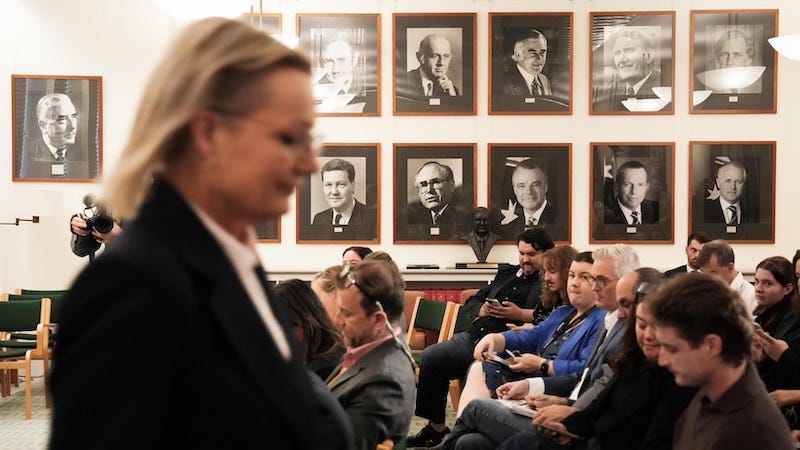
What has changed since that time? Absolutely nothing – except the fact that the Coalition lost government in 2022 and now sits in opposition – and with that loss, it abandoned its own policy positions, its own modelling, and even its supposed belief in net-zero targets.
It’s not a shift driven by scientific evidence but by political opportunism. Ley is now leading the party into a cul-de-sac of manufactured crises and costings pulled out of thin air, offering no credible modelling and no coherent policy direction. Instead, the Liberals have reverted to the oldest trick in the conservative playbook of trickery and superstition: link all of the ills in society – traffic congestion, energy prices, housing shortages, even the cost of coffee – to immigration, and hope that voters aren’t paying close attention. And if that doesn’t work, focus on other issues of complaint and link that up to another migrant group: after all, there’s always an endless supply of migrants to target in Australia.
This messaging is inane and pure retail politics, built on shallow associations and scapegoating rather than substance. But the 2025 federal election result shows that this tactic no longer works: their scare campaigns fell flat, the cultural wedge issues failed to gain traction, and the party suffered heavy losses once the electorate recognised that the Liberal Party has nothing left to offer beyond the anger, the noise and the mindless sloganeering.
Instead of using its time in opposition to meet stakeholders, consult communities, develop frameworks, test ideas, or refine its philosophy – in simple terms, to become a better political outfit – the party has turned inwards towards the retail zone of emptiness. Policy development requires discipline, intellectual honesty and meaningful engagement. But the fear and smear campaigns are far easier: a collection of smaller tactics rather than an overall strategy, that require no evidence, no complexity, and no courage.
Being in opposition – which now has the potential to reach at least a decade for the Liberal Party – is meant to be a training ground for a future government. It’s where parties sharpen their ideas, reconnect with voters, debate within themselves, and define what they want to stand for.
But the Liberals have treated opposition as an extended holiday run, almost like a political sabbatical, hopping from one episode of Sky News to another, to play out more stunts and act out the culture-war grievance, never doing the hard work of serious policymaking. When it comes a return to government – remembering that all oppositions do return to office, although with this opposition, there’s no clear evidence that this will ever happen – this leads to chaos, as we saw during 2013–22; in opposition, it just leads to irrelevance.
As for Sussan Ley’s leadership, her future is uncertain in this, the final week of Parliament for 2025. She may last longer than expected – remembering that the previous opposition leader Peter Dutton, against all predictions, limped all the way to election day – but she is trapped in a position defined by two realities: she needs the support of a conservative faction that will never truly back her, and she is leading a party that increasingly believes that the pathway back to power lies through louder populism, harsher rhetoric, and a stronger alignment with One Nation.
What these conservatives fail to understand is that this same strategy is why they keep losing. Chasing One Nation’s voter base might work in the short term, but it’s corroding the party’s moral and intellectual foundations – if indeed it has any – and the long-term cost is very clear. The modern Liberal Party is ideologically hollow, policy-starved, incapable of coherently governing, and reduced to harvesting resentment and a culture of complaint to try and remain relevant.
Retail politics has become the party’s entire political identity – and that is the main reason why it’s struggling to rebuild itself. As long as the Coalition keeps reaching for the cheap and easy stunts, it will remain trapped in a vicious cycle of the loud noise without any substance and, ultimate, all you’ll be leaving behind is a big headache for everyone else. A party that forgets how to govern eventually loses the trust of the public. And then, a party that forgets why it wants to govern, loses the public altogether.
Your paragraph sums up my view perfectly, "Many migrants come to Australia to contribute, either through meaningful employment, building communities and businesses, create their own families or reunite with existing families, or are escaping from turmoil in their home countries. In advanced economies such as Australia’s, immigration is a net gain, supporting economic growth, fixing skills shortages, contributing to tax revenues and enriching the cultural wellbeing of the nation. When managed well, immigration is one of a country’s strongest assets, although Indigenous people in Australia might care to differ about this, historically." 🤗
I agree the Liberals are blaming immigration, but reckon this is tactical, as their Raison D'etre is Neoliberalism. They're hating immigration now, after years of wanting more (just like almost all parties), because too many voters are assuming that the problems created by Neoliberalism and US imperialism are actually created by excessive (non-pale-skin) immigration. Lowering Golden Visa immigration might help us avoid becoming a corrupt state, but lowering refugee numbers is just inhumane, and lowering non-refugee/'economic' migration is likely to be counter-productive to our economy. I guess the Liberals intend to tactically stop the bleed of 'their' voters to the traditionally racist One Nation party, and strategically develop more relevance in the world increasingly waking up to the environmental, social, and financial costs of Neoliberalism. If that's true, I encourage Liberal Party members who genuinely respect peace, security, democracy, libertarianism, and productive (not rentier) capitalism to work to form closer ties with The Greens, and any other humane parties. Who appear to be sick of constantly being used & abused by the authoritarian & highly polluting & imperialist Australian Labor Party (and their less popular ideological mates in the Nationals). You come with good faith bargaining, and an open mind, and maybe a new force for sensible progressive Australian policy might form.