


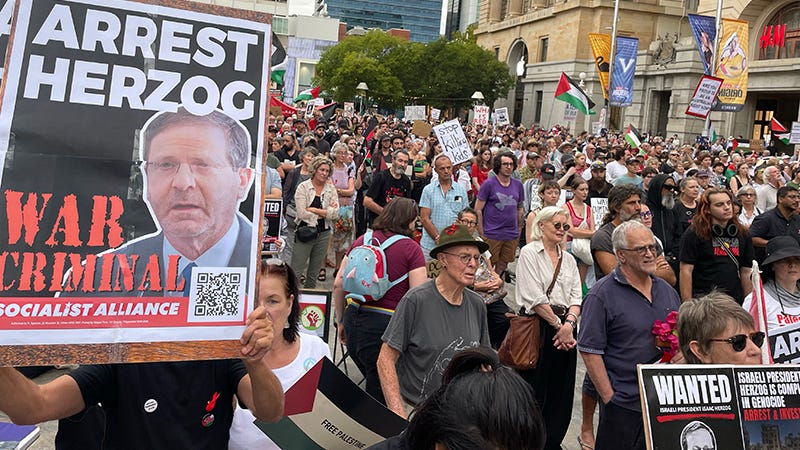
In recent months, Australia’s hate-speech laws have been expanded, with state governments moving in quickly behind new federal legislation offered as supposedly necessary responses to a claimed upsurge in antisemitism. The Queensland government – suffering from a classic case of the fear of missing out – has followed the changes already made in New South Wales and at the federal level, by introducing legislation that will criminalise the public use of phrases such as “from the river to the sea” and “globalise the intifada”, with penalties of up to two years in jail.
The speed at which these measures have been introduced raises many questions about their intent, how this legislation will be applied and, of course, the freedoms that they will restrict. Queensland’s political history, particularly under the long-running Bjelke-Petersen era between 1968 to 1987, suggests that the state is very comfortable using public order laws to suppress dissent rather than manage it proportionately, which is what we would expect from a normal functioning democracy. But it’s clear that many jurisdictions in Australia are currently dysfunctional when it comes to political rights and freedoms of expression.
The practical implications of these laws are still unclear, and it may take a while before they are fully tested, although one member of the public was arrested for shouting out “shame” at the President of Israel, Isaac Herzog, who is currently in Australia on an official state visit, for reasons which we are yet to fully comprehend. We now have a peculiar situation where identical speech – such as “from the river to the sea”, or perhaps even the word “shame” – may be lawful in one state and criminalised in another, depending purely on where the statement is made.
Protest slogans shouted in Perth – as they were today – may attract no sanction, while the same words uttered in Sydney or Brisbane could lead to arrest. The logic of this is legally incoherent, particularly in a country with national media, online communication, and international audiences. This will have dire consequences on political expression that extends far beyond the stated goal of supposedly protecting a specific community from harm, where that same community is, instead, using it to further their own political interests and supress the interests of others.
What these laws are ultimately protecting is not “social cohesion” – as the Prime Minister Anthony Albanese and NSW Premier Chris Minns keep claiming – but protecting and legitimising the criminal actions of the state of Israel, as well as the ideology of Zionism as it is currently stands within Israeli policy.
What is really being protected?
It’s worth having a short look at history to see exactly what is being protected here. The ideology of Zionism appeared in the early part of the twentieth century, with the view of creating a Jewish state in a land that was predominantly Arab – when the Balfour Declaration was released in 1917, the population in the region of Mandatory Palestine was 94 per cent Arab, and just under 6 per cent Jewish.
Over the next century, through war, displacement and ethnic cleansing perpetrated by Israel and fully supported by the imperial powers, that demographic number has changed dramatically. The mass expulsions associated with the Nakba from 1946 onwards, the creation of the state of Israel in 1948, successive military conflicts and the ongoing occupation and Israeli settlement of Palestinian territories has produced a radically different population balance and further entrenched inequality.
This historical and brutal transformation of the population is, for many people, at the heart of the strong contemporary criticisms of Zionism as a political project. It’s a colonial-settler project – not unlike the one Australia established all the way back in 1788 – that has relied on displacement and the systematic denial of Palestinian self-determination, culminating in the recent actions in Gaza that a growing number of international bodies and human-rights organisations have articulated quite clearly as a genocide.
Within this context, the slogans that are now being criminalised in Australia are widely understood by many of their users – not all, but many – as expressions of a resistance to mass violence, murder and dispossession of Palestinian people, not as calls for harm to Jewish people. Conflating these clear political expressions with antisemitism is deliberately tactic by Zionist groups to remove the clear differences between Judaism, Jewish communities, and the actions of a nation–state, in this case, the state of Israel.
Australian governments keep saying that these laws are necessary to combat antisemitism which, of course, must be addressed in those cases where it does exist. Yet the political function of these accusations can’t just be ignored and washed away. In practice, the liberal accusations of antisemitism are often used to narrow public debate, delegitimise any criticism of the state of Israel, and enforce a specific type of narrative across politics, media and many other institutions.
Pro-Israel advocacy within Australia operates through conventional lobbying channels, the strong influence of mainstream media narratives, and the close relationships with political leaders, to push through particular agendas, such as the adoption of the IHRA definition of antisemitism that blurs the line between prejudice against Jews and opposition to Israeli state policy.
This influence and concentration of influence is not some secret cabal, it’s very real, we can see it happening with our own eyes, and can see it exercised with considerable force, as we can have seen in New South Wales and Queensland.
Pointing out this power and influence is always labelled as an antisemitic trope, yet the evidence is visible in the extraordinary measures that have been put in place during this visit of President Herzog. Large parts of Sydney have been effectively shut down and gated up, protest rights have been curtailed, and new laws have been rushed through parliament, all in the name of deflecting from the genocidal actions of the state of Israel. If this is not the extraordinary use of power and influence, what then is it?
The New South Wales Labor Party has gone as far as threating internal disciplinary action and removal of pre-selections over speech that’s deemed to be “unacceptable”, creating an atmosphere of fear and compliance within the party, although that didn’t stop Labor MLCs Cameron Murphy, Stephen Lawrence and Sarah Kaine from attending the Sydney protests.
No comparable restrictions have been provided during visits by other foreign leaders, including those responsible for wars, occupations or human-rights abuses, and Australia has never criminalised slogans criticising the United States, China or any other state. The fact that this exceptionalism that has been applied to the state of Israel suggests that something more than safety for the Jewish community is at stake here.
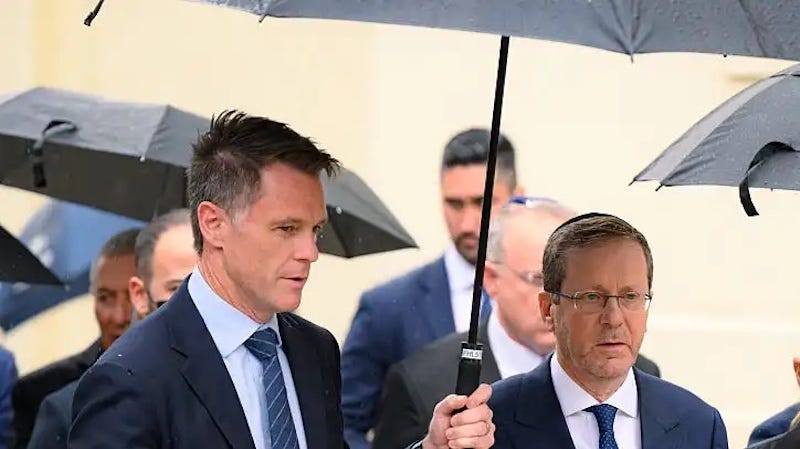
Israel’s standing internationally has deteriorated remarkably since its actions in Gaza commenced in 2023, yet Australian governments have responded by granting its head of state an elevated level of protection and deference, even to the point where Premier Minns was holding an umbrella to protect President Herzog from the rain as he gave his speech at the Bondi Pavillion. Symbolism is important in politics, but for Minns to give out this visual metaphor to the public was quite astonishing.
The invitation itself was gladly accepted by Israel, in its attempts to reverse its poor international standing, and it provides a level of respectability to the Israel government that many people in Australia just cannot accept – including many non-Zionist Jewish people – and it’s just more evidence that the charade of politics is far removed from the reality that exists within public sentiment.
Politics could have been avoided with an ethical alternative
The visit by President Herzog was promoted as a gesture of solidarity following the Bondi terror attack in December, but it’s clear that this was yet another politicised act. Only one of the victims was actually an Israeli citizen – three were not Jewish – and while it was clear that it was an antisemitic attack, we’re not clear about the full motivations of the alleged killers.
In this case, why was it necessary to make the invitation to a political figure? If the intention was to genuinely support Jewish communities in a moment of grief in Sydney, a different choice should have been made. A senior religious figure such as Rabbi David Rosen, who resides in Israel and is known for separating Jewish ethics from the state violence of Israel, and for engaging in dialogue between Judaism and Islam, would have provided the space for mourning without the politics that came to surround this event.
Instead, the decision to host a serving head of state ensured the event became inseparable from Israel’s conduct in Gaza and from Australia’s own political choices. Surely this would have been known by Albanese, and we can see that this was a foolish political choice to invite Herzog, even if it was primarily made at the behest of Zionist groups in Australia.
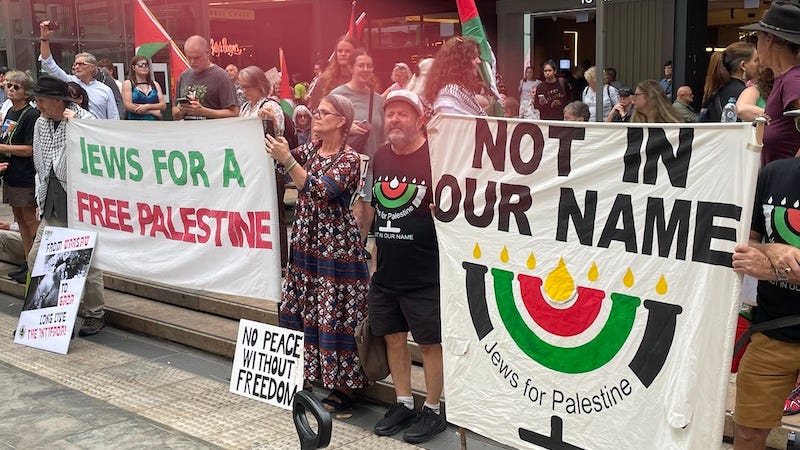
This was a moment when the Australian government could have drawn a clear line between respect for Jewish Australians who are grieving, and endorsing the actions of a foreign government. If Albanese had chosen an alternative based on ethics and reconciliation – and a clear choice on religion, rather than politics – the prime minister could have avoided the turmoil that erupted on the streets of Sydney.
Instead, Australia officially offered Israel a platform of respectability and legitimacy at a time when it faces unprecedented international criticism over war crimes, genocide and its practices of apartheid, reinforcing the perception that domestic political considerations and pressures coming in from lobbyists has far outweighed any judgments that should have been based on principle.
Sydney’s police brutality continues
Despite the legal uncertainty over the protests in Sydney – the Supreme Court handed down its decision to block the protest just one hour before its scheduled time at 5.30pm – and despite the heavy policing, the action against the Herzog’s visit did proceed peacefully, with thousands gathering in Sydney and many other demonstrations across 30 cities and towns across Australia.
That was until the NSW Police decided to provoke the crowds in Sydney, incited their own violence by throwing punches and using pepper spray, and went on to brutalise and arrest 27 people, including 20 Muslim men, who were praying outside Sydney Town Hall, an elderly man who had raised his arms up to surrender, a 71-year-old woman, pepper spraying a disabled woman, and then went on to punch a few women in the head, all video recorded and shared on social media.
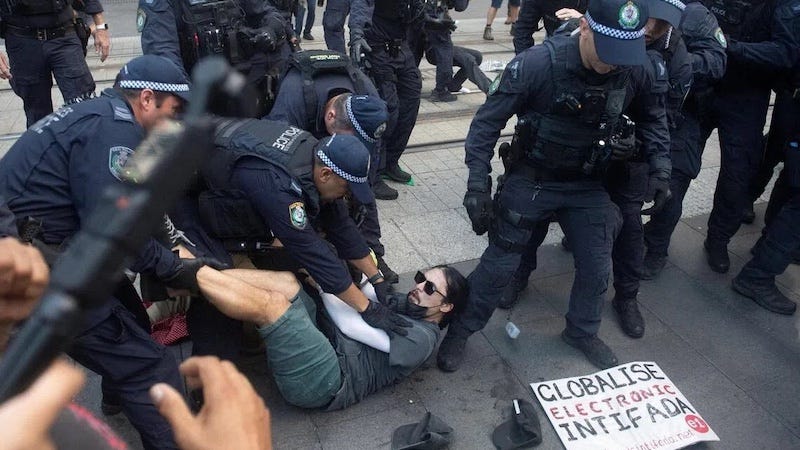
There were also police snipers on rooftops surrounding Sydney Town Hall, although it was never made clear who they were actually going to be protecting, because the protests – until the NSW Police sought provocation – were absent of any violence or disorder. And once again, it raises further questions about why such a restrictive approach was required by the NSW government and police, where the responses appeared less about public safety and more about controlling the narrative for the state of Israel and suppressing dissent.
It also shows a continuing pattern over the recent years in Australian politics, all implemented by Labor governments, with the exception of Queensland: a clear alignment with powerful interests and lobbying groups who will use their power in extreme ways, a rapid legislative response to constrain protest even if these laws are found to be unconstitutional later on, and an unwillingness to challenge foreign governments even when doing so carries a high political cost.
State and federal leaders have been corralled into providing credibility to a foreign government that many regard as an international pariah, and in the process, they’ve severely curtailed fundamental freedoms at home. The result has been a week of division, distrust and disillusionment – far from the “social cohesion” supposedly desired by Albanese and Minns – and another reminder that Australia’s political class remains vulnerable to pressure just at a time when it should be acting with principle in the national and public interest.
The decision to invite and diplomatically protect an Israeli president accused of inciting genocide, while using police brutality against those protesting Israel’s actions, may yet cost Premier Minns and Prime Minister Albanese far more in the long run. In good time, they might realise the errors of their ways – by which point, it could end up being too late for them.
Well written Eddy, except for your take that Labor's demonization and criminalization of dissent is accidental. >80% of Labor Federal and NSW politicians appear to be working with (>80% of) the Liberals to deliberately normalize punishment of dissent. Consider what we've learned in the past 2 years alone: All the excessive policing orders; The banning of known quantity non-violent Palestinian sayings under false pretenses of threat; All the Israel war crime symbolic fawning and complicity from Albo, Wong, Marles, Minns, and others; All the weapons (components) sales to Israel; The CTF153 using our ADF to kill those legitimately blockading the Israel war crime state (and who knows what other secret military actions in support of Israel they haven't told those they are there to represent about); The hosting of pine gap intel very likely used for illegally targeting Palestinian childs and other civilians; The purchasing from the Israel war crime state various weapons systems; The racist creation of an Antisemitism envoy instead of correctly funding & legislating to use our Australian Human Rights Commission to implement the National Anti-Racism Framework, support community education, and launch a national anti-racism campaign (assigned to a Zionist lobbyist with a long track record of trying to censor criticism of Israel's war crimes); Refusing to call out Israel's war crimes as the Australian state, as international law requires; Refusing to honor the ICC arrest warrant for Netanyahu & Smotrich; etc ad nauseam. I think there is a super-sufficiency of publicly available choices made by Labor to claim that Labor's federal and NSW representatives are (>80%) providing methodical and deliberate support to Israel's war crimes, and that they are similarly demonizing and criminalizing Australian and NSW dissent to those war crimes. The question is how far do we let these war crimes and civil liberties abuses by our governments and other state apparatuses to continue, before the majority of yet uninvolved spectators decide to lend a hand in organizing effective union and civil group political (peaceful) resistance to this clear and present danger. The sooner everyone gets started in replacing this abuse, the sooner we can all finish replacing this abuse with something worthy of The (once) Lucky Country.
https://ipan.org.au/
https://greens.org.au/
https://www.nswccl.org.au/your_civil_liberties
Wasn’t there someone in the visitor’s security detail who could have held the umbrella to protect him from the rain. How demeaning is it for the Premier of the state hosting the visit to do so! Would the Premier have wiped the visitor’s shoes too because they were wet? Takes subservience to a new level.