


Marching to the beat of One Nation’s drum
One Nation might be slipping in its opinion poll numbers – now that more people are looking at who they are and what they represent – but it’s still setting the agenda for conservative politics. Angus Taylor’s answer isn’t to differentiate the Liberal Party from Pauline Hanson, but to chase her further into the deep rabbit hole of the culture wars.
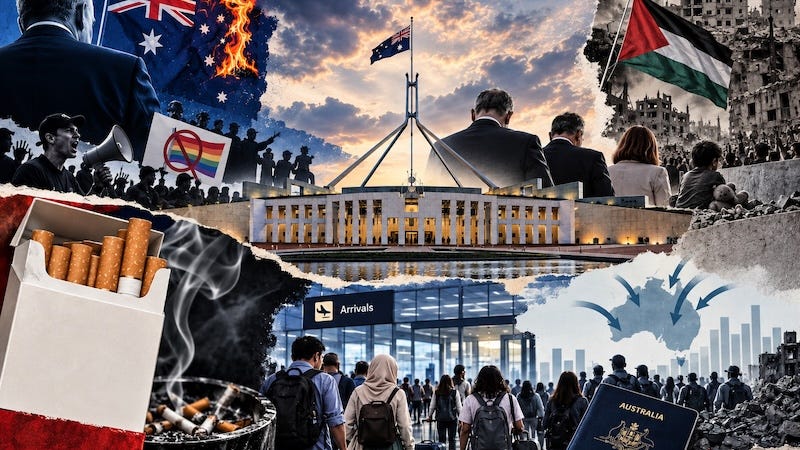
Taylor’s latest proposal to criminalise the burning and desecration of the Australian flag and entrench 26 January as “Australia Day” is pure political theatre and a classic conservative diversionary tactic: identify an offence according to the laws of culture war – real or imagined, it doesn’t really matter – then exaggerate the importance of the issue, and promise severe punishment for the culprits. It’s not exactly the tail wagging the dog, but it’s along the lines of the dog chasing a car and not knowing what to do with the car once it gets there.
And of course, it does nothing to address housing issues, wages, healthcare or inequality, but it does provides a cheap and easy performance art piece of hand-on-heart patriotism.
The same approach with the Coalition attacks on the Respectful Relationships education package, this time it’s coming from National Party leader Matt Canavan. These programs are intended to support education on consent, equality and non-violent relationships – commendable objectives, one would think – but are, according to Canavan, “woke” indoctrination that supposedly makes boys and men feel inferior. Rather than confronting the attitudes that contribute to harassment and gender-based violence, critics like Canavan manufacture these political-correctness-gone-mad grievances among men and then offer themselves as its political defenders of the right-wing faith. They’re insufferable.
In the most recent opinion polls – from Essential – Labor and the Coalition are now level on 26 per cent of the primary vote, with One Nation at 23 per cent, and Anthony Albanese recording his lowest approval rating ever as prime minister. This might give some encouragement for the Liberal Party but it seems that they just can’t help themselves: they keep chasing the agenda of One Nation but every time they do this, it sends the message out to the electorate that maybe One Nation was right all along.
And this doesn’t really ward off or defeat One Nation, it just validates it and shows that it’s becoming more difficult to discern the differences between them and the Coalition.
Lighting up for big tobacco
And if the Coalition is marching to the beat of One Nation, why stop at criminalising the burning of the Australian flag, when there are other things to burn, such as cigarettes?
The Coalition is promising to cut tobacco excise by 80 per cent – outbidding One Nation’s proposal to cut it by 75 per cent – and this is being sold as a way of targeting organised crime. Angus Taylor’s argument is that cheaper legal cigarettes will destroy the illicit cigarette trade, even though there’s no strong evidence to support this claim, not that this has ever been a problem for the Liberal Party.
The black market is in any sector is going to be a problem but the Coalition’s proposal looks very similar to the policy tobacco companies have been after for decades: cheaper cigarettes, a weaker price deterrent and a brand new market for nicotine. And if this proposal was ever implemented, it would be a nice return on investment the tobacco industry provides to the National Party – $225,500 in the most recent political donations year.
Cutting this excise would not remove the enormous profit margins available to criminal suppliers, who can then go on to lower their prices as well. And it would also make legal tobacco far more profitable and undermine Australia’s most successful public health policy ever. When Australia began its campaign to reduce smoking levels in 1976, the daily smoking rate among people aged over 16 was 38 per cent: that level today is around 6 per cent. It’s an amazing statistic that has prevented 500,000 premature deaths, and has saved billions of dollars over the past 50 years in societal, health and economic costs associated with tobacco. Even today, with low rates of smoking, the costs are estimated to be $155 billion per year and if these measures had not been introduced in 1976, that cost would be close to a trillion dollars each year.
Under Taylor’s proposal, these costs would rise and filter through to the health care system, while the tobacco companies – of course – would bank the immediate profits. After years of being treated as a discredited industry – which is fully deserved – big tobacco has returned to Canberra as a respectable policy adviser. This is exactly how this insidious corporate influence works: exploit a crisis, redefine the problem and offer a supposedly “obvious” solution that, by the way, just happens to improve the profits for the industry.
What was the recognition of Palestine all about?
Palestine is likely to return to Question Time as the pressure builds on Foreign Minister Penny Wong and Prime Minister Albanese over Australia’s response to Israel’s conduct in Gaza, and the totally unresolved issue of the attack that killed Zomi Frankcom in 2024.
Israel keeps rubbing the dirt – and the genocide – in Australia’s face, and the federal government keeps asking for more. This time, it was former Israel Defense Forces reserve colonel Nochi Mendel said he would do “exactly the same thing” again and that Frankcom and her World Central Kitchen colleagues were “not innocent”.
This is the commentary of an extremist and rogue state – as it has been since 1948 – and Wong and the rest of the federal Cabinet just sit there and take it all in, sending meaningless words of “outrage” and swatting away calls for stronger action against Israel. And as time goes by, we can see that Australia’s recognition of Palestinian statehood in September 2025 is a meaningless as it ever was.
Sure, it was symbolically important, but it was also politically convenient symbolism: in cases like this, it’s Palestine that’s treated like the pariah state – even though it has been recognised by Australia – when all the actions should be against the state of Israel.
Australia’s recognition of Palestine hasn’t resolved any of the questions about sanctions against Israel, the military exports of F-35 parts, humanitarian assistance and support for Gaza, or Australia’s relationship with the Netanyahu government.
Nor has it stopped the destruction and dispossession of Palestinian communities, or stopped the proposal by senior Israeli politicians for the supposedly “voluntary emigration” of Gazans, which should be recognised for what it is: ethnic cleansing of a population whose homes and society have already been devastated, and clearly in contravention of international law and any semblance of humanity.
These are the realities and truths that the Australian government will need to face up to: recognition means something, or it means nothing at all. And at the moment, it’s clear that Palestine means nothing at all to the likes of Wong and Albanese.
The migration blame game
Migration continues to be the convenient explanation for almost every Australian policy failure: if there’s unaffordable housing, congested roads, overcrowded hospitals, stagnant wages or deteriorating public services, it’s never the fault of poor policy development and implementation by government, blame the migrant: it’s all their fault. Always.
Labor, the Coalition and One Nation are now in this undignified competition to promise lower migration numbers – and that’s understandable: most of these MPs are undignified people – while being vague about which migrants could be excluded and how the economic consequences of lower numbers would be managed.
It’s a debate that always confuses permanent migration, temporary visas and net overseas migration – and all rolled into a massive number that is always misused and misquoted, provides a very alarming news headline, and create the impression that it’s a simple as the government turning a tap off, and with no flow-on effects.
Migration does increase demand for housing and infrastructure, there’s no denying that. But migrants aren’t the ones who decide policy: they’re not the ones who privatised essential services, suppressed or removed public investment, turn housing into a speculative asset, or allow employers to exploit insecure temporary labour. These are political choices made by successive neoliberalist governments over many decades, and there are very few solutions that are on the table.
The Labor Party is exposed on this issue because it allowed migration to rise without providing a serious plan for the housing and services that are needed to support such a rise, preferring to boost housing through incrementalist policies and housing development funded through a close-to-useless Housing Australia Future Fund.
The Coalition attacks migration numbers even though they were largely responsible for creating the economic model that is highly dependent on higher levels of migration. One Nation offers dramatic reductions in numbers without explaining the effect that these reductions would have on universities, aged care, agriculture, construction and government revenue.
It’s united approach and an auction through to the bottom of the pile which has one sole purpose: it creates public anger towards migrants and deflects from the governments and corporations that designed the system in the first place.
In addition to our politicians being undignified people, they are lacking basic humanity, empathy and morals. There's seems to be no point now in looking at the detail of policy announcements because the basic critique will be one of hypocrisy. Where is the logical consistency in decision-making? Palestine and Palestinians are treated as pariahs while a country whose leader has been accused of war crimes is still given legitimacy and respect! Respect the rule of law we are told; look how great the judeo-christian values are when put into practice - smoke and mirrors, hypocrisy.
Arguments about tobacco excise ignore the underlying policy intent to reduce smoking rates. Complaints about housing costs are reduced to blaming migration while at the same time complaining that the housing market has slowed ever-so slightly since the Govt's announced changes to neg gearing. Left hand, right hand? It's much easier to blame the faceless migrants rather than have a hypothetical loss to the value of the home you are living in and don't intend on moving from in the immediate future!
Our society has been conditioned to value materiality over human rights. This brainwashing has made too many compliant to neo-liberalism's arguments, resulting in an unsympathetic populace.
Well said , and precisely correct in every detail . The level of racism and inhumanity amongst too many politicians appears to be increasing like a plague . They have virtually no concern for those they were elected to serve . Their odious priority has become
their corporate masters . Poor fellow our country .