


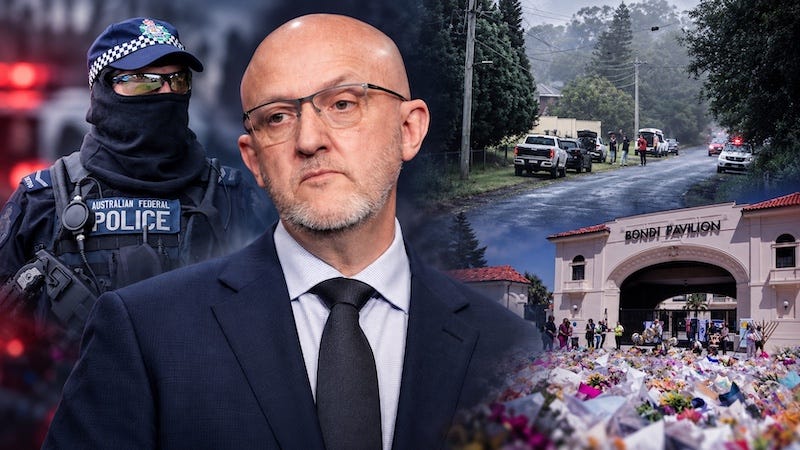
Sixteen potential terrorist threats in just nine months sounds absolutely terrifying. But coming from AISO, these extraordinary claims should invite a healthy level of cynicism. And what is meant by a potential threat? A terrorist threat is either real, or it’s not, and for these claims to come from a senior government bureaucrat without providing any substantiation, suggests that it’s a bureaucrat more intent on making himself more relevant than he needs to be, than the main interest of keeping the public safe.
The Director–General of ASIO Mike Burgess – who with his many media appearances seems to be confusing his role as top spy with a celebrity performer and is surely due for an appearance on Dancing With The Stars – says grievance, intolerance and political polarisation are creating an ever growing and dangerous security environment. We know very little about these threats but, surely, it’s the role of Australia’s security agency – and its top spy – to be not seen and not heard and just quietly do its work in the background and get on with it.
And instead of vague self-seeking messages about the unknown threats, why haven’t we heard more about the threats that were known to ASIO? An ASIO informant claims that he warned the agency about the Bondi killers – Naveed and Sajid Akram – all the way back in 2019. Why haven’t we heard more about this, and why wasn’t this claim fully examined by the Royal Commission into Antisemitism and Social Cohesion?
This would be far more valuable to Australian community, rather than the irresponsible propaganda that he spewed out to the radio broadcaster Neil Mitchell, saying that he “wouldn’t rule out the possibility that Iran would want to kill prominent Jewish Australians”, and that it wasn’t because of any immediate threat, but “because of their hatred of Jews”.
Let’s examine this statement: in the infinite world of possibilities, he could also say that he also wouldn’t rule out Nigeria. Or Poland. Or Argentina. Or even the United States. It’s highly unlikely and the chances must be close to zero, but still, you never know: you can’t rule out the possibility.
And then, Burgess also announced there’s no immediate threat, so why the need to bring it up at this point of time?
Also, it needs to be pointed out Iran doesn’t have a specific hatred of Jews as alleged by Burgess; it’s a hatred of the ideology of Zionism and the actions of the state of Israel, which according to many opinion polls, a clear majority of people around the world agree with.
The Ayatollah Khomeini issued a fatwa in 1979 outlining the protection of the Jewish community in Iran from violence and be granted fair treatment, stating at the time that “we recognize our Jews as separate from those godless, bloodsucking Zionists”. Sure, we can see that there are institutional barriers to Jewish people participating fully in Iranian life, for example, not able to hold senior government positions, serve as judges or receive compensation in legal disputes – and let’s not kid ourselves that Iran is a model of excellence for the 20,000 Jewish people who do live in the country – but the issue Iran has is with Zionism and Israel, and not specifically with Jewish people.
So, what is driving the commentary of Burgess, and why does he feel the need to impose this commentary on the public at such regular intervals? Is it relevance deprivation? Or is it the need to place more pressure on the government to boost funding for ASIO, yet again?
Since Burgess took on the leadership of ASIO in 2019, its funding has increased from $555 million, to $1.1 billion, and an overall funding increase of $3.4 billion for all National Intelligence Community agencies. Yet within this overall funding increase, budget allocations toward counter-terrorism programs – programs that could have prevented the Bondi attacks – have dropped from 23 per cent of the budget, down to 16 per cent.
Burgess did testify at the Royal Commission in May about this drop for counter-terrorism funding, but was essentially protected by the Albanese government when they claimed Public Interest Immunity to block the Commissioner from accessing specific ASIO documents, even though the Prime Minster explicitly promised investigators would have “full access to all material” and that the government would “cooperate fully with the review and provide assistance in the form of documents, data, material and meetings”.
Security agencies need to operate within a high level of secrecy – that’s the nature of their business – but there’s also a need for the community to have full confidence in their operations and understand that they are always acting in the public interest. However, it’s not actually clear in whose interests Burgess is acting in.
Without being overly cynical and invoking the spirit of Yes Minister too much, the primary role of any government department is to sustain itself and ensure that it can operate well into the future. In that sense, Burgess has done well in doubling the budget for ASIO, but how can the public know that this represents value for money, the same value many other departments need to prove to the government?
This quest for departmental sustainability helps to explain why Burgess felt the need to make the claims about disrupting 16 potential threats, in the wake of failing to disrupt the one real threat in December 2025 that ASIO had been informed about seven years ago. During this time, ASIO has prioritised counter-espionage and foreign interference, primarily China, Russia and Iran, and placed homegrown terror on a much lower priority. It also explains why ASIO investigated the Akrams but decided they posed no threat to the Australian community, and why they decided to hold information about the Dural Hoax in January 2025 as “highly classified” until March, even though they knew within hours that it was a fake bomb plot.
How does this represent value for money for the Australian public? Failing to reveal the Dural Hoax immediately prolonged fear within the community, and allowed the claims of an imminent antisemitic attack to go unchallenged for almost two months. Deprioritising homegrown terror and giving the all-clear on the Akrams resulted in the violent deaths of 15 civilians and injuries to 40 another people. How did these actions protect the public, which we’d assume would be the primary role of ASIO?
For too long, Burgess has played the political game in his role at ASIO: a carefully planted story here, a National Press Club address there, going on to speak on a right-wing podcast to amplify his messages of fear and terror coming any time soon, but failing to stop the real fear and terror when it actually arrives. Holding a secret and undisclosed meeting with the Israeli President Isaac Herzog, surely a severe compromise of Australia’s intelligence and security, which was only revealed after intense questioning by Senator David Pocock, three weeks after the meeting occurred. Does this represent value for money?
The bigger question is why the Albanese government has tolerated such an incompetent head of ASIO, who has clearly failed to act in the public interest and protect the community. Sure, even if we can accept that there were 16 potential threats disrupted, it’s the real threats that were missed that we have to be concerned about.
If Burgess wants the Australian public to accept his claims, he needs to explain the many failures of ASIO, including the warnings it failed to act upon and the information it withheld from the community, and why this occurred despite the doubling of its budget over the past seven years. Any other public servant with a comparable record would have been long gone and put out to retirement, and it’s now up to government to explain why he is still there and whether his role is to protect the public, or protect ASIO and his own position within it.


💯