


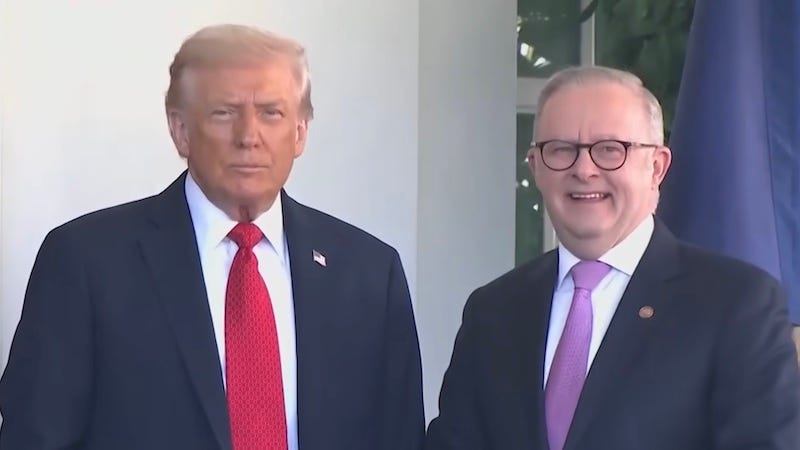
The long-anticipated meeting between Prime Minister Anthony Albanese and US President Donald Trump took place last week, and while many in the mainstream media had anticipated a disaster – for Albanese – when the meeting finally happened, it was more like a carefully stage-managed conversation between two long-term friends than a confrontation. In other words, it was business as usual.
The official White House video, with its cinematic lighting, vainglorious soundtrack and looking more like a trailer to a blockbuster movie, presented the two leaders as allies sealing a historic deal on critical minerals and rare earths – which according to Albanese, are “the building blocks of the next stage of the international economy”. Albanese spoke of friendship and the partnership, calling it “a really significant day in our relationship,” while Trump offered effusive praise for “a great Prime Minister” and “a great ally”. This is definitely not what the media expected.
Of course, the tone of the coverage then had to shift. Deprived of a diplomatic gaffe or public embarrassment they’d been egging on for months, the media then turned their attention elsewhere – to the minor theatre of Trump’s off-hand insult about Australia’s Ambassador to the United States, Kevin Rudd. When asked about Rudd’s past criticisms of him, Trump replied after noticing him in the room: “I don’t like you either and I probably never will”. The exchange drew the howls of laughter from the media pack, but there was no serious analysis or understanding on what it meant for the broader relationship between the two countries, or how Australia was missing out in other ways.
In most contexts, a head of state publicly disparaging another nation’s ambassador would provoke outrage. But with Trump, it was treated as entertainment – another episode in the ongoing spectacle of politics and news commentary as a bizzarro form of reality television. And besides, the media – especially News Corporation – hold a particular distaste for Rudd, so he was always going to be fair game. The press gallery chuckled, yet beneath the humour was the realisation that the President of the United States can now say almost anything, and Australia – and many others throughout the world – just needs to tolerate it and lap it up. Business as usual.
For Albanese, the success of the meeting wasn’t so much in the optics but in the outcome – an $8.5 billion agreement giving US industries expanded access to Australia’s critical minerals, offering supply-chain security and providing Australian mining magnates with a windfall – as these kinds of deals usually do – but the national benefit is far less clear. That’s the question that’s never raised by the media – and on this occasion it was all drowned out by Trump’s theatrics and honing in on Rudd’s comments from years ago – whether this arrangement truly serves Australia’s long-term interests and, on this occasion, it’s not so clear that it does.
The deal also shows how dependent Australia is with the United States, both diplomatically and economically, and while Albanese may have received public praise from Trump – and even landing a joke about using Trump in Labor’s next election campaign material – the reality is that Australia will continue to define its position in the world through the approval of the United States. And in an age that requires more strategic independence and economic diversity, that dependency is beginning to look less like security and more like a straightjacket.
Submarines and the illusion of success
While the headline act of the Washington meeting was the critical minerals agreement, discussions then moved over to AUKUS, where Trump displayed a new enthusiasm for the deal, even though months earlier, he didn’t even seem to know what it was. Now, he speaks confidently about Australia’s “upcoming fleet” of nuclear-powered submarines, assuring everyone that the deal is on track – even though very people in the world believe those submarines will ever arrive. And, as we’ve seen with Trump, he’ll say one thing and then do another: after securing a good mineral deal, he could virtually promise anything.
For Albanese, it was a win on the politics. There were no gaffes, he defused potential points of tension, and came away from the White House with some tangible outcomes. Whether these outcomes are viable or not is a different matter, but at least the conservative commentators and sceptics within the Liberal Party, who had been predicting a diplomatic disaster, were kept quiet – at least temporarily. Trump deflected the awkward questions about Palestine and climate change, there were no uncomfortable questions about Australia’s defence budget that the United States wants to see substantially increased.
The image of Trump as a kind of political mafia, where he closed the deal with a slap on the back – or what seemed to be a slap on Albanese’s knee – and refusing further discussion, captured the essence of this meeting. Australia delivered what the United States wanted: access to vast reserves of lithium, cobalt and other critical minerals, and in return, Australia received some warm words of praise, photo opportunities, and another reminder of its subservient relationship within the alliance. And just like in the movies, the mafioso boss always looks after his little mate.
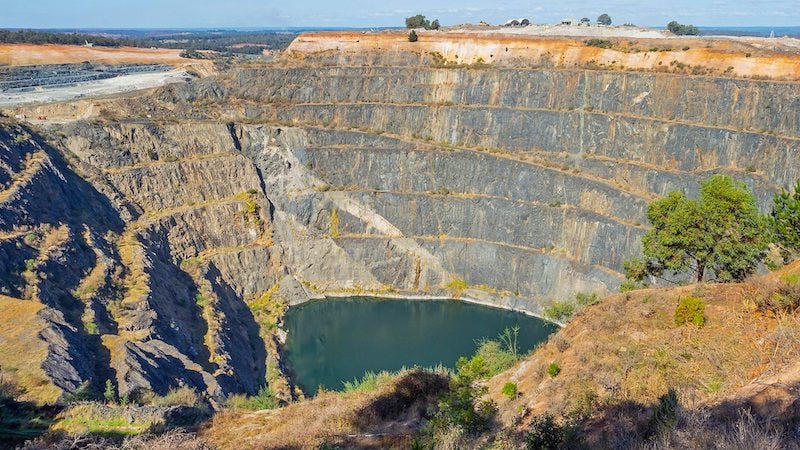
However, there’s other deeper issues that should be up for consideration: Australia continues to act as the world’s quarry, exporting the raw materials that support global innovation in other countries, while doing very little to build the industries that could process, refine and profit from them domestically. China still dominates the rare-earth market and maintains the world’s largest reserves, yet it is diversifying into high-end manufacturing and energy technologies – the areas where Australia has a weakness in. Digging up and exporting the raw materials is easy money; investing in value adding production is harder to do, but has infinite longer-term financial and security-based benefits, benefits which Australia is currently throwing away.
Because of this, the government’s short-term success in the United States is likely to come at a long-term cost. While Albanese can claim this diplomatic coup, the fundamentals of Australia’s economy remain unchanged: an overreliance on extractive industries, a lack of industrial diversity, and an ongoing dependence on American military and economic favours.
And then there’s the environmental issue, which was barely mentioned during this visit. The extraction of these minerals will have an enormous ecological cost, through the depletion of water tables, degradation of land and increasing carbon emissions. These issues weren’t discussed at the White House, but they are factors that will need to be addressed at some point in the future.
Of course, the Albanese government will enjoy this moment of success: the Prime Minister went to Washington and came back with something that can be presented as a successful outcome. Whether it proves to be a genuine success, or just another political fix at the expense of the longer-term national interest can only be tested over time.
The prosperity myth
So, what is the ultimate result of this Albanese–Trump meeting? There were no diplomatic missteps for the media and Liberal Party to exploit and no public embarrassment to sensationalise – which essentially means the establishment ended up getting what it wanted: a major mineral deal with the United States, the further confirmation of the alliance, and the exclusion of China – which meant that the only area they could focus on was the Ambassador, Kevin Rudd. The leader of the opposition, Sussan Ley called for Rudd to be sacked – offering no reasons, aside from Rudd’s comment from 2021 that Trump is “a village idiot, incompetent in his national statecraft” – but recanted when she realised that she wasn’t getting much traction from within her own party.
Once Rudd’s remarks resurfaced, they then became the week’s talking point in the media – endless television panels analysing diplomatic etiquette, followed by the usual editorial outrage. However, Rudd’s previous opinion of Trump – whether justified or not – had no bearing on his performance: it’s his job to facilitate the kind of deal that just took place. The fixation on his remarks was just a distraction from the real story: the shape of Australia’s economic future and who truly benefits from it.
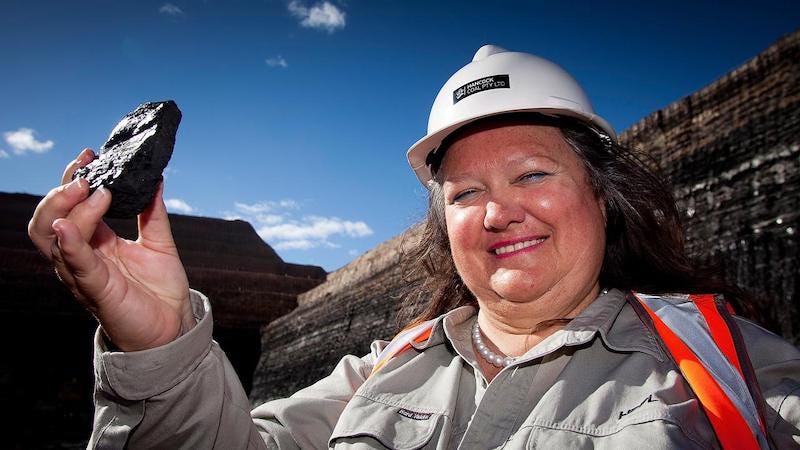
For the time being, the United States has obtained a reliable source of rare metals – in return, Australia has received some vague promises of military and industrial support, and mining billionaires such as Gina Rinehart will gain their handsome profits. The Australian public, however, is unlikely to see very much in return. It’s an arrangement reminiscent of the disastrous 30-year gas export deals signed under the Howard government in 2005, which locked in low prices for foreign buyers and left Australian consumers paying a fortune to buy back their own resources decades later.
This pattern – exporting raw wealth and importing dependency – has been the running narrative of Australia’s economic story since the 1960s, with royalty rates on minerals that have historically been set too low and, over half a century, successive governments have failed to reform this basic imbalance. The result is that private corporations, not the public, gain all the rewards of Australia’s natural resources. The Commonwealth is being eaten away by voracious corporate interests, and by successive governments that did not know what they were doing, or just didn’t care enough about what they were doing and were happy to sell out to corporate interests.
This is in contrast to Norway, where the proceeds from resources are channelled into a sovereign wealth fund that ultimately funds healthcare, education and infrastructure. Australians are constantly told that taxing mining profits more fairly would drive investors away, but looking at the Norwegian experience, it’s an argument that defies logic. If companies threaten to leave because they can no longer exploit public resources at bargain basement rates, perhaps they should. The minerals aren’t going anywhere, and neither should the wealth they generate.
The real deception isn’t in Trump’s theatrics or even in Albanese’s diplomacy – it’s in the economic thinking that insists that Australia’s only role in the global economy is to dig, ship and sell, and then repeat the cycle until there’s nothing left to dig. It’s a mindset that serves the conservatives of this world, who equate national prosperity with corporate extraction and believe that the common wealth should be there for them to claim as their private profit.
If Australia had the courage to rethink this old capitalist model and build its own capacity to refine, manufacture and innovate, the revenue from its mineral wealth could transform the nation: billions poured into early childhood education, hospitals, universities, transport and renewable energy. Instead, that money flows offshore or into the pockets of a few billionaires who inherited the luck of geography, just like Lang Hancock did in the 1950s, when he flew over the Pilbara region and correctly guessed that the redness on the walls of the Turner River gorge was oxidised iron. The real con, then, is not the one pulled by Trump in the Oval Office: it’s the one perpetuated by those back in Australia – the political and corporate elite who insist that this is the only way that things can be done.
Australia deserves better than to be the quarry of the world and sell its public resources and the common wealth for a song to vested interests. Until that situation changes, every handshake in Washington, every smiling press conference, and every “historic deal” will be just another chapter in the long story of a wealthy nation that was too afraid to harvest its own wealth for the benefit of its own people.
That’s right. “And, as we’ve seen with Trump, he’ll say one thing and then do another: after securing a good mineral deal, he could virtually promise anything.” This deal, or any other deal such as AUKUS, will be forgotten about or retracted.
Trump's mental health limitations are are a deliberate comedic foil and distraction.
Like POTUS George W Bush being a Texas village idiot while https://www.motherjones.com/politics/2011/12/leadup-iraq-war-timeline/
Like 'dignified' Barack Obama bothsides-ing genocide, or 'Genocide' Joe Biden being a 'nice, old guy' while https://www.ohchr.org/en/press-releases/2025/10/gaza-genocide-crime-israel-did-not-commit-alone-says-special-rapporteur
Their cognitive and emotional faults are likely to be exaggerated, performative distractions to provide humorous cover to help you ignore their authoritarian, imperialist Neoliberalism governance. They appear to continue the (now very old) US strategy of militarist expansionism, coupled with economic and espionage coercion and bribery.
I specifically want Australia to end or minimize our: Force Posture Agreement -remove US forces from Australian soil and waters (https://ipan.org.au/end-aukus/); AUKUS (kills our sovereignty, kills our peace focus by building up war culture & infrastructure to prepare our complicity in the next US war of aggression; ends hundreds of billions of $ needed in public health, education, and housing; attacks Chine rather than defending our waters and lands); Sinophobia (PRC appears authoritarian, but they have invaded only Tibet AFAIK, and are not a invasion threat to us if we invest in an actual DEFENSE force instead of wasting it on pointless AUKUS attack subs); US blind adoration (the USA has invaded Nations every few years, has trained scores of illegal coups, has supported many atrocious massacres, has consistently supported the war crimes of allied Nation States like Israel, shows no sign of change under GOP or Democrat governance -maybe a Greens).