


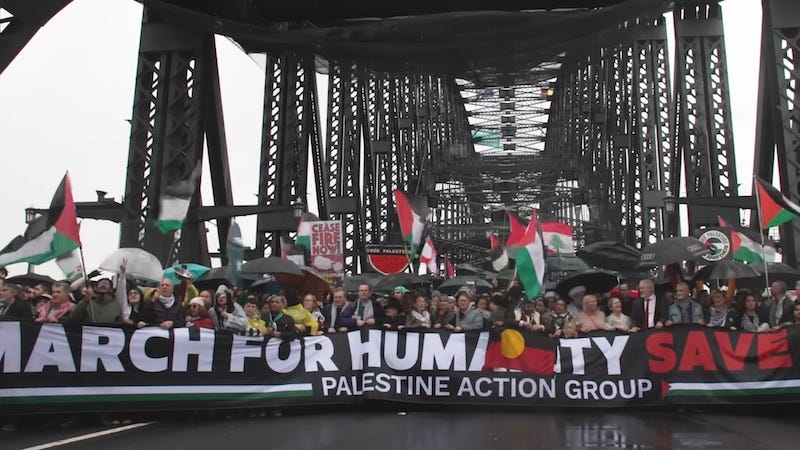
There was more movement on Palestine this week, driven by the complete humanitarian disaster and unfolding genocide in Gaza. In what is seen primarily as a symbolic gesture at this stage, Australia signed a joint statement with 15 other foreign ministers – including those from France and Canada – reaffirming their “unwavering commitment” to a two-state solution. But the meaning of this is becoming unclear and shrouded in double-speak and obfuscation: if a two-state solution is the consensus for many countries, then logically, that means a state of Palestine and a state of Israel.
Yet the practical commitment to a state of Palestine remains far away, especially from nations such as Australia, where Prime Minister Anthony Albanese was quick to clarify that there is no move on the table to recognise the state of Palestine, despite his constant rhetoric about a “commitment” and “long-held desire” for a two-state solution. Treasurer Jim Chalmers also chimed in, saying that it was “a matter of when, not if” Palestine will achieve statehood, but without a clear timeline, “when” could be a matter of decades, or well into the next century.
The current pathway for Palestinian statehood is loaded with conditions, caveats and contradictions – all of them are unclear, and seem to be designed to defer action indefinitely. Albanese has insisted that Hamas must be “completely removed” and Palestine must be “completely demilitarised” before any recognition is even considered, a condition that’s diplomatically and strategically ambiguous. What does “complete removal” mean? How will a state of Palestine defend itself from likely Israeli attacks if it has no military to speak of? Or guard itself against the settler violence in the West Bank? And who decides when that threshold is met?
More recently, Albanese has introduced another stipulation: that other Middle Eastern countries must recognise Israel before Palestine can be granted statehood. This raises another question – why is the fate of Palestine now tied to the diplomatic positions of other sovereign nations? It’s an endless cul-de-sac designed to appease Israeli interests, and one that further delays justice for the Palestinians.
Meanwhile, the United Kingdom has taken a different approach, suggesting it will recognise a Palestinian state only if Israel fails to implement a ceasefire – a “stick-and-carrot” approach that, like the Australian position, still links recognition of Palestine with Israel’s behaviour, rather than applying the inherent rights of the Palestinian people. Other countries have tied recognition to the release of all hostages, despite Israel’s repeated violations of ceasefires even after previous hostage releases, and even their refusal to accept the release of hostages as a condition of ceasefires. The double standards are obvious and sickening.
But despite the diplomatic stonewalling from Albanese and Foreign Minister Penny Wong, there is a growing momentum, and much of it has been fuelled by the harrowing images that have shaken the global conscience. One such image – of the emaciated 18-month-old boy, Mohammad Zakaria, clinging to life in Gaza City – has begun to cut through the geopolitical pantomime act. His fragile skeletal body, held in the arms of his grieving mother, has horrified even those who were previously unmoved, and it’s this singular photograph that has jolted leaders into at least sounding more serious about ending the crisis.
Albanese responded emotionally, saying that “a one-year-old boy is not a Hamas fighter. Clearly, it is a breach of international law to stop food being delivered… but it’s also a breach of decent humanity and morality”. But as if to cancel out this small slither of support of a starving Palestinian child, within the same breath, he reiterated Israel’s right to defend itself. And, as clearly as Albanese could see a breach of international law, he had to defend the right of this rogue state of Israel to make these breaches. Once again, it’s all so sickening.
The question remains: if this level of suffering and visible starvation is what it takes to trigger rhetorical shifts, what does it say about the world’s moral compass? And what does it mean for the thousands of Gazans who have already died – starved, bombed, gunned down – without a photograph to tell their story?
Israel, predictably, pushed back, as it always does – using its team of propaganda journalists to publish false medical records of Mohammad Zakaria that he had other underlying health conditions – remembering that this is Israel, who will stoop to unknown depths to justify its obscene actions – going on to accuse Albanese of lying, denying that there is any famine in Gaza, despite overwhelming independent evidence to the contrary.
But this ongoing denialism is losing any small level of credibility that Israel might have once had. This genocide has exposed the horrific logic of the West: that footage of starving children, flattened neighbourhoods, and mass graves are required before the world even begins to acknowledge atrocity, let alone take action. And that speaks to a deeper failure – not just of policy, but of the human values within the decrepit state of international diplomacy.
It should never have reached this point. From the earliest days of this war/massacre/genocide, the evidence of ethnic cleansing, expulsions, war crimes, and mass killing was there. And yet, the global response has been weak, fragmented, and geopolitically caution; Albanese being the best example of this. But now, the horror has become too widespread for political leaders to ignore: the world has arrived at a historical sliding doors moment, and it’s one that will determine the moral fortitude of the international community for generations to come.
If this moment is lost, it risks normalising a genocide that we’ve all been witnessing. It risks sending a message to authoritarian, fascist and militarised states everywhere, including Israel, that mass murder, if done slowly and bureaucratically, will go unpunished, and create the space for more genocides in the future, just because the global community looked away when it mattered the most.
The global tipping point
We’ve reached a tipping point that is becoming impossible for politicians to ignore. The outrage is no longer coming from fringe voices or isolated activists that the political class usually dismisses – it’s coming from different parliaments, political spectrums, and different jurisdictions. From national assemblies in Europe to local councils in Australia, from global south leaders to civil groups in the West, the calls are getting much louder: something has fundamentally shifted, and the world can no longer look away from what is happening in Gaza.
In Australia, the signs of change are becoming increasingly visible: Senator David Pocock, long known for his independent stance on humanitarian issues, has now joined the call for the formal recognition of a Palestinian state. Independents such as Sophie Scamps and Kate Chaney – representing highly conservative seats in Sydney and Perth – have added their voices, along with Labor MPs such as Ed Husic, one of the few federal politicians to speak forcefully against Israel’s actions during this crisis. The Labor Friends of Palestine in Victoria have also become more vocal, demanding urgent diplomatic recognition of Palestine. And it’s not just politicians – unions, churches, community leaders are all arriving at the same message: recognise Palestine now.
For decades, the international conversation has been framed in absolutes – condemn Hamas, defend Israel. But this logic is quickly falling apart, and the world is now saying: enough is enough.
This understanding from the public doesn’t require expertise in Middle Eastern history or deep familiarity with the arcane nature of UN resolutions and geopolitics: the absolute horrors has become obvious to everyone, except for Israel and its supporters. Families buried under rubble, food convoys blocked or bombed by Israel, a generation of children left traumatised or starved. These aren’t just statistics or strategic mistakes – these are war crimes. And the global public, weary of the many excuses provided by their leaders, is beginning to demand not just recognition of Palestine as a state, but accountability for Israel as a brutal occupying power.
Yet, despite these calls, recognition can’t just be the end – it will be the beginning of a long and uncertain process. Borders will need to be redrawn, with the fundamental basics of stopping the killings and suffering. The rights of millions of Palestinians who have lived under occupation for decades will need to be acknowledged, respected, and restored. And what of the more than 700,000 Israeli settlers who have been encouraged to live illegally in the West Bank? Many of them are radicalised vandals, many are armed, many of them are determined to stay and unlikely to vacate the occupied territory without resistance. Any peace will require not just recognition and good intentions, but international and multilateral enforcement – and is almost likely to be controversial.
The fundamental problem in Palestine isn’t just about land or politics: it’s about the abandonment of international law in favour of military force, Israeli religious nationalism, and double standards. Since 1948, the conflicts in this region have been interpreted through a distortion of historical European guilt, superpower political games, and biblical claims that should have been dispensed with many centuries ago. The only viable path forward is one grounded in international law – clear, consistent, and enforceable – not through myths of a bible, military supremacy, or the rules of great power diplomacy that seem to change depending on who the victim is.
There’s no question that the genocide must stop. The collective punishment, the blockades by Israel, the targeting of hospitals and aid workers by the Israel Defense Forces and their affiliated mercenaries – it all needs to stop now. It’s a catastrophe that history will remember with shame, unless the world acts now, and even then, it still might be too late.
Israel’s Prime Minister, Benjamin Netanyahu must be held accountable – not only in Israel, where he faces charges of corruption and abuse of power – but also by the international community. These crimes against humanity can’t be buried under politics, and the pursuit of real justice needs to be uncompromising.
But Netanyahu is not the only one with questions to answer. What about the other world leaders who have enabled and supported Israel’s campaign: Anthony Albanese; Penny Wong; Keir Starmer; Ursula von der Leyen? Joe Biden and Donald Trump in the US? These are the names not just being thrown around by punters in the streets or the socialist clubs of Sydney or Europe, but by legal scholars and political ethicists who are now suggesting that complicity during a mass atrocity – even if it does only involve just looking the other way and turning a blind eye – must have legal consequences.
A March for humanity: The city that said enough is enough
It’s becoming increasingly clear all around the world, that many people have just had enough of the silence and complicity of governments who have the power to act, but do nothing. They’ve had enough of the daily images of civilian carnage, of children starving, of families trapped beneath rubble. And as frustration with government inaction grows, that anger and grief is now being translated into mass mobilisation, including one of the most powerful protests in recent Australian history.
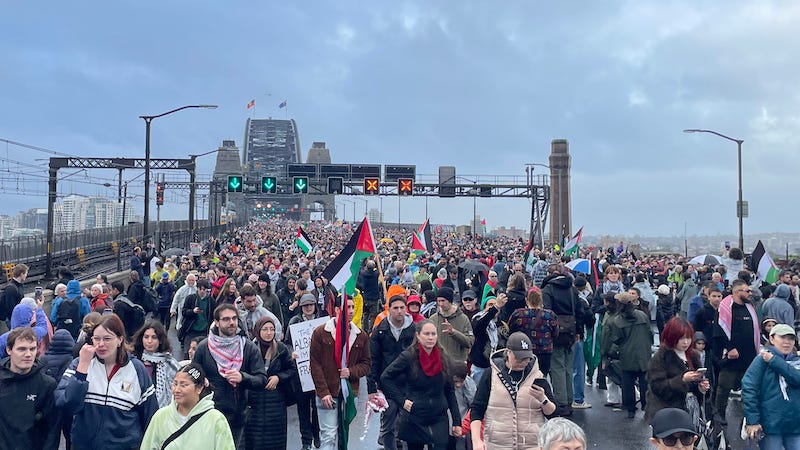
Well over 100,000 people marched across the Sydney Harbour Bridge in a torrential downpour, a dramatic act of civil resistance demanding an end to Israel’s genocide in Gaza and the immediate recognition of Palestine, becoming a symbol of grief, rage, and solidarity. Following the banner of the “March for Humanity”, this was also a symbol of moral defiance.
The demands at this march were clear: sanction Netanyahu, halt all military co-operation with Israel, and formally recognise the state of Palestine. The protest didn’t just defy apathy and expectations from the political class that it was just going to be the riff-raff of extremism designed to inconvenience Sydneysiders – it defied that political power. NSW Premier Chris Minns – who has become far more right-wing and more conservative than many Labor supporters would have hoped for – opposed the demonstration from the outset, after his government recently introduced harsh anti-protest laws threatening fines and prison sentences for those disrupting major roads. But despite the intimidation and fear Minns wanted to instil, at least five NSW Labor MPs attended the rally in open defiance of their leader. And over 100,000 protestors.
This wasn’t a niche protest attended by rabble-rousers, it was a massive success in diversity. Young Palestinians draped in keffiyehs marched alongside Jewish peace activists in yarmulkes; teachers, nurses, students, and retirees alongside a broad range of people from different age groups – young, old, and everyone in between. Trade unionists stood with climate activists and religious figures. The message was clear: this isn’t about geopolitics, it’s about humanity.
Such a groundswell in popular opinion and perception made one thing very clear: support for Gaza is not a marginal issue in Australia – it has become mainstream. And as government officials continue to couch their language in “balanced diplomacy” at a time when more decisive action against Israel needs to be taken, this protest revealed a public that has moved far beyond the political class that has been left floundering behind, trying to create more excuses to justify their lack of action.
More than anything else, this march wasn’t a confrontation with just the government, but a pricking of Australia’s conscience, and a question to the nation in the simple terms: when children are being deliberately starved, where do we stand? When a people are being bombed into oblivion, what do we do? Do we speak up? Or do we look away – which is exactly what our political leaders want us to do.
This wasn’t a march for votes, or political reform, or even about national pride – it was a march for humanity. And in that moment, as the rain poured over the harbour and the echoes of the voices bounced off the steel bridge structures on the bridge above, it became impossible to deny that Australia is changing its perspective on Gaza and the future of Palestine. That silence that had been enforced by our political class is breaking down, and many more people are refusing to back down – in our streets, in our homes, in our conscience and now, quite literally, on our bridge. Things need to change, now.
Minns, who lit up the Opera House with the Israeli flag and victim-blamed Hannah Thomas.
Minns, the proponent and knee-jerk implementer of grotesquely anti-democratic protest laws affecting ALL NSW residents at the whim of a minority pro-Israel lobby and suckered by a cooked up explosive caravan scam.
Minns, a stain on the proud tradition and record of the working class and progressive movements in standing up for decency.
He has to go.
With the groundswell of public anger against the pathetic heads-in-the-sand attitudes of so-called leaders and their mealy-mouthed platitudes, expect a false flag incident in the near future. We've already had a caravan containing old explosives that was used by politicians of both sides to claim it was a major antisemitic terrorist plot. It wasn't. Expect the Zionists to do something to flip the script.