


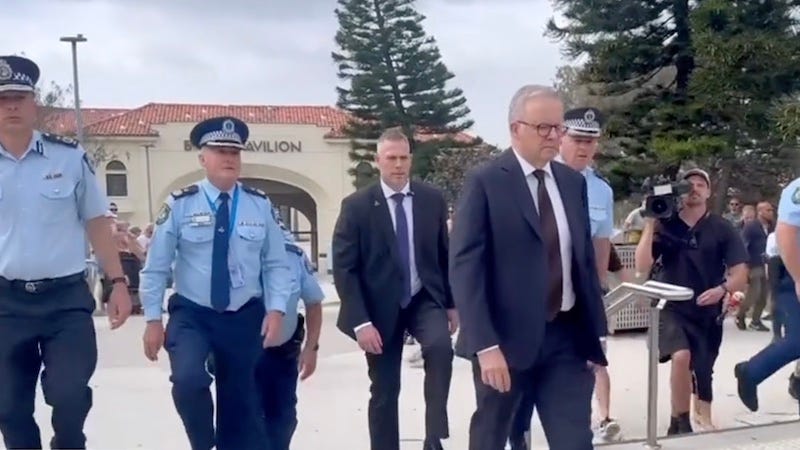
The debate over whether a Royal Commission should be held into the Bondi attack last December at the beginning of Hanukkah – where 15 people were killed by two radicalised gunmen – has, at this point, almost become meaningless. This isn’t because there shouldn’t be any accountability for the attack and the reasons behind it, but because the entire process has been politically hijacked beyond belief. What should have been a measured and considered review about security failures – of which there seems to have been quite a few – as well as public safety and preventing these kinds of attacks happening again in the future, has instead become a highly charged and angry political talkfest, driven by conservative media hysteria and pressure, and sordid political opportunism for the Liberal Party.
At this stage, it doesn’t really matter what Prime Minister Anthony Albanese does, he’ll be attacked for whatever he decides to do. Any decision he made would have been framed either as a capitulation or not enough, and the announcement of a Royal Commission into Antisemitism and Social Cohesion won’t shut his critics up; it will just give them more ammunition to use against him.
The other factor is that it won’t appease his supporters either, many of whom already believe he has conceded too much ground to the Israel and Zionist lobby groups, who have been running a sustained campaign of political intimidation against the prime minister, ever since the October 2023 attacks and killings by Hamas near the border of Gaza, and the subsequent acts of genocide by the state of Israel.
It’s the same old trap that Albanese has frequently fallen into when it comes to contentious issues: an attempt to neutralise the issue by compromising, only to end up with the worst of both worlds – the continued relentless attacks from opponents who will never congratulate him on anything that he does, and a growing disillusionment among those supporters who thought his government would act solely in the public interest, and not bow to the noisy and most influential lobbyists out there.
Albanese’s biggest crime is that he was once a vocal supporter of Palestinian rights, and his government formally recognised the state of Palestine in 2025. In the current political climate, those positions will never be forgiven or forgotten by extremist Zionist groups, and these are not disagreements or issues that will be debated: they are sins that need to be constantly punished, even to the point where Albanese ends up being replaced, either through a subsequent election, or internally by his own party. The Bondi tragedy has been seized upon by these Zionist groups and the Liberal Party as an opportunity to wage a much broader political campaign, with Albanese himself as the ultimate target.
What makes this cantankerous campaign for a Royal Commission so out of line is that a substantial inquiry had already been announced by Albanese. The independent review, led by Dennis Richardson – a former senior public servant, diplomat and intelligence officer respected by all sides of politics – has been commissioned to examine the actions of Commonwealth intelligence and law-enforcement agencies, particularly ASIO and the Australian Federal Police. Richardson’s brief is pretty clear and direct: to assess what authorities knew about the perpetrators of the Bondi attacks, whether there were failures in intelligence-sharing or potential actions that could have prevented these attacks, and what kinds of legislative reforms and resources can reduce the risk of similar attacks in the future.
Richardson has got solid credentials and, so far, he is yet to be attacked by conservative media players and political figures. His appointment to the position wasn’t controversial, and his review was designed to be broad but completed as soon as possible, with his findings and deliberations due by the end of April. By any reasonable measure, and knowing how the machinery of bureaucracy and government can slow processes down, this appeared to be a proportionate, credible and expeditious response.
This Richardson review will still take place, but will now become a part of the new Royal Commission, which will expand the overall review, but also increases the political risks for Albanese. Governments are usually reluctant to hold Royal Commissions unless the terms of reference are tightly controlled and the risks can be managed if there are unknown issues that arise from the inquiry.
While it’s an adage that was popularised through the television series Yes, Minister, there are two basic rules of government: never look into anything you don’t have to; and never set up an enquiry unless you know in advance what its findings will be. It’s a cynical process, but the cynicism is obvious if we look at how Royal Commissions in recent times have been used as political weapons, rather than a true source of inquiry.
Of course, there have been some Royal Commissions that have acted in the public interest and done some good. The inquiries into the Robodebt scheme and child sexual abuse in institutions exposed many failures of government and institutional practices but they virtually held no political risk for the Labor governments that called for them.
Others have been far more blatantly politically. For example, the Royal Commissions into trade unions and the pink batts insulation scheme in 2014 found close to nothing and were partisan show trials that were primarily designed to damage former Labor prime ministers and the Labor Party.
This Royal Commission announced by Albanese is different to these: the outcome is entirely unpredictable, the proceedings will be available as an ongoing conservative attack until at least its completion in December, and the context of the Commission is politically toxic. Based on the outrageous, aggressive and unhinged lobbying and media pressure, what could have been achieved through a quick and wide-ranging independent review – which is still due to take place within its original timeframe – risks being buried under endless hearings, long-term grandstanding, and ideological point scoring.
A comprehensive and independent review may have found all the answers and solutions that were required – under a far safer environment for the community and for the government – but this Royal Commission has the potential to find all the wrong answers and steer events in a manner that threatens the government itself. And that may have been the intention all along.
Selective outrage and the political pressure points
The politicisation of the Bondi attack has not been driven by a single group alone although, essentially, that’s where it originated from. Alongside pro-Israel and Zionist lobby organisations, both the federal and New South Wales Liberal Party have worked relentlessly to extract as much political advantage as possible from the tragedy. This has been, in many respects, the most unedifying aspect of this entire episode.
Yes, seeking justice for victims and their families is of the greatest importance, that principle should never be in dispute, nor should it be compromised. But the loudest calls for a Royal Commission have been motivated by opportunism rather than by justice. Did Josh Frydenberg really think that screaming at the government in a purely partisan manner was the best way to achieve justice for the victims and their families?
And if there was to be any consistency, why is there a Royal Commission now, but none after the Port Arthur massacre in 1996, an event that reshaped Australia’s gun laws and affected the national psyche for many years after? Or following the Lindt Café siege in 2014, despite it clearly being a terrorist attack and littered with so many security failures? Why, then, is Bondi different? And why does asking these pertinent questions always veer towards the label of anti-Semitism?
Where is the Royal Commission into domestic violence against women, despite the massive effect that this issue has on Australian families and society? Where is the inquiry into Islamophobia, which seems to be a far greater problem in Australia? And why no inquiry into the role of the mainstream media in magnifying fear and racism, even after over 500,000 people petitioned the government to hold one? Yet anti-Semitism – as real and serious as it is – has been elevated far above all other forms of social harm, treated as uniquely deserving of a strong response. Are we not even allowed to be curious and ask or enquire why this should be the case?
What has become increasingly clear through this process is the behaviour and the political influences of pro-Israel and Zionist lobby groups within Australian public life. Of course, pointing this out is repeatedly framed as anti-Semitism itself, but this is a tactic that’s been used so often that it has lost much of its potency and its meaning. After all, a pack of cards is useless if every one of them is an ace of hearts, and so it is when the card of anti-Semitism is played at whim and at every opportunity.
When symbolic gestures such as displaying a watermelon cartoon in solidarity with Palestinians are treated as an act of anti-Semitism – as was suggested at the 2025 Australian Mayors Summit Against Antisemitism – or when phrases like “globalise the intifada” are criminalised, the credibility of those making such claims falls apart very quickly.
The gold medal in sportswashing
This hostile environment then fed directly into a co-ordinated public-relations campaign in which prominent sports figures were called upon to demand a Royal Commission, with the underlying message that to oppose such a measure was the act of an anti-Semite. Sportspeople, of course, have a right to offer their political opinions as often as they like, even those opinions that we might be repulsed by, but many of those involved appeared to have little understanding of what a Royal Commission actually is, or whether it was meant to examine the Bondi attack, or anti-Semitism more broadly – or some undefined combination of both – or even if it was a better option than the review that had already been announced.
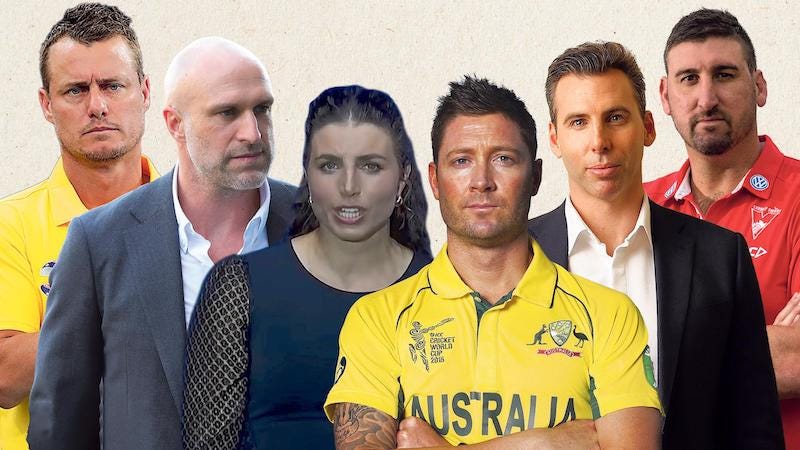
And this came with the full support of the conservative media, who not so long ago were arguing that sports stars had no right to interfere in politics when it came to the promotion of the “Yes” campaign in the Voice to Parliament referendum in 2023, or when they called for the captain of the Fremantle Dockers, Alex Pearce, to stand down after he “liked” an Instagram post from the Irish band Kneecap, which stated that Israel is committing genocide against the Palestinian people. Obviously, some politically commentary is acceptable, but it’s got to be the right kind of political commentary, in more ways than one.
There was also more confusion with the New South Wales government already deciding to establish its own Royal Commission in late December, yet no one questioned why two commissions would be required to run in parallel. As it turned out, Premier Chris Minns quietly cancelled his own commission once Albanese made the federal announcement. Yet, the media was very quiet about the decision by Minns, yet another sign that the attacks on Albanese were politically motivated.
The other point is that Minns is a strong supporter of Zionism and will happily light up the flag of Israel on public buildings of his choice in Sydney, even if he isn’t asked to do so. Although he and Albanese belong to the same party, they come from different factions – and it was Albanese, not Minns, who recognised Palestine, and it’s this act that will continue to be punished by Zionists groups.
And if it wasn’t enough to pile on the pressure to hold a federal Royal Commission, the bullying extended to who was going to act as the commissioner and its terms of reference. Once the rumours starting circulating that the former High Court justice Virginia Bell might lead the Royal Commission, Frydenberg continued with his outrage and complained that “it is unthinkable the prime minister would choose a commissioner that did not have the total confidence of the Jewish community”.
Who would he suggest then? Benjamin Netanyahu? Or should there be a segregated public vote within these communities to decide who should lead the Commission, rather than the elected government of the day? What exactly is Frydenberg after, except to humiliate a Labor government and boost his own profile? Why is it offensive to call this out, when that’s exactly what he’s doing?
Frydenberg feels that he is above the law – he has no role in public life after being voted out of office at the 2022 federal election – but wants to dictate the leadership of the Royal Commission, influence its terms of reference, and what he wants this inquiry to find. For many Australians, this level of external pressure on the democratic process is not just inappropriate – it’s totally unacceptable.
The other inquiries Australia refuses to hold
If Royal Commissions are really about finding out the answers and confronting the uncomfortable truths in Australian society, there are other inquiries that would arguably be more in the public interest. One such inquiry could examine the role and influence of the Israeli government and its security agencies within Australian political life. And this is a query that is neither anti-Semitic nor conspiratorial; it’s well grounded in documented national and international concerns.
In New South Wales, Labor MP Anthony D’Adam – a convenor of Labor Friends of Palestine – has unsurprisingly appeared in a dossier produced by the Israeli government, accusing him of promoting anti-Semitism and anti-Zionism, when he’s done nothing of the sort. Last year, Australian Federal Police said that a bomb hoax which allegedly threatened synagogues in Sydney was a “fake terrorism plot” that was orchestrated by “undisclosed figures” based in Australia and offshore. But who were these offshore figures? Why was Iran blamed – without any evidence to suggest this was the case, and with no clear political benefit or motive – for being behind an arson attack on a café in Sydney in October last year, and another on a synagogue in Melbourne?
Why is there so much noise when these incidents occur – and when the accusations that are made against countries such as Iran – but virtually nothing when we find who was actually behind the incidents?
In the peculiar case of Angelo Loras, the homeless 34-year-old Sydney man who was arrested and found guilty of starting a fire to the doors of the East Melbourne Hebrew Congregation synagogue last year, we never found out why someone who was diagnosed with schizophrenia travelled from Sydney all the way to Melbourne to set fire to what he believed was a residential property. There are 28 listed synagogues in Melbourne – out of the over two million properties that exist in the city – how is it that the one property that Loras tried to set fire to, just happened to be a synagogue?
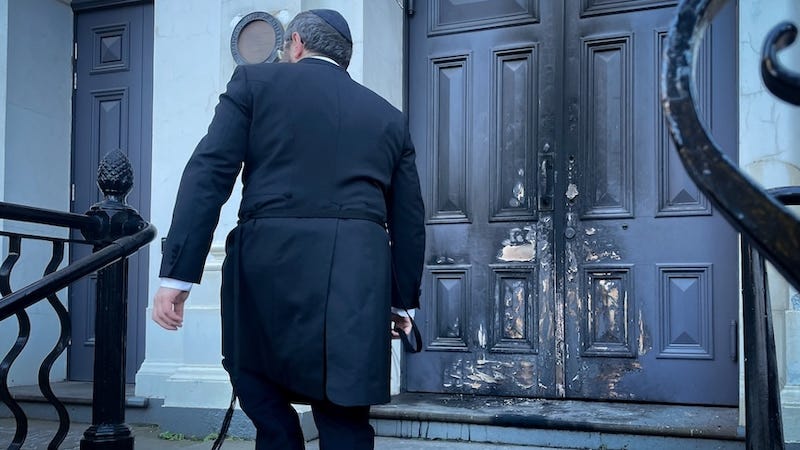
The court case was underreported in the mainstream media in November last year, but after pleading guilty, Loras was sentenced to time already served in prison – 134 days – and released with community correction orders. The actions of Loras constitute a serious crime – endangering lives, causing $54,000 in damage and using a fire accelerant would usually result in a five-year term of imprisonment, with a maximum of ten years. For such a crime, even taking into account the mental health issues, why was the sentence so lenient?
Overseas, the Netherlands has disclosed how Israel attempts to influence local opinion and its domestic politics through disinformation campaigns and, as a result, has listed Israel as a clear threat to its internal security. There was also a dossier created by the Israel government – not dissimilar to the one that contains the name of Anthony D’Adam – which contained personal details of Dutch citizens, and the Netherlands government believes these people were earmarked for potential harm by the state of Israel.
The Netherlands is not a marginal actor nor a hot bed of anti-Semitism and radical Islam; it’s a core member of the European Union and a close partner to Australia. Should Australia also be assessing what kind of potential harm or threats could exist for its own citizens? Are there any other dossiers the Israel government has created that suggests that Australian citizens could be harmed or threatened? It would be a dereliction of duty for an Australian government to not know about this, or even make the attempt to find out what the risks might be.
There are many other issues that such a Royal Commission could investigate. Closer to home, the pattern of cultural and institutional cowering is becoming harder to ignore and brush away under the carpet. The Adelaide Festival’s decision to remove the academic and author Randa Abdel-Fattah from its Writer’s Week program is the latest example.
According to the Festival Board, her appearance was deemed too “culturally insensitive” and too soon after the Bondi attacks, despite the fact that Abdel-Fattah’s appearance was to be scheduled almost four months after in early March. If four months later is deemed to be a “culturally insensitive” timeframe, when is a more appropriate time? Palestinian voices are always considered to be too disruptive, dangerous, or too inconvenient to be heard by the cultural elites and Zionist sympathisers even at the best of times, but when would be the right time?
As it turned out, it seems that there was immense pressure from the South Australia Premier Peter Malinauskas to remove Abdel-Fattah – after a letter of complaint from the Jewish Community Council of South Australia – and once Abdel-Fattah was removed, almost 90 of the 124 speakers from the Writer’s Week program also withdrew in protest. So, based on one letter of complaint, an internationally acclaimed event has been hijacked, and reputation of the Adelaide Festival has been destroyed, without even testing the merits of that complaint.
It’s a tried and tested formula and, fresh from their “success” in destroying Writer’s Week, they’ve started to target WOMADelaide, calling for the removal of Techno DJ Sama Abdulhami from the program, a vocal supporter of Palestinian rights. As we also saw at the recent Bendigo Writers Festival, it’s part of a broader process where institutions are humiliated and often willing to damage their own credibility and independence in order to appease well-heeled and well-organised Zionist lobby groups.
The question that’s never answered is why this keeps happening, why the rights of the rest of the community are trampled upon in preference of the rights of these lobby groups, and how deeply these pressures influence decision-making across cultural, political and media institutions. And it’s not conspiratorial to ask these questions when we can see the evidence of these actions appearing right in front of our eyes.
If Royal Commissions are meant to shine the light on power, on accountability, and influence, then these are the right types of questions that need to be asked and followed up with serious investigation, and, perhaps this Royal Commission might actually be the right one.
After all, this Royal Commission is meant to be asking the questions about anti-Semitism and social cohesion, and it appears that there’s one group out there who is doing their best to disrupt and undermine social cohesion. We need to ask why that is the case, and until Australia is willing to ask these types of questions, the belief that this process is about “social cohesion” will just continue to be a false narrative and a waste of everyone’s time.
Since becoming the leader of Labor, Albanese is always looking for his "Munich agreement" on pretty much every contentious issue. This is a perfect example. Gaza is perhaps the worst example.
I detect no 'co-mingling'. As for fearing Islam, er, no. The word for that is Islamophobia, which is an irrational fear of Islam in its entirety, not a relative minority of radicalised Islamists. Further, if the Jewish 'community' (there isn't a single entity culturally united) is thrown, then it surely has been by the fact of Netanyahu's malevolent version of Israel having dug miles of tunnels under the Star of David, using Jews as human shields. And Zionism, it might be said, is the most insidious form of antisemitism of all.