


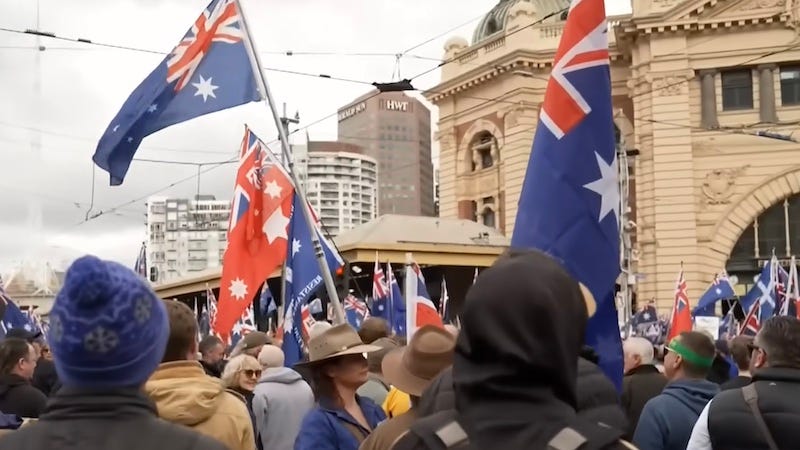
Thousands of people have marched under the banner of “March for Australia” in cities from Sydney to Perth, with an innocuous message that seemed to shield a racist and populist opposition to “mass migration”. But why were they actually marching? What was is really about? Beneath the veneer of economic anxiety and misguided patriotic pride, there is a resurgent white nationalist ideology that has little to do with Australia’s past or future – all in plain sight and embedded within the movement that the mainstream media and political figures are reinforcing.
Organisers of the march framed their message as a fight for community cohesion, citing concerns about strained infrastructure, housing shortages and cultural changes to society, with overblown hyperbole warning that “mass migration has torn at the bonds that held our communities together,” and flyers targeting the Indian diaspora in particular, an obvious and explicit tactic of scapegoating the other. Someone needs to be blamed, and it may as well be them. No need to bring out the dog whistle here: this is clearly a racist agenda megaphoned from the streets of Australian cities.
Yet even as they denied their far-right intentions and links, there are disturbing undertones: the March for Australia website featured explicit references to “remigration” and “white replacement theory” (which were later removed), some organisers shared pro-Nazi and pro-Hitler images through social media, and displayed posters at the marches lauding the sovereign citizen, Dezi Freeman, who is on the run after murdering two police officers in Porepunkah last week.
These are extremists but high-profile political figures have also added their names to this movement and are only too happy to appear by their side. One Nation’s Pauline Hanson – a gold medallist in the culture of complaint category – and MP Bob Katter – fresh from threatening to punch any journalist in the mouth for mentioning his Lebanese heritage – addressed the crowds, calling for them to “take back” the country, invoking an imaginary nostalgia for an Australia that has never existed and never will.
In Townsville, members of Katter’s Australian Party were later photographed with protestors displaying neo-Nazi symbols, with the party’s deputy leader, Nick Dametto saying that he had “no dramas with them standing and doing their own thing over there”, and then suggested he didn’t call them out as a way of “avoid escalating tensions”. This type of equivocation highlights the dangerous normalisation of this kind of extremism in public life.
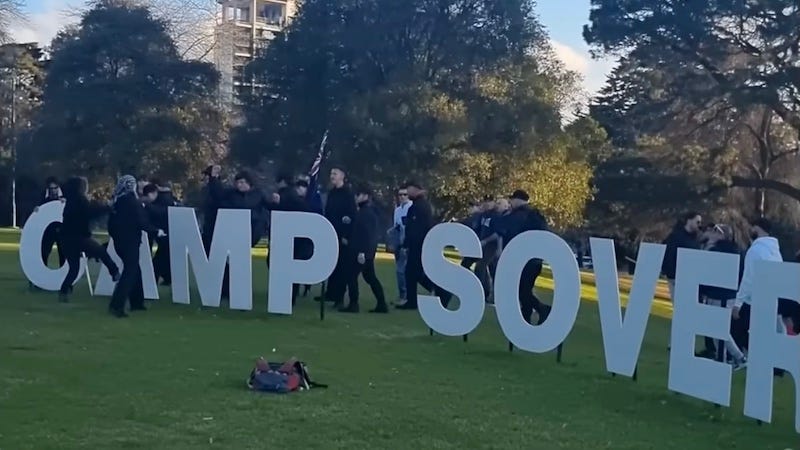
In Melbourne, this extremism led to violence. The neo-Nazi Thomas Sewell led a group of agitators who stormed Camp Sovereignty, the site of an Indigenous protest movement, wielding pipes and branches, tearing down Aboriginal flags, and assaulting women and older members at the site, with authorities now being urged to classify the attack as a hate crime, which it obviously is. Meanwhile, across Australia, at least 21 other people were arrested for similar actions and activities.
Media coverage also presented a range of supportive narratives, even from the most unlikely sources. Elon Musk grossly exaggerated the attendance figures – suggesting on X/Twitter that there were 150,000 protesters in Sydney, rather than actual figure of less than 10,000 – shows how disinformation can fuel this momentum and legitimise extremism. The mainstream media, in the supposed interests of faux neutrality and “both-sidesism,” broadcast printed statements from organisers alongside commentary from government without contextualising the ideological extremism at the heart of the movement, claiming the right to express “legitimate concerns”, but stopped short of calling out the white supremacist undercurrent, even as the actions and support from groups such as the National Socialist Network became obvious.
This merging of nationalistic politics, extremist violence, media complicity and the silence from political leaders who should know better, reveals a concerning reality: “March for Australia” wasn’t just a demonstration of anti-immigration sentiment – primarily using “mass migration” to hide its true racist intentions – it was a modern interpretation of the historic White Australia policy, supported and enabled by players across the political spectrum.
How the right-wing media sanitises racism with euphemisms
For many years, far-right activists have relied on coded language to hide the true nature of their agenda, trying to achieve legitimacy to what is essentially a culture of complaint, and providing excuses for “life not being quite right”. Instead of looking at their own fallibilities, they look for others to blame: life would suddenly be better, apparently, if there were less brown people in society taking our jobs, or if everyone could just speak the same language. The message of “anti-mass immigration” becomes a cloak for racial exclusion – references to “heritage” and “culture” become euphemisms for racial purity: these are not innocent references; they are carefully calibrated to cover over their intent and deflect from scrutiny of the real message.
Amplification by conservative media figures also adds to this deflection. Several weeks before the March for Australia event, the 2GB radio host Ben Fordham falsely declared that “1,544 migrants or the equivalent of five fully‑loaded Boeing 787 Dreamliners, were arriving in Australia day after day, week after week”. It’s all rubbish of course, but this imagery fuels a sense of crisis through an easily digestible piece of propaganda – five large planes of brown people invading our country, causing an influx that is overwhelming housing, jobs, and services – our way of life – without offering a substantive context. And the subtext is that all of these problems will be solved and disappear if only we can somehow stop those five Dreamliners coming into the country.
The Australian Bureau of Statistics has rebutted Fordham’s claims – who seemingly wants to replicate Alan Jones’s role in the 2005 Cronulla riots and gain a place in the infamous hall of racist notoriety – explaining that the Overseas Arrivals and Departures data that Fordham was relying on reflected repeated border crossings – not permanent migration – did not represent the number of migrants arriving to settle in Australia, and was an overblown figure.
Despite this, some commentators – most notably those associated with the Institute of Public Affairs and people such as conservative economist Leith van Onselen – defended the use of this data as a true representation, and continued to misuse the data to distort reality. The consequences of this reckless framing were seen through certain incidents at the March for Australia event. By inflating perceived migration numbers, right-wing media outlets and political activists fuel xenophobia and resentment, giving a veneer of empirical justification for people’s dissatisfaction with whatever they might be feeling in life, the old conservative tradition of blaming the migrant, weaponised disinformation as proof that Australia is being “overrun,” stoking fear rather than fostering informed debate.
It’s the life of the coward: who’s got time for reality when the flames can be fuelled and watched from a distance, all while society burns away under the payload of lies and fabrication. And that’s the key part of this strategy: sanitising racism with inflated numbers, lies and overblown rhetoric, amplifying fear under a masquerade of facts. It’s an ecosystem of disinformation that swallows up reality and spits out gob-filled anger – a deliberately constructed narrative of a false crisis.
A silence in the face of selective outrage
The political response to the “March for Australia” protests has also shown a difficult balancing act – and even the Prime Minister seems to have difficulty in working how to provide an adequate response, deciding that instead of condemning these protests and the subsequent infiltration by neo-Nazis, it was better to normalise this extremism through a misguided sense of even-handedness, with a fear of offending those who protested.
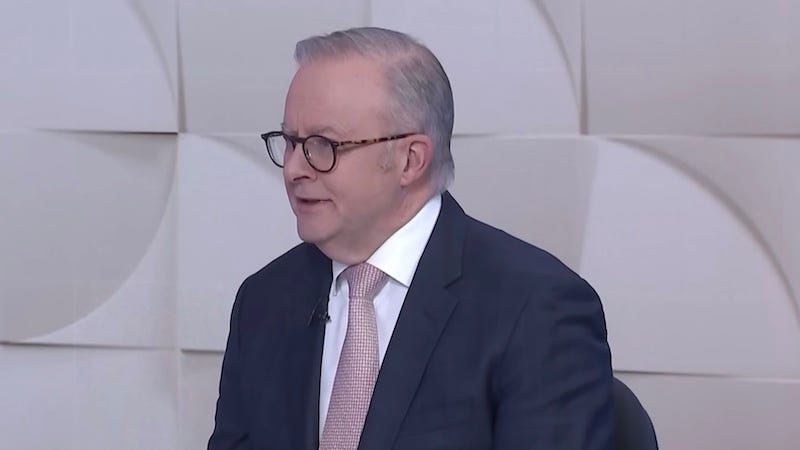
Anthony Albanese’s suggestion that “good people” may have attended the rallies echoed US President Donald Trump’s infamous claim about “very fine people on both sides” at neo-Nazi gatherings – a fundamentally weak response and pathetic sitting on the fence that totally sidesteps the deeply racist rhetoric that was a central part of this event.
We also have to remember that former Prime Minister Scott Morrison strongly condemned the Black Lives Matter protesters in 2020 – people who would never vote for Morrison or the Liberal Party – saying that this event had been “taken over by much more politically driven left-wing agendas” and demonstrators at future events should be charged. The protesters at March for Australia are unlikely to support Albanese or vote for the Labor Party, so why is he so reluctant to condemn the right, in the same way Morrison was so eager to condemn the left? What good is a Prime Minister who cannot unequivocally condemn such a racist event that is manufactured and supported by right-wing agitators and neo-Nazis?
Meanwhile, these agitators are crossing lines that a democratic society should never tolerate. In Melbourne, prior to leading the attacks on Camp Sovereignty, Sewell violently disrupted Premier Jacinta Allan’s media conference on the same day, hurling insults and accusations that he had been barred from protesting on the day, even though he was clearly seen bellowing his racist diatribes into a microphone and addressed the crowds at the steps of Parliament House.
These agitators need to be forcefully condemned, not just by the public, but by political and community leaders. Albanese’s “both-sideism” and suggestions of “good people” just doesn’t stack up: he didn’t need to give a sideways nod of support to these apparently good people; just a strong condemnation of the march and their actions and he should have just left it at that, just as Morrison did five years earlier.
And it’s not just Albanese: voices that are typically prominent in condemning extremism have been absent and very quiet about the March for Australia protests. Jillian Segal – Albanese’s hand-picked Special Envoy to Combat Antisemitism – has remained silent on the actions of these neo-Nazis and white supremacists, who are far more likely to engage in antisemitic action than any of the pro-Palestine marches that she is so bitterly opposed to.
Her silence is in contrast to her rather loud advocacy in other contexts – such as when she advocated for tougher hate-speech laws, mandatory sentencing for antisemitic crimes, and even reductions in funding to institutions that fail to combat antisemitism according to her definitions – but when the real Nazis arrive, she has nothing to say.
Segal’s silence raises other questions, especially since a trust linked to her husband donated $50,000 to Advance Australia – a conservative advocacy group aligned with nationalist agendas, such as the claim that “mass immigration is destroying the Australian way of life and it’s time to stop it”, a message that was clearly replicated at the March for Australia. And there’s even more silence from the pro-Israel and Zionist lobbyists, who – like Segal – condemn peaceful pro-Palestine demonstrations but have nothing to say to the violent anti-immigration and white-supremacist fervour of these neo-Nazi agitators.
Ultimately, March for Australia was not just an expression of economic anxiety or cultural insecurities by a small group of people, but a clear example of how easily white nationalist rhetoric can be dressed up as patriotism and legitimised by political figures and the mainstream media, who should be speaking out, rather than condoning it, tacitly or otherwise. Unless these forces are confronted directly – and called out for what they are – Australia risks normalising extremism and allowing a distorted nostalgia for a country that never was, to shape the one that actually exists.
Your article almost makes me weep at the rise of the fascist racist ultra right. One matter I would counter is your phrase “distorted nostalgia for a country that never was”. Remember the ‘White Australia’ policy was mainstream from the formation of the Commonwealth until the 1960s. And the final remnants of the White Australia were not removed until 1973.
Remember Arthur Caldwell’s infamous ‘two Wongs don’t make a White’ (yes he said this was misinterpreted as it was meant to be a jacose (very witty, not) and ‘If we let in any U.S. citizen we will have to admit U.S. negroes. I don't think any mothers and fathers want to see that.’
Also, I remember people from the Mediterranean who came in the 1950s were referred to as ‘dagoes’ and ‘wogs’. I can Romberg being asked in primary school if I was a ‘wog’ because of my dark skin and being told my dad got into a fight in the pub in the 1950s when someone made a joke saying I was a ‘pickaninny’. Oh, and the hostility towards south East Asian refugees during the 1970s and 1980s.
Yeah, Australians put on a nice face. But underneath there remains a fear and hostility towards First Nations and immigrants.
Jillian Segal is the Special Envoy for Zionist Israel and Ongoing Genocide.