


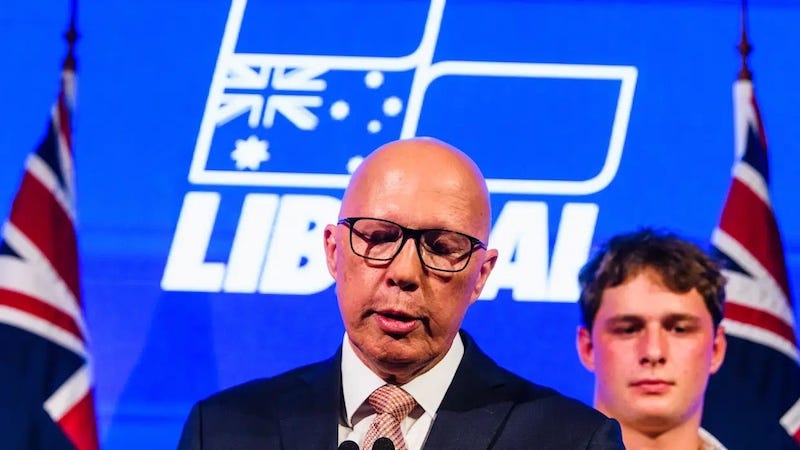
The temptation after an election defeat like the one in 2025 for the Liberal Party, is to search for a single, decisive cause, and in contemporary politics that almost always means focusing on the leader. The former opposition leader Peter Dutton centralised authority within the party, made too many misjudgments, overestimated the quality of favourable polling, and ran a campaign that appeared at to be too rigid and haphazard. Of course, these are all critical points, yet to reduce the Liberal Party’s failures to the shortcomings of one man would be a mistake. Leaders are symptoms as much as the causes, as they are selected by parties that reveal who they really in the act of choosing.
Political parties don’t collapse just because they lose elections, and the Labor Party offers the most obvious example. Between 1949 and 1972 Labor had 23 years in opposition. After the 1996 election, it remained out of office for eleven years and after 2013, it waited for another six. Those stretches were not terminal illnesses but they were periods of malfunction, internal contests, and an eventual recalibration, or at least, enough to get back into office. During these times in opposition, Labor argued fiercely with itself about policy, identity and leadership, it became fractured and then reassembled itself. What it didn’t do was treat defeat as an aberration that requiring only a few pieces of tactical change, and it went through some serious soul-searching and questioned its own long-held assumptions.
The question facing the Liberal Party isn’t whether it can survive being in opposition. It’s really about whether it retains the flexibility required to produce leaders capable of expanding its reach, rather than going through a reduction, which is clearly what has happened over the past three years. A party in good health selects leaders who can extend its appeal beyond the parliamentary party room. A party in a defensive mood selects leaders who exert internal control, become anxious and don’t offer the confidence required to improve the party’s stocks.
Dutton’s elevation in 2022 occurred during one of these defensive moments. The party had just lost government, the erosion of metropolitan seats had been visible for several election cycles. The teal independents had cut into seats once regarded as permanent fixtures, and there was unease about fragmentation and distrust of internal dissent. In that climate, steadiness inside the party room could look more valuable than to the electorate looking in from outside. Dutton was a known entity, unambiguous in his ideological outlook, and aligned with the dominant faction of the party room. Those qualities satisfied the immediate need for consolidation of the Liberal Party at the time.
That choice, however, reflected a longer devolution within the party. The internal realignment that began during the Rudd–Gillard period and crystallised in 2009, started to reshape the Liberal Party’s political centre. Nick Minchin played a central role in that turning point, and his support for Tony Abbott’s elevation over Malcolm Turnbull wasn’t just an internal tactic over an emissions trading scheme – it was a statement about which conservative instincts would define the party. Abbott’s victory energised the conservative base and restored its aggression approach in opposition. It also signalled that the parliamentary party would prioritise ideologically-based positions – such as the never-ending climate wars – if it was ever forced to choose.
